The City of Houston requires a written, verified notice of claim within 90 days of a vehicle crash. That deadline is much shorter than the standard six-month Texas notice period for many governmental claims.
A car crash can change your life in seconds, but you don't have to face recovery alone. You may be dealing with pain, medical appointments, vehicle damage, lost income, and an insurance adjuster asking for answers before you understand what happened. If a City of Houston vehicle, employee, or municipal condition played a role, ordinary accident procedures may not protect your claim.
The City of Houston vehicle crash claim notice requirement is different from a typical claim against another driver. A police report, medical record, or auto insurance claim may document the collision, but those steps don't automatically replace the city's required written and verified notice. Acting quickly protects your options.
The 90-Day Rule That Can Make or Break Your Claim
After a collision, people focus first on emergency care, vehicle repairs, and insurance calls. Those concerns matter, but a municipal claim creates another urgent task. Written and verified notice must reach the mayor and city council within 90 days after the injury or property damage occurs. The requirement appears in Article IX, Section 11 of the Houston City Charter, and the charter states that failing to provide notice in the required time and manner releases the City from liability. Houston's official claim-filing instructions identify the process and supporting materials the city requests.
The 90-day period is not another lawsuit deadline. It functions as an early administrative prerequisite. If you miss it, the city may argue that your claim cannot proceed even though you haven't reached the later deadline that may apply to filing a lawsuit.
What you should do first
Start by identifying every possible connection to the City of Houston. Was the other vehicle city-owned? Was the driver performing city work? Did a municipal road condition contribute to the collision? Were you injured as a passenger, pedestrian, cyclist, or driver?
Then preserve evidence immediately:
- Get medical care: Follow medical advice and keep records of treatment, bills, diagnoses, and restrictions.
- Save crash evidence: Keep photographs, video, vehicle information, witness details, and the police report.
- Mark the notice date: Calculate 90 days from the crash-related injury or property damage and treat that date as an urgent legal cutoff.
- Get legal guidance: A Houston car accident lawyer can determine whether the charter applies and help prepare a compliant notice.
A standard road-defect claim may involve a different notice analysis. If a roadway condition contributed to your crash, review the City of Houston road defect claim notice requirements and speak with counsel promptly.
Practical rule: Don't wait for your medical treatment to finish before addressing the notice. You can update damages later, but missing the initial deadline can create a serious barrier.
Houston's municipal notice language has historical roots reaching back more than a century. That history doesn't make the rule less important today. It makes the point clear: city claims operate under a specific local framework, not the same process as a private-driver insurance claim.
Houston City Charter vs Texas Tort Claims Act
Texas law provides a broader framework for claims against governmental units. Under Texas Civil Practice and Remedies Code Section 101.101, a governmental unit generally must receive notice no later than six months after the incident. The notice should reasonably describe the injury or property damage, the time and place of the occurrence, and the incident itself. Section 101.101 also recognizes an actual-notice exception when the governmental unit already knows that death, injury, or property damage occurred.
Houston's charter requirement is more demanding. It uses 90 days instead of six months, requires verification, and calls for detailed information about the event, losses, residence, and witnesses. The city's rule is therefore not something you should treat as a routine extension of the general Texas statute.
Why actual notice isn't a safe plan
Suppose a Houston police officer responds to a collision involving a city vehicle. The city may already possess an incident report, photographs, or internal records. That doesn't mean you should assume the city has the legally sufficient notice required for your claim.
Actual notice can involve legal questions about what the government knew, when it knew it, and whether its knowledge covered the injury or damage you later claim. Relying on that exception forces you into a dispute you may avoid by sending proper notice on time.
The same caution applies when a city bus or other municipal vehicle is involved. A Houston Metro bus claim and Texas Tort Claims Act notice can raise separate questions about the responsible governmental entity, the vehicle, and the required procedure.
For general insurance background, QuoteFii's guide for Texas drivers can help explain how coverage works. Insurance information is useful, but it doesn't replace municipal notice.
You can also review Filing an Injury Claim in Harris County Courts for a factual overview of how personal injury cases proceed in Harris County civil courts.
What Your Written Notice Must Include
A short letter saying you were in a crash may not be enough. The Houston City Charter calls for a written and verified notice with specific information. The city's filing instructions also request supporting documents that help evaluate the collision, the losses, and the connection to the municipality.
Build the notice around these facts
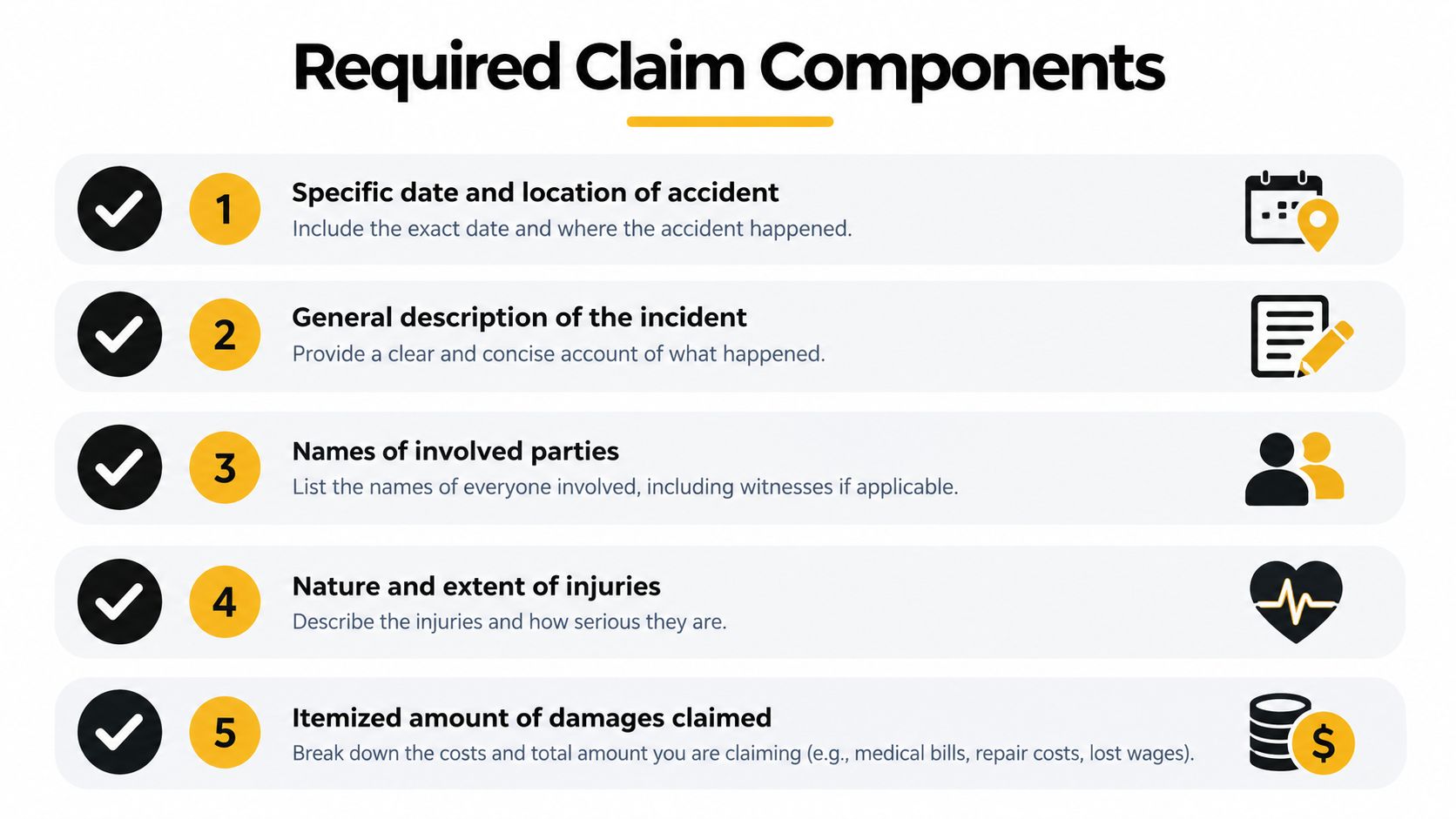
Your notice should address:
- Time and place: State when and where the crash or damage occurred.
- How it happened: Describe the incident and explain the apparent municipal connection.
- Injury or destruction: Describe the apparent extent of bodily injury or property damage.
- Damages claimed: State the amount of damages you claim and the amount for which you're willing to settle.
- Residence information: Provide your current residence and your residence during the preceding six months.
- Witness information: List the names and addresses of supporting witnesses.
- Verification: Make sure the notice meets the charter's verification requirement.
The financial information can be difficult when treatment is ongoing. Don't guess casually, and don't omit the requirement because the final medical picture isn't known. A Texas injury attorney can help you present the information accurately while preserving your position.
Gather the supporting materials
Houston's official instructions request materials that may include an accident report, photographs, three property-damage estimates, vehicle-title documentation, medical bills, and a doctor's narrative. These documents serve different purposes. Photos show the scene and damage, estimates support property loss, and medical records connect treatment to the crash.
Create a dated copy of everything you send. If you transmit documents by fax, a fax transmission confirmation guide can help you understand why a confirmation report matters for documenting delivery efforts. Keep the confirmation with the notice, attachments, and any response.
You can request the crash record through the Houston Police Department CR-3 crash report guide. Don't let a delayed report become a reason to delay legal advice. Send the notice before the 90-day window closes, and supplement the file when additional records become available.
Common Pitfalls and Dangerous Assumptions
The most dangerous assumption is that a police report automatically satisfies the City of Houston vehicle crash claim notice requirement. It usually serves a different purpose. A crash report records an investigation or collision event, while the charter requires a written, verified claim notice containing specific information and financial details.
An insurance claim has the same problem. An adjuster may open a file, inspect a vehicle, or discuss payment, but that interaction doesn't necessarily provide the mayor and city council with the notice the charter demands. Don't let an active auto insurance claim create false confidence.
Traps that require immediate attention
- Waiting for the adjuster: Insurance companies work on their own schedules. The municipal deadline keeps running.
- Assuming the driver's employer is the city: A vehicle may belong to a contractor rather than the City of Houston. Identify the owner, operator, and responsible entity.
- Treating a city connection as obvious: A municipal vehicle, roadway, employee, or contractor may create different legal questions. Get the facts documented.
- Delaying after serious injury: Pain, hospitalization, or family responsibilities can make paperwork feel impossible. Those circumstances are precisely why someone should help protect the deadline.
- Overlooking a fatal crash: A family seeking wrongful death compensation needs immediate advice because municipal notice rules can apply before a broader wrongful death case develops.
- Assuming a minor's claim can wait: Injuries involving children require careful analysis of notice, representation, and evidence. Don't rely on an informal assumption that the deadline pauses.
The charter says failure to provide notice within the required time and manner exonerates and releases the City from liability. That language is why passive reliance on a report or claim number is a poor strategy.
A notice deadline is not the same thing as an insurance deadline. Treat each process separately until a lawyer confirms otherwise.
If a private driver caused the crash, the municipal rule may not apply. But if there's any reasonable question about city involvement, investigate it immediately. Waiting for the government or an insurer to identify the correct legal path leaves control in someone else's hands.
Protecting Your Rights Under Texas Comparative Fault Rules
Texas negligence law asks whether another person or entity failed to use reasonable care and whether that failure caused your injury. Liability means legal responsibility for causing the crash. Comparative fault means assigning responsibility among the people or entities involved. Damages means the legally recognized losses caused by the event, such as medical expenses, lost income, vehicle damage, pain, and other harm.
Texas uses modified comparative responsibility under Chapter 33 of the Civil Practice and Remedies Code. Your damages are reduced according to your percentage of responsibility, but you can't recover if your responsibility is greater than 50 percent. Texas Civil Practice and Remedies Code Chapter 33 provides the governing framework.
A freeway example
A Houston driver is rear-ended on I-45 by a city vehicle. The driver photographs the vehicles, records the lane positions, obtains witness information, receives medical care, and preserves vehicle data. The city argues that the driver stopped suddenly and shares responsibility.
If a jury finds the Houston driver 20 percent responsible and total damages are $100,000, the recoverable amount would generally be $80,000. If the driver is found 51 percent responsible, Chapter 33 bars recovery. Those examples show why evidence matters before the parties settle on a story.
Photographs can show impact points and road conditions. Witness statements can address traffic movement and signals. Medical records can connect the injury to the collision, while vehicle data may help explain braking, speed, or impact. A police report can help, but it isn't the entire case.
Protect the evidence while notice is pending
The 90-day period is also a practical evidence-preservation window. Save photographs in their original form, keep damaged parts when possible, write down what you remember, and avoid deleting messages or videos. Don't give a recorded statement to a government representative or insurer before you understand the claim.
A statute of limitations is the deadline for filing a lawsuit in court. It is different from the Houston notice requirement. Meeting one doesn't automatically satisfy the other, so track both with legal help.
When to Contact a Houston Car Accident Lawyer
Contact a Houston car accident lawyer as soon as you suspect a city connection. You don't need to wait until your treatment ends, your vehicle is repaired, or an insurer makes an offer. Early legal review can identify the responsible entity, preserve evidence, and address the verified notice before the deadline becomes a crisis.
Your first 48 hours
If your condition allows, take these steps:
- Get medical attention: Tell providers about every symptom and follow the treatment plan.
- Document the scene: Photograph vehicles, roadway conditions, traffic controls, visible injuries, and property damage.
- Collect identities: Record driver, vehicle, employer, agency, witness, and insurance information.
- Save communications: Keep texts, emails, claim numbers, letters, and adjuster messages.
- Avoid recorded statements: Politely explain that you'll respond after receiving legal advice.
- Call counsel: Ask whether the City of Houston notice requirement applies and what must be filed.
A Texas injury attorney can investigate ownership and employment records, prepare the written and verified notice, organize supporting materials, and communicate with insurers. The lawyer can also evaluate negligence, comparative fault, medical damages, lost income, and potential claims involving a private contractor.
If a loved one died, your family may need help with both municipal notice and a wrongful death case. Records and family rights can become complicated quickly. A guide to private autopsy findings may help explain the role of autopsy information in a death investigation, but it doesn't replace advice about Houston filing requirements.
The Law Office of Bryan Fagan, PLLC handles Texas accident claims, including car, truck, insurance, and fatal-crash matters. The firm offers free consultations and contingency-fee representation, so clients don't pay attorney fees unless the firm recovers compensation.
The The Law Office of Bryan Fagan, PLLC can review your City of Houston vehicle crash claim notice requirement, help preserve evidence, and address insurers before critical deadlines pass. Contact the firm for a free consultation so you can protect your rights, your recovery, and your family's future.