A car crash can change your life in seconds, but you don't have to face recovery alone. If your child was hurt on a Houston school district bus, you may be focused on hospital visits, missed school, and the fear that a symptom will appear after everyone else has moved on. The legal question often follows soon after: how long do we have to notify the right government entity?
The answer can't wait for a final diagnosis. Texas generally gives families six months from the crash date to provide notice to a governmental unit, and that notice deadline is separate from the longer period for filing a lawsuit. The school district, city transit authority, private contractor, charter school, or another district may also follow different procedures. This guide gives you a practical plan for protecting your child's claim while treatment continues.
The Morning Everything Changed for Your Family
The morning started like any other Houston school day. Your child climbed onto the bus with a backpack, a lunch, and a quick goodbye. A few minutes later, the bus stopped suddenly on a neighborhood street, collided with another vehicle, or was struck while traveling toward campus. By the time you reached the scene or the emergency room, your ordinary routine had disappeared.
Your first concern is your child's health. That's right. But parents often discover that school transportation claims involve deadlines that run while doctors are still evaluating the injury. A child may seem fine at first and later develop signs of a concussion, spinal injury, anxiety, or other trauma. You don't need to know the final medical outcome before taking protective legal steps.

Two deadlines deserve your attention
The first clock is the governmental notice deadline. Texas Civil Practice and Remedies Code §101.101 generally requires notice within six months after the incident. The second clock is the statute of limitations, meaning the legal period for filing a lawsuit. For ordinary personal-injury claims, that period is generally two years, but you shouldn't treat it as your first deadline when a public entity may be involved. The notice rule is the immediate problem.
A representative family might spend the first weeks arranging pediatric appointments, speaking with the school, and responding to an insurer. That's understandable, but a conversation with a principal or driver isn't a reliable substitute for formal written notice to the legally responsible entity.
Your child's recovery and your family's legal protection can happen at the same time. Preserve records, identify the bus operator, and obtain legal advice promptly.
Emotional recovery matters, too. If your child is frightened, withdrawn, or struggling to return to normal activities, a qualified mental-health resource such as Katy Teen & Family Counseling on trauma may help your family understand trauma responses. A Houston school district bus crash claim notice deadline is a procedural issue, but the child behind the claim needs care first.
What the Texas Tort Claims Act Notice Deadline Really Means
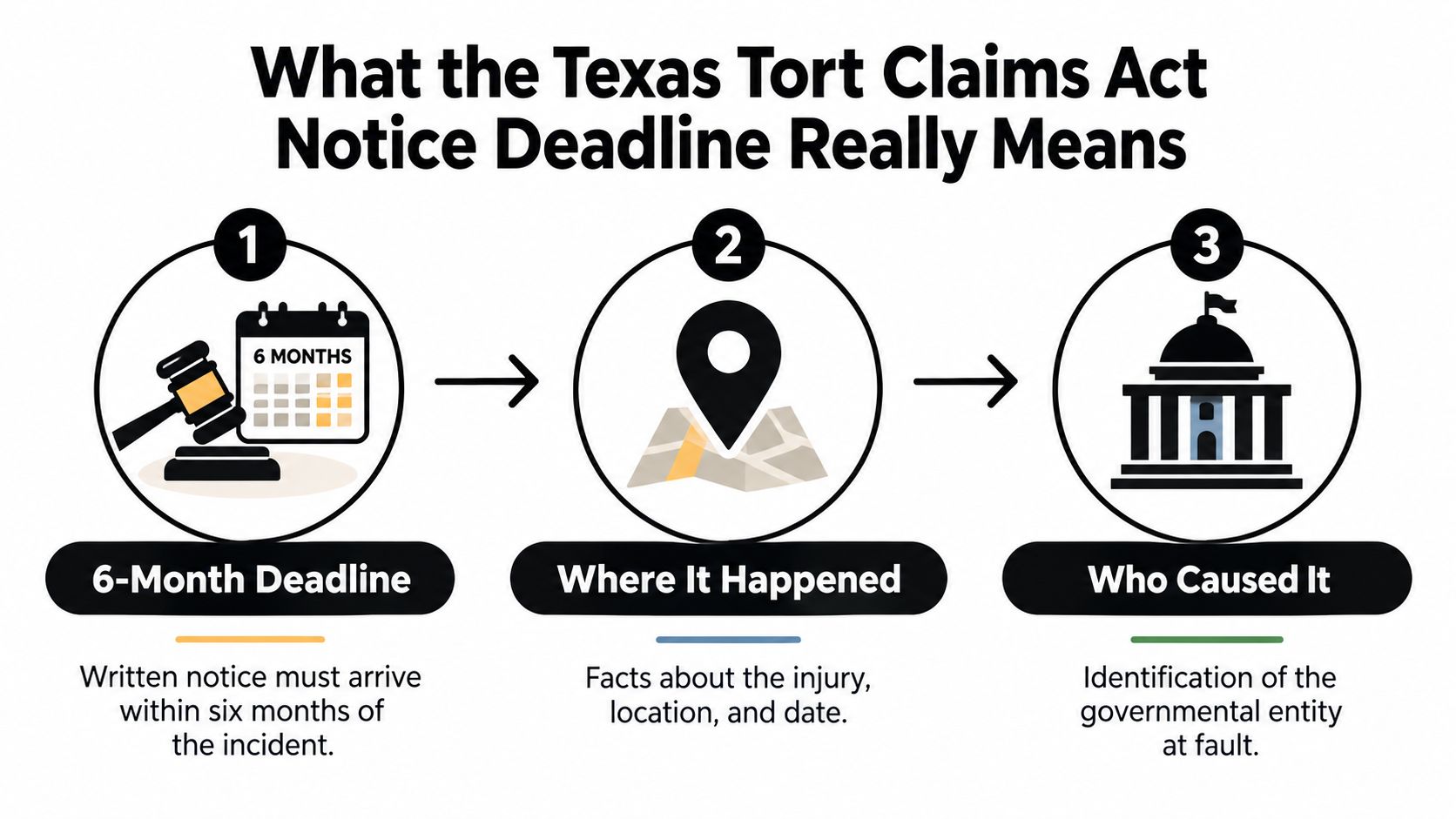
A school bus crash can leave a family focused on emergency care, missed school, and a child's changing symptoms. The legal clock still runs from the crash date. Under Texas Civil Practice and Remedies Code §101.101, a claim against a public school district or another governmental unit generally requires written notice no later than six months after the crash. The roughly 180-day period does not wait for a diagnosis.
Your notice should give the government entity enough information to identify the claim:
- The injury or damage claimed. Describe what happened to the student and list known physical or emotional injuries.
- The time and place. Provide the crash date, the approximate time if known, and the location.
- The occurrence itself. Explain the bus event, such as a collision, sudden stop, unsafe maneuver, or other known circumstance.
Why the crash date controls
Waiting for a complete diagnosis can put the claim at risk. The notice period generally starts on the incident date, not when a doctor confirms the injury, an insurer receives a call, or symptoms become obvious.
Send notice with the facts available now. Identify the known injuries and state that the family will supplement the information as treatment continues. Do not wait for a specialist to determine whether your child has a concussion, spinal condition, or psychological injury.
You can read the governing provision in Texas Civil Practice and Remedies Code §101.101. For later court-procedure questions, Filing an Injury Claim in Harris County Courts explains how personal-injury cases proceed in Harris County civil courts.
An accident report is not a safe shortcut
The statute recognizes an exception when the governmental unit already has actual notice that a death, injury, or property damage occurred. A school's knowledge that a crash happened may not establish knowledge of the facts supporting your child's claim, including the injury and alleged responsibility.
The school may possess an accident report, witness account, emergency record, or internal investigation. Those records can matter, but relying on them without confirming the district's legal knowledge invites a dispute over whether notice was sufficient. Send formal written notice to the entity responsible for the bus and keep proof of delivery.
For a related public-transit example, review this Houston METRO bus claim discussion. The operator determines where notice must go, so identify that entity before the deadline expires.
Which Entity Actually Controls the Bus You Were On
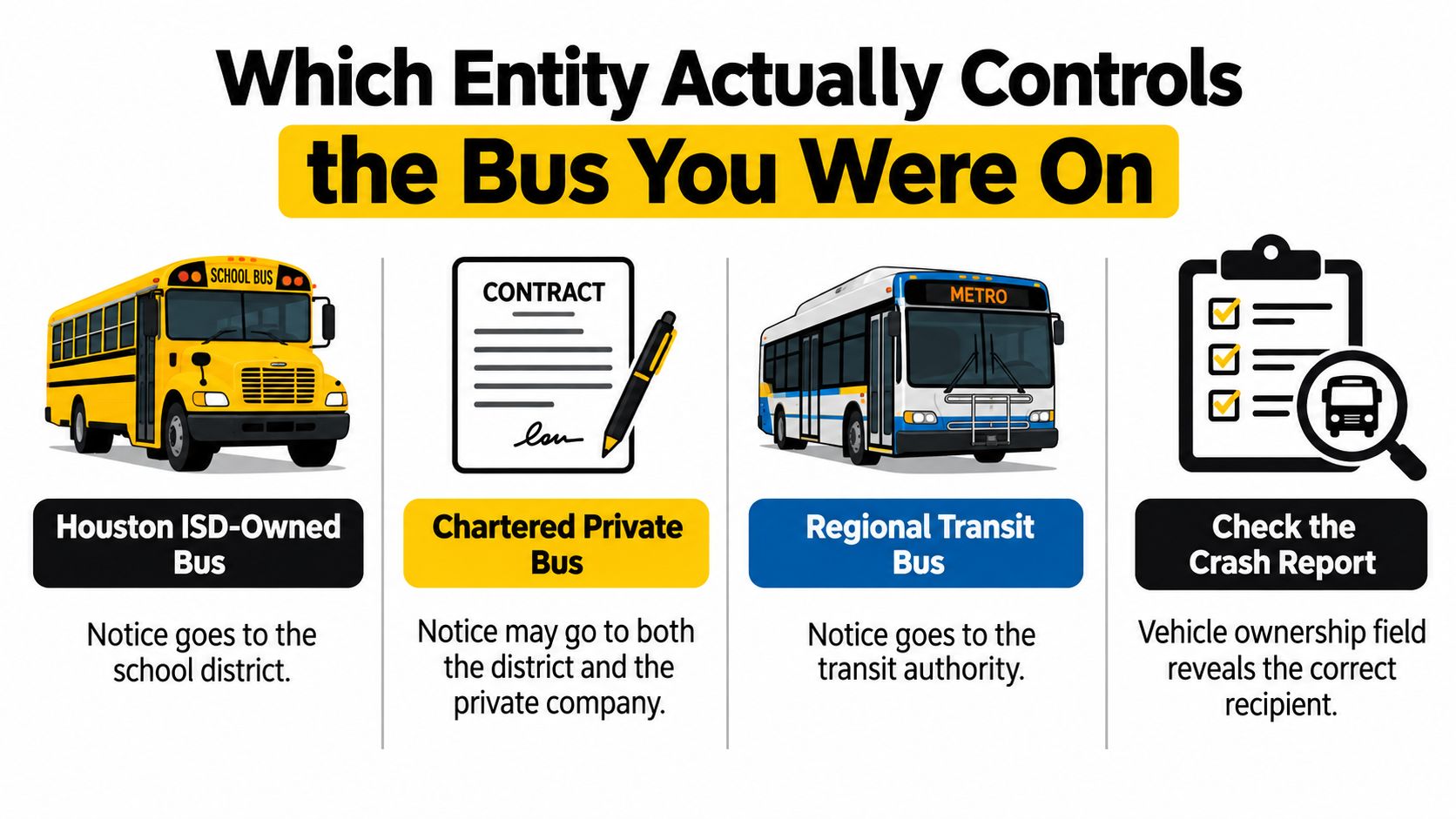
The hardest question often comes before the deadline calculation: who must receive the notice? A bus may display a school district logo while a private transportation company owns or operates it. A city or regional transit authority may operate a public bus that transported a student, while a charter school or another district may control a school route.
Those distinctions matter because a district vehicle, a City of Houston or transit-authority vehicle, and a private contractor can follow different procedures. Local rules or an entity's governing law may also impose a shorter deadline than the general six-month rule.
Start with the vehicle, not the assumption
Suppose your child was hurt on a route serving a Houston school, but the bus carried a contractor decal near the rear door. You send a letter only to the driver, campus principal, or insurance adjuster. That letter may not satisfy the legal notice requirement if the responsible district or governmental unit never receives it.
The same problem can arise when families confuse Houston ISD claims with City of Houston or METRO claims. A public school bus and a regional transit bus aren't automatically governed by the same claims process.
Use this checklist during the first week:
- Record the bus number: Write down the vehicle number from the crash report, photographs, or school records.
- Identify the route: Preserve the route name, stop, direction of travel, and school connection.
- Inspect markings: Look for district insignia, contractor decals, transit branding, and fleet identification.
- Review the crash report: The ownership or operator field may identify the correct recipient.
- Contact transportation officials: Ask which entity owned, operated, and controlled the vehicle.
- Track the driver and witnesses: Keep names and contact details, but don't assume telling the driver provides legal notice.
Do not send notice only to the person who happened to be present. The letter should reach the governmental entity or other legally responsible operator.
If the crash involved a passenger vehicle rather than the bus itself, a Houston Car Accident Lawyer resource can help explain representation for car accident victims in Houston and Harris County. The same basic concept applies here: identify every potentially responsible party before an insurer narrows the claim to one vehicle.
What a Valid Notice Looks Like in Practice
A defensible notice doesn't need courtroom language. It needs enough accurate information to identify the event, the injured person, and the claim. The safest approach is a clear written letter directed to the governmental unit or operator that controls the bus, with copies sent to other potentially responsible entities when ownership is uncertain.
Include these details:
- Claimant identity: Name the parent or legal representative and the injured student.
- Recipient identity: Specify the school district, transit authority, city, contractor, charter school, or other operator receiving notice.
- Crash information: State the date, location, route, vehicle number, and approximate time if available.
- Factual description: Explain what happened without guessing. Identify the collision, sudden stop, turn, impact, or other known event.
- Injury description: List known injuries, treatment, and symptoms. State that the family reserves the right to supplement as medical care continues.
- Procedure request: Ask the entity to provide its claim procedures and identify the person or office handling the matter.
Make delivery provable
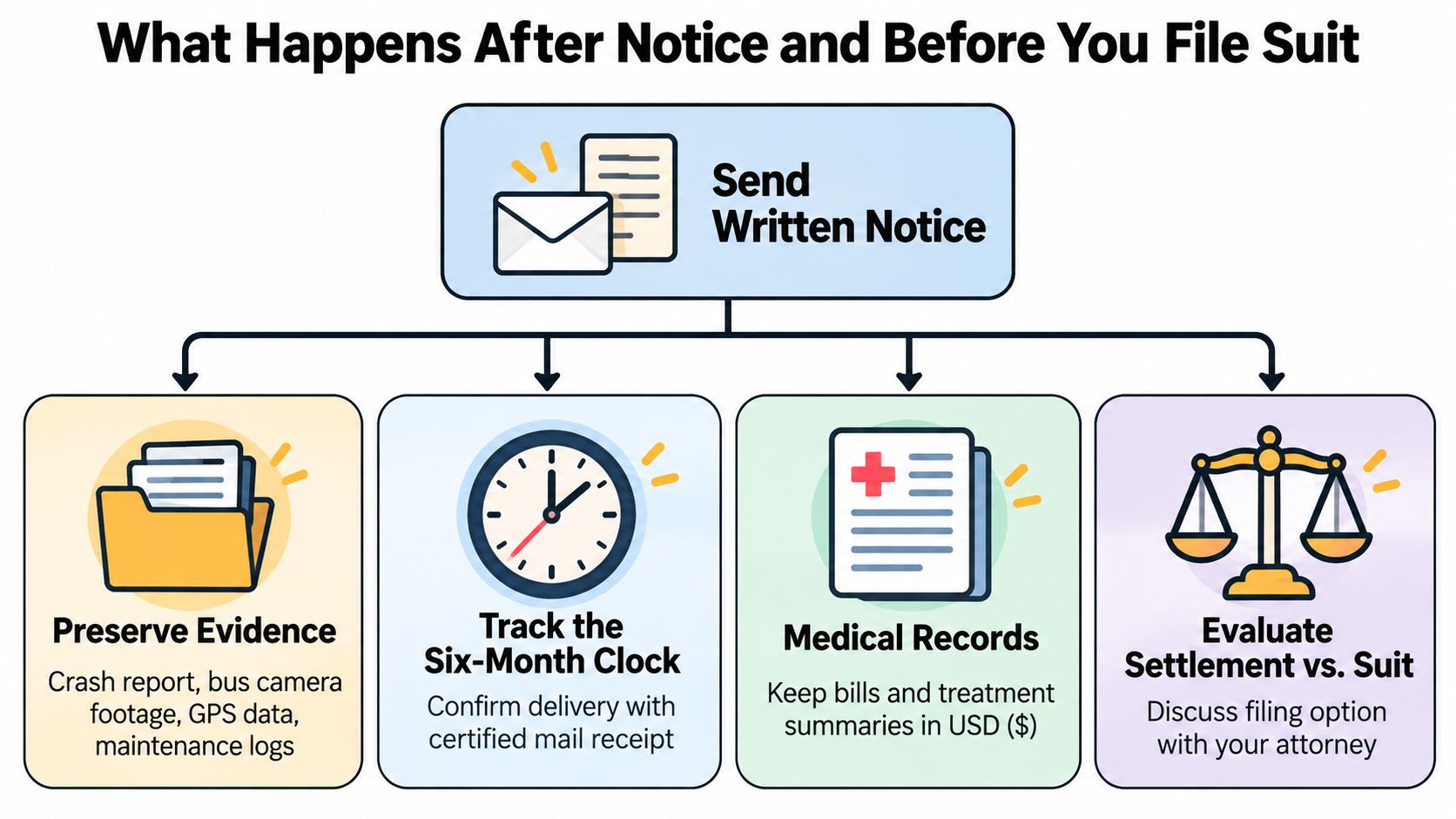
Keep a dated copy of everything. Use a delivery method that creates evidence, such as certified mail, courier tracking, or an email transmission with confirmation when the entity accepts that method. Preserve the receipt, tracking record, transmission details, and any acknowledgment.
A parent's conversation with a campus administrator may help establish what the school knew, but it shouldn't be your only notice strategy. The same goes for telling a driver, police department, or insurance adjuster. Those contacts may not equal notice to the governmental unit.
Keep the notice factual
You don't need to prove the whole case in the letter. Don't make medical conclusions that your doctors haven't made, and don't speculate about fault. Identify the occurrence, location, date, injury, and responsible entity clearly.
The three statutory elements and the correct recipient are fixed requirements. A precise letter also helps preserve a consistent record while your child's diagnosis develops.
Notice Deadline vs. Lawsuit Deadline and Why the Difference Matters
Families often hear “two years to sue” and assume they can wait. That's the wrong approach when a governmental entity may be involved. Notice and limitations are separate clocks. The six-month notice period concerns notifying the governmental unit, while the general personal-injury limitations period concerns filing a lawsuit.
The notice clock usually begins on the crash date. The lawsuit clock also generally relates to the injury event, but the exact application can depend on the claim and the parties involved. A later diagnosis doesn't automatically erase the need to protect the original event-based notice deadline.
A child's age doesn't make notice optional
A child's minority does not automatically extend the governmental notice period. Families sometimes believe that because the injured person is underage, every deadline waits until adulthood. That assumption can leave a district claim exposed while parents focus on treatment.
Actual notice may become relevant if the governmental unit had legally sufficient knowledge of the injury, circumstances, and injured person. But a routine accident report or simple awareness that a crash occurred may not prove everything required. Treat actual notice as an issue to investigate, not as permission to delay.
The following calendar is a practical way to organize the two clocks:
| Clock | Statutory source | Trigger date | Duration | Minority effect |
|---|---|---|---|---|
| Governmental-unit notice | Texas Civil Practice and Remedies Code §101.101, Texas statute text | Crash date | Generally six months, approximately 180 days | A child's minority does not automatically extend the notice period |
| Personal-injury lawsuit | General Texas limitations rule, discussed in Texas statutes of limitations guidance | Usually the injury event | Generally two years for personal-injury claims | Application can involve separate rules and should be reviewed for the specific claim |
Use milestones instead of memory
- Day 1: Get medical care, obtain the crash report, photograph the bus and injuries, and record the operator.
- Week 1: Gather records, identify ownership, request preservation of bus-camera and route information, and arrange legal review.
- Month 1: Send written notice with delivery proof if a governmental unit may be responsible.
- Month 3: Confirm the entity received notice, continue treatment, and update the evidence file.
- Six-month outer window: Treat this as the statutory deadline for governmental notice, not as a target date. Local procedures may require faster action.
What Happens After Notice and Before You File Suit
Sending notice protects an important procedural step, but it doesn't finish the claim. The next job is preserving evidence before records disappear or memories fade. Ask counsel to pursue the crash report, bus-camera footage, route and GPS data, maintenance logs, driver information, witness statements, photographs, phone records, and complete medical documentation.
Fault can involve more than one driver
Liability means legal responsibility for causing harm. Comparative fault, also called proportionate responsibility, means a court assigns percentages of responsibility to the parties whose conduct contributed to the crash.
For example, assume a Houston student is injured when a district bus is struck on I-45. A jury could find the private driver 70 percent responsible, the school district 20 percent responsible, and the student 10 percent responsible. Under Texas Civil Practice and Remedies Code §33.001, the student's damages would generally be reduced by the student's assigned share. If the claimant is found more than 50 percent responsible, Chapter 33 bars recovery under the cited rule. Review the statute through Texas Civil Practice and Remedies Code Chapter 33.
Evidence can change that analysis. Police reports, bus-camera footage, witness statements, phone records, maintenance records, and medical documentation may affect how each party's responsibility is evaluated.
Damages and exemplary damages are different
Damages are the losses a claim seeks to address, such as medical expenses, lost income, physical pain, emotional distress, and future treatment. Compensatory damages aim to repay those losses.
Exemplary damages, sometimes called punitive damages, serve a different purpose. Chapter 41 addresses them when conduct involves fraud, malice, or gross negligence. Gross negligence requires an extreme degree of risk and the defendant's actual, subjective awareness of that risk while acting with conscious indifference to others' safety. Ordinary carelessness alone usually isn't enough. Families should preserve evidence that may support such a claim, but they shouldn't assume exemplary damages apply.
A lawyer may recommend negotiation first, filing suit when the response stalls, the insurance offer fails to reflect the harm, or the limitations deadline requires active litigation. If you're also managing an auto insurance claim, avoid recorded statements or releases until you understand how they may affect claims against the bus operator and other parties.
Talking With a Houston School Bus Crash Lawyer This Week
A same-week consultation gives your family a chance to address the deadline before the diagnosis is complete. Bring the crash report, bus and route information, photographs, medical records, school communications, insurance letters, and any draft or sent notice. Include receipts and treatment summaries, even if the records feel incomplete.
The Law Office of Bryan Fagan, PLLC handles Texas personal-injury matters involving vehicle crashes, governmental-entity issues, comparative-fault disputes, and evidence preservation. The firm serves Houston, Dallas–Fort Worth, Austin, San Antonio, and surrounding Texas communities, and its contingency-fee model means you don't pay unless the firm wins your case.
Families also need clear advice about related claims. If a crash causes a death, the available legal issues may include wrongful death compensation, separate from an injured child's personal-injury claim. A consultation can help identify the correct parties, notice procedures, insurance communications, and lawsuit timeline without promising a particular result.
Bring the paperwork you have, even if it's disorganized. A lawyer can help turn scattered records into a deadline and evidence plan.
You don't have to carry the Houston school district bus crash claim notice deadline alone. Contact a Houston school bus accident lawyer this week, before a delayed diagnosis or wrong recipient creates an avoidable dispute.
The Law Office of Bryan Fagan, PLLC offers free consultations and contingency-fee representation for families addressing school bus crash notices, insurance disputes, comparative fault, and serious injury claims. Visit The Law Office of Bryan Fagan, PLLC to request a same-week review and discuss the evidence and deadlines affecting your child's recovery.