Distracted driving is driving while your eyes, hands, or mind aren't fully on the road. NHTSA reports 3,275 people were killed and roughly 324,819 injured in distraction-involved U.S. crashes in 2023.
You're stopped at a light, on your way home, doing nothing wrong. Then you're hit by a driver who never saw you because they were looking somewhere else. A car crash can change your life in seconds, but you don't have to face recovery alone. If you're hurt, sore, and unsure whether the other driver was texting, eating, or just not paying attention, you're asking the right question. What is distracted driving isn't just a definition for a textbook. For you, it's the difference between an insurer calling this a simple accident and evidence showing another driver failed to use reasonable care.
What Distracted Driving Really Means
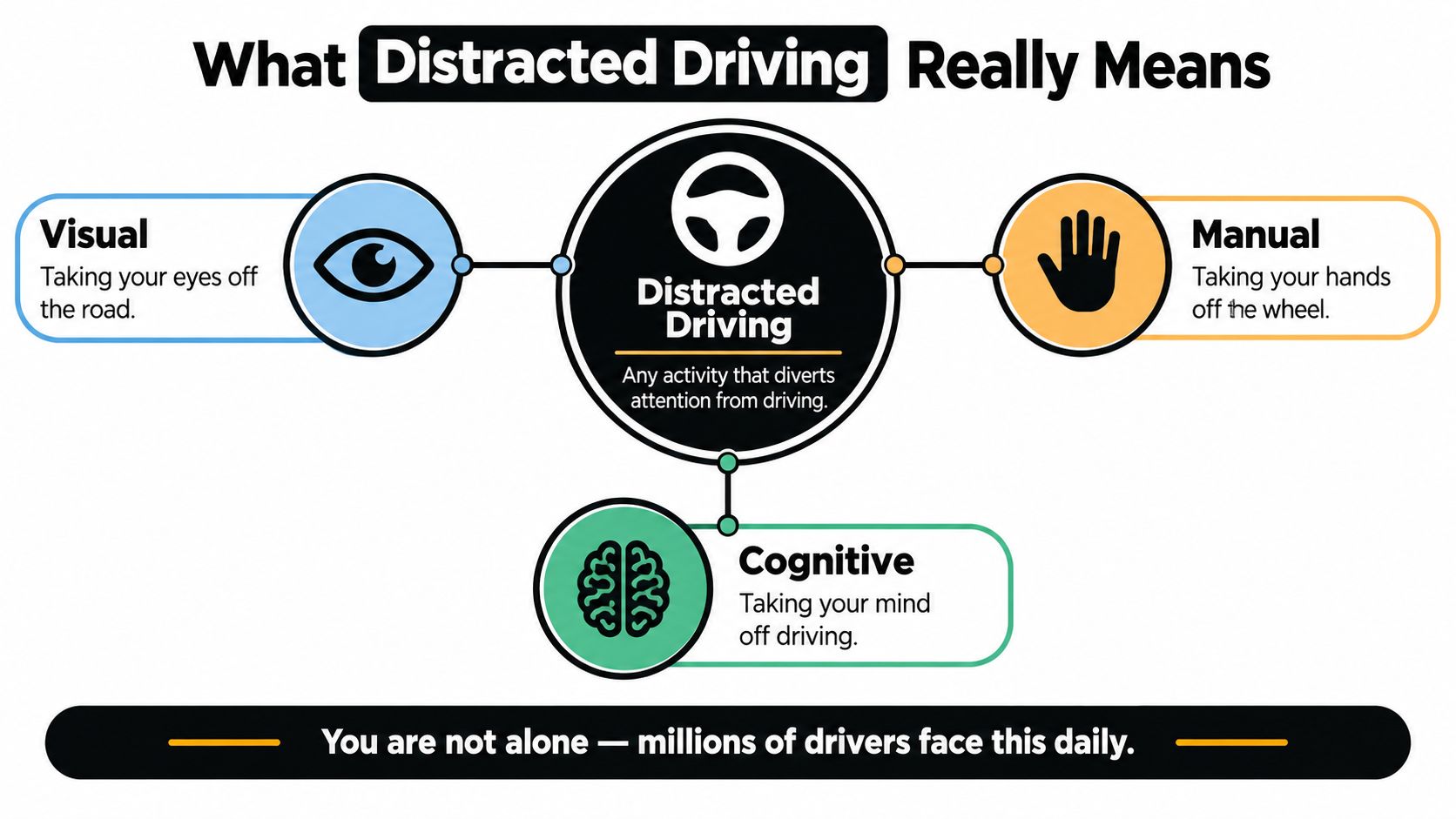
You don't need to prove the other driver meant to hurt you. Distracted driving means performing another activity that diverts attention from operating a vehicle, whether that's using a cellphone, texting, eating, adjusting controls, talking with passengers, or looking away from the roadway. Put plainly, the driver chose, even briefly, to do something else while a moving vehicle needed their full attention.
Think about cutting vegetables with a sharp kitchen knife. You need your eyes on the blade, your hands steady, and your mind on what you're doing. Look at the TV, reach for your phone with one hand, or start replaying an argument in your head, and you can get cut. Driving works the same way, except the risk reaches everyone around you.
A Simple Way To Spot It
Every distraction fits at least one of three buckets.
- Visual distraction: Your eyes leave the roadway, like reading a notification or checking a passenger in the back seat.
- Manual distraction: Your hands leave the wheel, like reaching for coffee, food, or a phone that slid across the seat.
- Cognitive distraction: Your mind leaves the driving task, like carrying on an intense conversation or thinking through a work problem.
One behavior can check more than one box. Reading a text takes your eyes off traffic, your hand off the wheel, and your mind onto the message. That's why a driver can say, "I only looked down for a second," and still have missed stopped traffic, a red light, or you crossing in front of them.
Plain rule for victims: Don't limit your case to "Was he texting?" Ask what the driver was doing instead of watching the road.
That broader question matters after a Texas crash. If you're learning the basics for yourself or a teen driver, Lendrum's facts on road distractions is a useful plain-language resource from Lendrum's Driving School on how everyday distractions lead to collisions. For your claim, though, the label matters less than the proof. A driver who wasn't watching, steering, or thinking about traffic wasn't driving with the care Texas law expects, and your rights don't disappear just because no one caught them holding a phone.
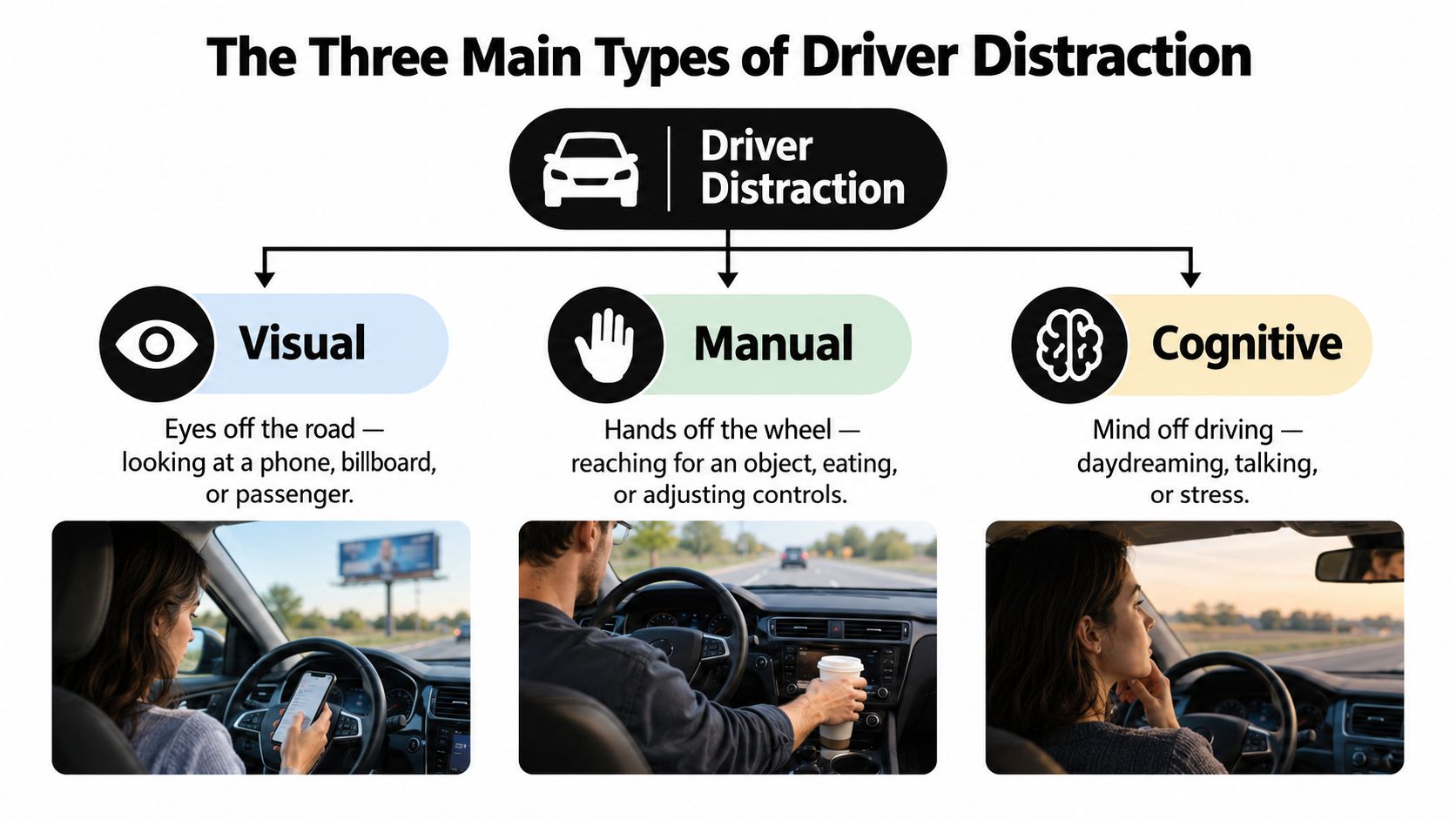
The Three Main Types of Driver Distraction
A Houston driver rear-ended on I-45 often tells a similar story. Traffic slowed, brake lights came on, and the driver behind never braked until impact. When you look at what happened in that cab, the three types usually overlap.
Visual distraction is the easiest to picture. The driver reads a text, scans a navigation screen, looks at a smartwatch alert, or turns to talk to a passenger. Their eyes aren't available to catch your brake lights or a car merging into their lane. Even a short glance removes the information they need to react.
Manual distraction happens when hands leave the wheel. Eating a burger, adjusting the radio, reaching for a dropped phone, or typing an address all reduce control. The driver may still be looking forward part of the time, but they can't steer or correct as quickly with one hand busy and the other trying to compensate.
Why Hands-Free Doesn't End the Problem
Cognitive distraction is the one drivers underestimate. Your hands can stay at ten and two while your mind is somewhere else entirely. The World Health Organization road traffic injury fact sheet reports that drivers using mobile phones are approximately four times more likely to be involved in a crash than drivers who aren't using them, and it states hands-free phones aren't much safer than handheld phones because cognitive attention remains divided.
Texting sits at the worst end of the scale because it demands eyes, hands, and thought at once. Virginia Tech Transportation Institute distracted driving research found texting while driving increased commercial-driver crash risk by approximately 23 times and identified texting as carrying the highest risk among studied sources of distraction.
Take that I-45 driver with coffee in one hand, a Bluetooth call in progress, and navigation rerouting on the screen. That's manual, cognitive, and visual distraction stacked together. Stories like this account of Snapchat use and the lifelong consequences of distracted driving show how fast a routine drive turns serious. Your takeaway is practical. If the other driver says they were "hands-free," that doesn't settle fault. Ask what they were seeing, holding, and thinking about in the seconds before they hit you.
Texas Laws and Penalties for Distracted Driving
Texas law gives you two separate tools after a distraction crash. One is the traffic rule the driver may have broken. The other is civil negligence law, which is how you pursue money for your injuries. Don't confuse a ticket with your claim. They're related, but they aren't the same thing.
The Texas Texting Ban
Texas prohibits drivers from reading, writing, or sending electronic messages while operating a motor vehicle, and the statewide texting-while-driving ban took effect on September 1, 2017, with a violation punishable by a fine of up to $200, according to the Texas Department of Transportation distracted driving campaign. TxDOT also warns that hands-free devices and voice-to-text programs don't eliminate distraction. Interacting with a device can still affect attention and performance.
That fine doesn't pay your hospital bill. Your injury case runs through negligence. Negligence means someone failed to use the care a reasonable driver would use under the same circumstances. Liability means legal responsibility for causing harm. If a Houston driver rear-ends you on I-45 while reading a message, and phone records, witnesses, or dashcam footage connect that message to the failure to stop, that evidence can support liability for your crash.
You can read the details in this guide to Texas cell phone driving laws, but don't wait for a citation to protect yourself. An officer may not ticket the driver, and you can still have a valid civil claim.
Comparative Fault Under Chapter 33
Texas follows comparative fault under the Texas Civil Practice and Remedies Code, Chapter 33. In plain English, fault can be shared. If you're found partly responsible, your recovery can be reduced by your share, and if you're found more responsible than the other side, you may be barred from recovering. Insurers know this rule well. They'll look for any reason to shift blame to you, like speed, following distance, or a sudden stop.
That's why you shouldn't guess about fault in a recorded statement. Stick to facts you know. Say what you saw, not what you assume the other driver was thinking.
Chapter 41 of the same code covers exemplary damages, which are extra damages in limited cases involving especially serious misconduct. Most distracted driving cases focus on ordinary compensation for your losses, not punishment. A Texas injury attorney can tell you whether Chapter 41 even belongs in your conversation. For most victims, the priority is simpler. Prove the driver wasn't paying attention, prove that caused the wreck, and document what it cost you.
Crash Statistics and Common Injury Patterns
The numbers explain why insurers shouldn't treat your crash as a minor mistake. Distraction shows up in fatal and injury crashes across the country, and Texas roads carry a heavy share of that harm.
The image below summarizes the scale before we turn to Texas figures.
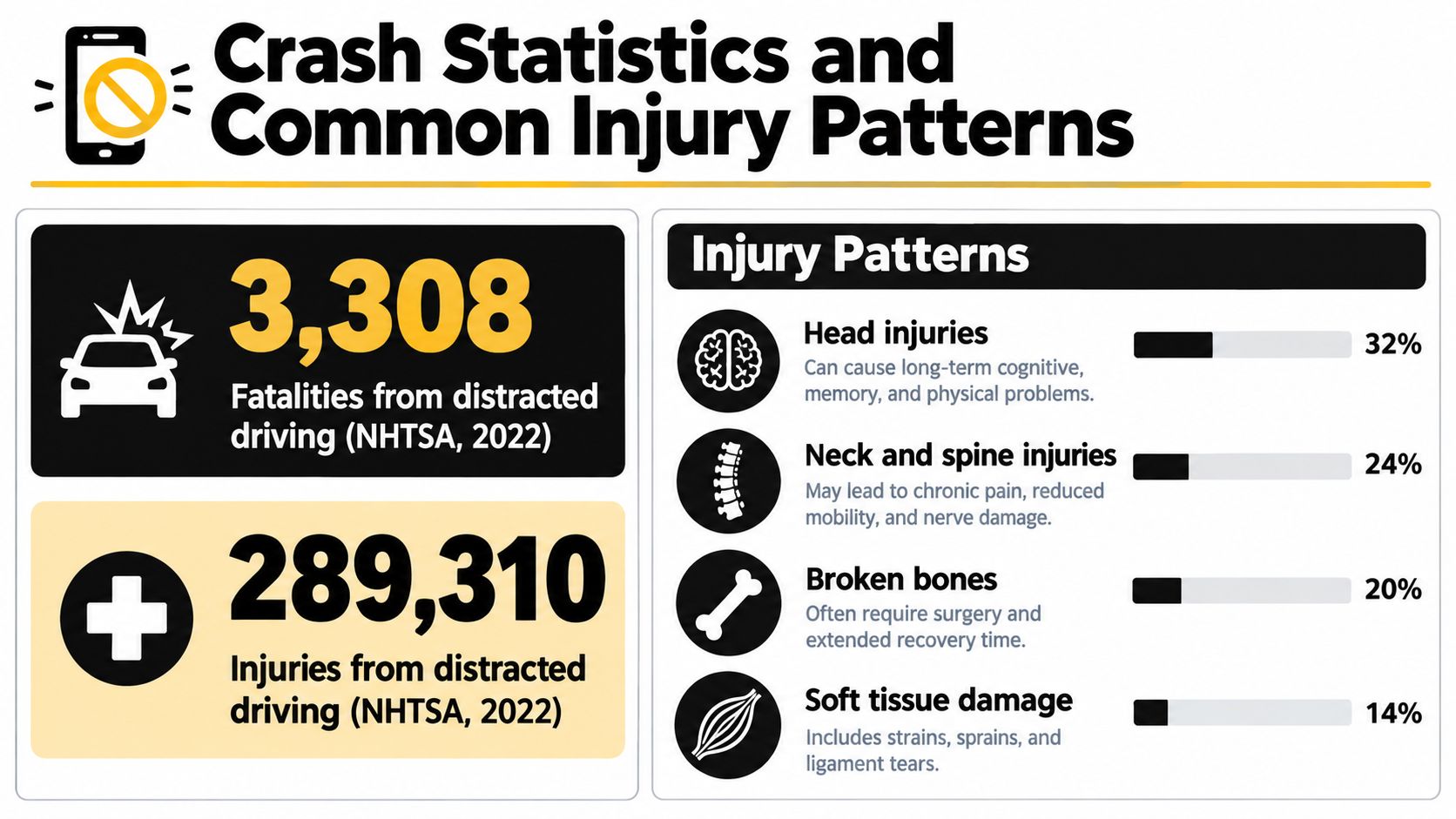
NHTSA's 2023 distracted driving publication recorded 3,021 fatal crashes involving distraction out of 37,654 fatal crashes overall, and distraction-affected crashes represented 8% of all fatal crashes and an estimated 13% of injury crashes that year. Cellphone use was reported as a distraction in 369 fatal crashes, or 12% of all distraction-affected fatal crashes, in that same NHTSA publication.
The problem didn't vanish the next year. NHTSA's 2024 distracted driving data reported 3,208 people killed and an estimated 315,167 people injured in crashes involving distracted drivers. Closer to home, the Texas Department of Transportation traffic safety data story recorded 91,043 distracted-driving crashes, more than 2,587 serious injuries, and 373 deaths in Texas in 2024.
Treat those totals as conservative. Distraction is hard to establish after impact because drivers may not admit device use, witnesses may not see inside the car, and investigators may lack digital or vehicle data. Recent reporting on texting and driving statistics and trends also noted fatal crashes involving distracted drivers rose 5% from 2019 to 2023. If the crash report doesn't list distraction, that doesn't prove the driver was attentive.
The video below is a useful reminder of how quickly inattention becomes impact.
Injuries That Often Appear After These Wrecks
Rear-end crashes commonly strain the neck and back. You may hear terms like whiplash, herniated discs, and soft-tissue damage. Side impacts and harder collisions can cause concussions, broken bones, and joint injuries. Don't dismiss yourself because you walked away. Headaches, stiffness, numbness, dizziness, and back pain can build over the next few days as swelling and adrenaline fade.
Get checked promptly and follow up if symptoms change. Medical records created close to the crash help connect your injuries to the collision. If you wait and hope it passes, the insurer will argue something else caused your pain. Your body and your claim both benefit from early care.
How Distracted Driving Is Proven in a Claim
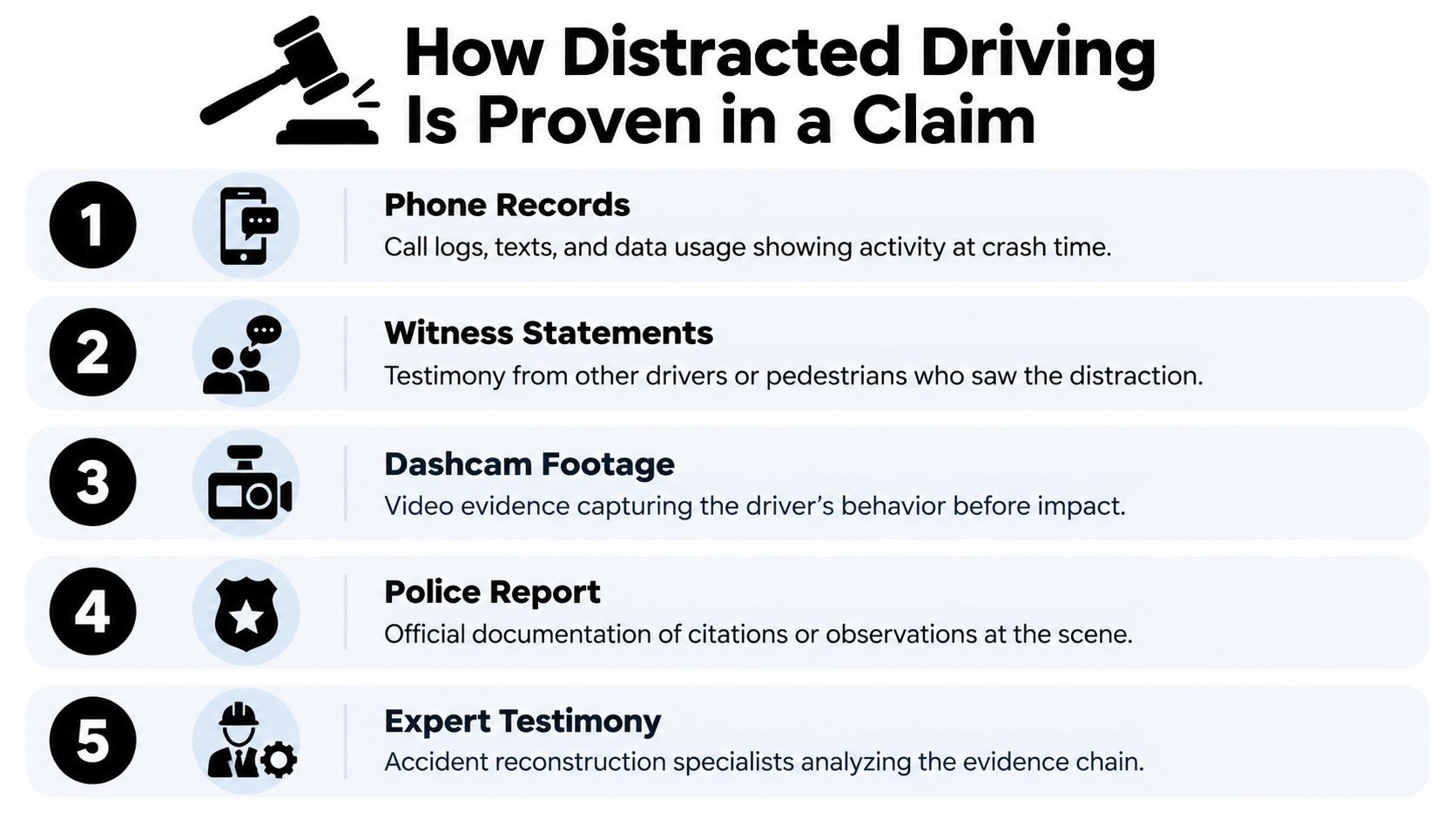
You probably didn't see inside the other driver's car. That's normal, and it doesn't end your case. Distracted driving is proven by building a timeline from records, video, vehicle data, and people who saw pieces of what happened.
Evidence That Can Carry Your Case
- Phone and app records: Call logs, texts, data use, navigation activity, and infotainment logs can show interaction near the time of impact.
- Video: Dashcam footage, traffic cameras, nearby business surveillance, and doorbell video can show lane drift, delayed braking, or a driver looking down.
- Vehicle data: Event data and connected-car records can help establish speed, braking, steering, and timing before the collision.
- Witnesses and passengers: Other drivers, pedestrians, and passengers may have seen the driver eating, reaching, arguing, or staring at a screen.
- Admissions and the crash report: A simple "I looked down" at the scene matters, and you should know how to read a police accident report so you can spot contributing factors and errors.
A driver can deny texting and still have been distracted. Eating, adjusting controls, interacting with passengers, or looking away from traffic can all show inattention.
Picture a Katy Freeway rear-end crash. The driver denies texting. Your dashcam shows no brake lights until the last moment. A witness in the next lane saw the driver looking down and drifting. Phone records later show activity right before impact, and vehicle data confirms little braking. No single item has to do all the work. Together, they tell a clear story.
Modern cars complicate the "hands-free" defense. Voice-to-text, Bluetooth controls, smartwatch alerts, and driver-assistance prompts can still create cognitive or visual distraction. An investigation may need connected-car logs, app activity, smartwatch records, and navigation data, not just a text history. Distraction can also coexist with speeding, fatigue, intoxication, or an unsafe lane change. Don't let anyone force you into picking only one cause.
Act early. Video gets overwritten, vehicles get repaired, and electronic records become harder to obtain. Preserve your own photos, dashcam files, and messages, and write down exactly what the driver said to you. A Houston car accident lawyer can send preservation requests and pursue records you can't get on your own. That's how suspicion becomes proof in an auto insurance claim.
What To Do Right After a Distracted Driving Crash
Your first job is safety, not building a lawsuit. Once you're safe, the steps you take in the next few hours protect your health and preserve the facts while they're fresh.
At the Scene
- Move to safety if you can. Get vehicles and people out of traffic when it's safe, and call for help if anyone is hurt.
- Photograph everything. Capture vehicle damage, positions, license plates, skid marks, traffic signals, debris, and visible injuries.
- Record the basics. Note the date, time, exact location, weather, and road conditions before details blur.
- Exchange information. Get the other driver's name, contact details, license plate, insurance information, and policy number.
- Find witnesses. Ask names and phone numbers, and note whether anyone mentioned seeing the driver on a phone or looking down.
Those steps follow the Texas Department of Insurance guidance on what to do after a wreck, which recommends photographing the scene, collecting driver and insurance details, identifying witnesses, obtaining the police report, and notifying your insurer promptly. Follow that checklist even if the other driver seems apologetic and cooperative.
Get medical care the same day when you can, even if pain feels mild. Tell the provider you were in a crash and describe every symptom, including headache, neck stiffness, back pain, numbness, or confusion. Keep discharge papers, imaging results, prescriptions, bills, and follow-up instructions in one folder.
In the Days That Follow
Notify your own insurer promptly, but don't speculate about fault. Report facts, provide accurate information, and avoid a recorded statement to the other insurer until you understand your injuries. If you're unsure what to say, it's fine to say you're still being evaluated.
Know the claim clock. The Texas Department of Insurance claim payment guidance states an insurer generally has 15 business days to acknowledge receipt of a claim and, after receiving the information it needs, generally another 15 business days to notify the policyholder whether it will pay. Those deadlines govern claim handling. They don't decide fault or guarantee payment.
Keep a written log of every call, the adjuster's name, documents requested, and evidence you submitted. Save repair estimates, rental receipts, wage records, and proof of missed work. That paper trail proves damages, meaning the financial and nonfinancial losses caused by your injury. Organized records make it harder for an insurer to lowball you.
Legal Options for Compensation in Texas
You have more options than accepting the first check an adjuster offers. Your path depends on who caused the crash, what insurance is available, and whether the insurer treats you fairly.
Damages include economic losses like medical bills, future treatment, lost wages, reduced earning ability, and vehicle damage. They also include non-economic losses like pain, suffering, and the disruption the injury causes in your daily life. Document both. A stack of bills shows cost, but your records should also show missed work, canceled plans, sleep problems, and activities you can't do while you recover.
Your Main Paths To Recovery
Most cases start with a claim against the at-fault driver's liability coverage. You present evidence of distraction, causation, injuries, and losses, then negotiate. If that driver's limits aren't enough, your own underinsured motorist coverage may help, if you bought it. Uninsured motorist coverage may apply when the driver has no insurance or leaves the scene and can't be identified under the policy terms.
If the insurer denies responsibility or offers less than your documented loss, filing a civil lawsuit may be necessary. A lawsuit doesn't automatically mean a trial. It creates deadlines, formal evidence exchange, and pressure to value the case seriously. Truck cases, rideshare crashes, and fatal collisions can involve additional policies and parties, so don't assume there's only one source of recovery.
The statute of limitations is the legal deadline to file suit. In Texas, personal injury claims generally must be filed within a limited period after the crash, and wrongful death claims follow their own rules and deadlines for eligible family members. Don't test that deadline. Waiting also makes phone records, video, and witness memories harder to secure.
If your family lost someone, wrongful death compensation may address funeral costs, lost financial support, and the loss of companionship, depending on your relationship and Texas law. Those cases deserve careful, prompt review because evidence and filing rights are specific.
Avoid three common mistakes. Don't give a recorded statement while medicated, confused, or unsure. Don't sign a quick settlement before you know whether you'll need more treatment. Don't post photos or commentary about the crash on social media, because insurers will use your posts to question your injuries. Get advice before you give away advantage.
Getting the Right Help for Your Recovery
You have the right to medical care, the right to pursue a fair insurance claim, and the right to seek compensation when another driver's inattention caused real harm. You don't have to know which record proves distraction or which deadline applies before you ask for help. That's the work a lawyer does with you.
If you're in Harris County, a Houston Car Accident Lawyer provides representation for car accident victims in Houston and Harris County. The Law Office of Bryan Fagan, PLLC offers free consultations and contingency-fee representation for injured Texans, which means you can get your case reviewed without paying upfront to learn where you stand. The firm serves Houston, Dallas-Fort Worth, Austin, San Antonio, and surrounding Texas communities.
Bring what you have. Photos, the crash report number, medical papers, repair estimates, insurance letters, and your notes about what the driver said are enough to start. If something is missing, say so early. A prompt investigation can pursue video, witness statements, phone records, and vehicle data before they disappear.
You were paying attention. The other driver wasn't. Now put that evidence to work and protect your recovery, your income, and your future.
If a distracted driver hit you in Houston or anywhere in Texas, The Law Office of Bryan Fagan, PLLC can review your crash, explain your options in plain English, and help preserve the phone, video, and vehicle evidence your claim may need. Reach out today for a free consultation and get clear next steps for your medical bills, lost income, and recovery.