4,150 people died in Texas motor-vehicle crashes in 2024, and a wrongful-death claim generally must be filed within two years of the death. Under Texas Chapter 71, only the surviving spouse, children, and parents may bring the wrongful-death claim, subject to the statute's rules.
A car crash can change your life in seconds, but you don't have to face recovery alone. If you're sitting in a Houston living room with funeral paperwork on the table, unanswered questions from an insurer, and no clear explanation of what happened, your family may feel frozen between grief and urgent decisions. A wrongful death lawsuit in Texas is not a substitute for your loved one, but it can help address financial losses and hold a responsible person or company accountable.
This guide is written for families, not lawyers. It explains what Texas law requires, what evidence can disappear, how rural and single-vehicle crashes change an investigation, and what steps can protect your family's rights.
What You Are Facing After a Fatal Texas Crash
A Houston family may learn about a fatal crash by phone, at a hospital, or from an officer at the front door. The first hours often bring practical demands that feel impossible to manage: identifying the vehicle, contacting relatives, arranging medical or funeral services, and trying to understand whether another driver, a trucking company, or a dangerous roadway played a role.
The family may also receive a call from an insurance adjuster. The adjuster may sound kind and ask for a recorded statement or a quick explanation of what happened. That conversation can matter later, especially when the family has not yet seen the crash report, medical records, vehicle data, or witness accounts.
Practical rule: Preserve first and explain later. Early statements, photographs, vehicle records, and electronic data can affect the entire investigation.
A wrongful-death case combines grief, logistics, and legal decisions. You may need to establish who has the right to file, identify every potentially responsible party, document the losses caused by the death, and protect evidence before a damaged vehicle is repaired or discarded.
A rural family may face a different problem. There may be few witnesses, limited surveillance, a long distance to specialized crash investigators, and a roadway condition that changes after the collision. An apparently single-car crash may involve a tire defect, poor signage, unsafe roadway design, employer conduct, or another vehicle that left the scene.
Take one step at a time. Gather the documents you already have, avoid signing a release before the losses are understood, and get advice from a Texas injury attorney before making decisions that can't be undone.
How Texas Defines a Wrongful Death Claim
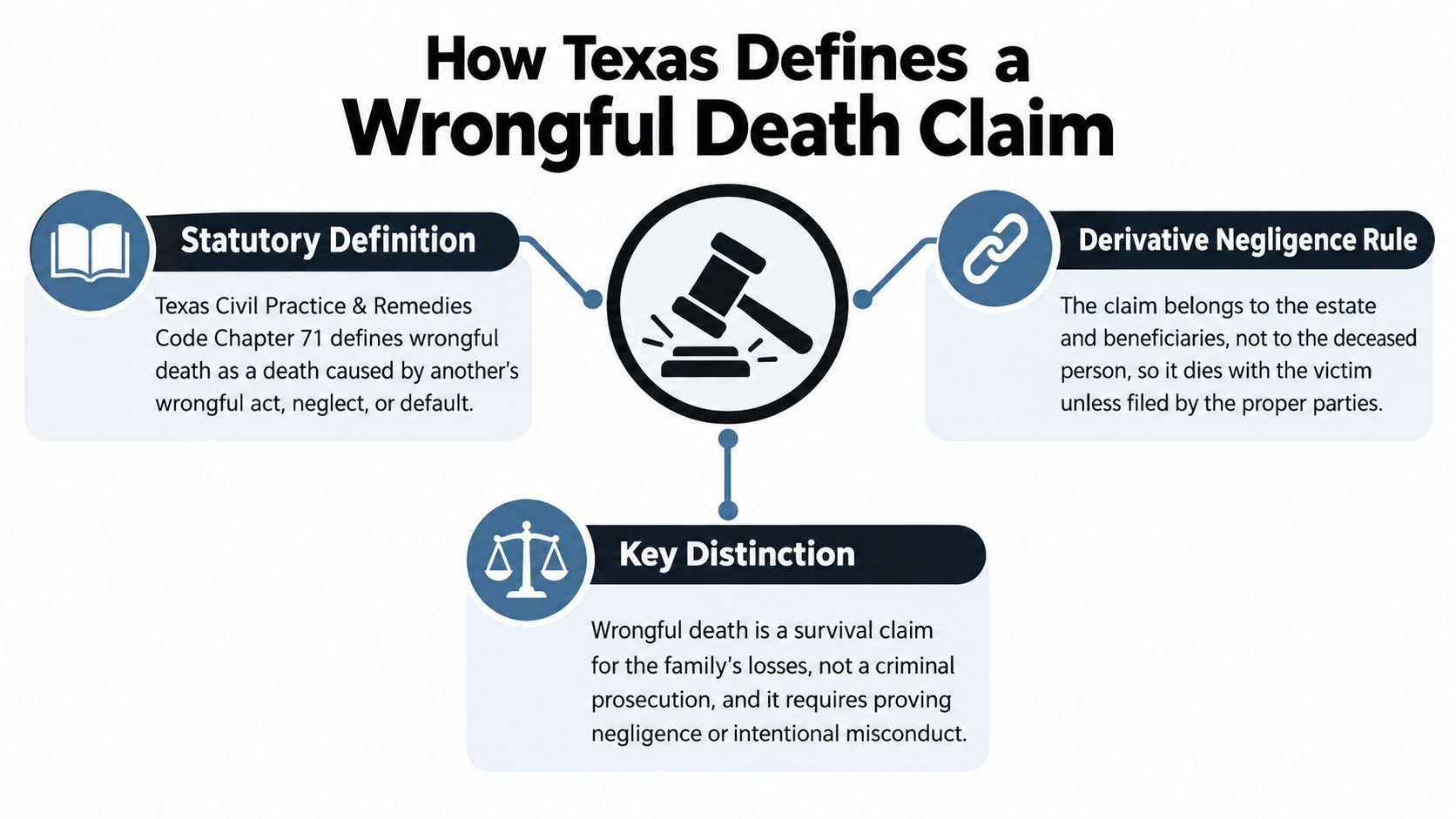
Texas Chapter 71 treats wrongful death as a civil claim when a person dies because of another person's wrongful act, neglect, carelessness, unskillfulness, or default. In practical terms, the evidence generally must show a legal duty, a failure to meet that duty or other wrongful conduct, and a causal connection to the death. A fatal crash does not automatically establish liability. A single-vehicle collision may require examination of roadway design, signage, vehicle maintenance, a defective part, or an employer's conduct, depending on the facts.
The claim is derivative, meaning it depends on the personal-injury claim the decedent could have pursued if they had survived. If the evidence would not support that underlying claim, the family's wrongful-death claim may also fail. The statutory framework appears in the Texas Civil Practice and Remedies Code, Chapter 71.
Two claims may arise from one death
A wrongful-death action seeks compensation for losses suffered by eligible surviving beneficiaries. Those losses may include financial support, household services, companionship, guidance, and mental anguish.
A survival action is separate. It belongs to the decedent's estate and seeks losses the person could have recovered had they lived, including injury-related medical expenses and pain experienced before death. Both claims may arise from one crash, while involving different legal interests and evidence.
A person might survive a collision for a period before dying from complications. Medical records, autopsy findings, treating-physician opinions, and expert testimony may be needed to connect the crash to the death. The defense may argue that a preexisting condition, delayed care, or a later medical event caused the death.
Liability means legal responsibility for the harm. Depending on the evidence, potentially responsible parties may include a driver, employer, vehicle manufacturer, maintenance provider, property owner, or public entity. A Houston wrongful death lawyer can help families identify those parties and preserve evidence, but the claim still requires proof of duty, wrongdoing, causation, and legally recognized losses. Witness accounts, vehicle data, maintenance records, roadway conditions, and available reports can determine whether that proof exists.
Who Has the Right to File in Texas
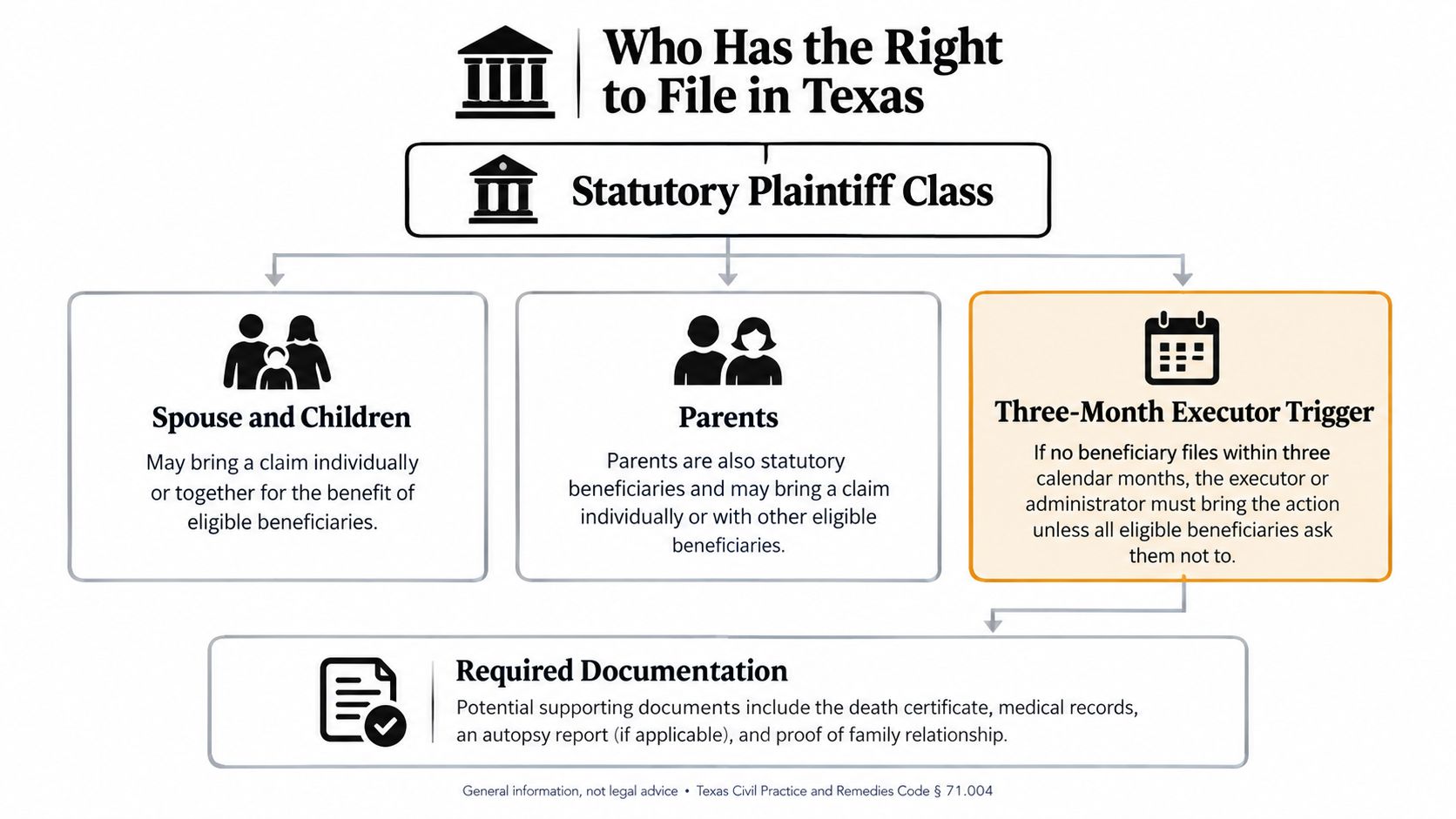
Texas limits the people who may bring a wrongful-death claim. The eligible class is the decedent's surviving spouse, children, and parents. One or more eligible beneficiaries may file for the benefit of all eligible beneficiaries.
Siblings, grandparents, and unmarried partners aren't included in that statutory plaintiff class. They may have other legal interests through an estate, but they can't substitute themselves for the spouse, children, or parents in a Chapter 71 wrongful-death claim.
The three-month estate issue
If no eligible beneficiary files within three calendar months, the executor or administrator generally must bring the action unless every eligible beneficiary requests otherwise. This makes communication among family members important, especially when the estate is being opened at the same time as the crash investigation.
Consider a Houston spouse caring for minor children. The spouse may file for the benefit of the eligible family members, while the children's birth records and the marriage record help establish standing. In a rural case involving an unmarried adult decedent with no spouse or children, an eligible parent may be the person who brings the claim.
Documents that establish standing
Gather documents that show both family relationship and the circumstances of death:
- Family records: Preserve marriage certificates, birth certificates, adoption records, and court orders affecting parentage.
- Death records: Request the death certificate, autopsy materials when available, and medical records.
- Estate papers: Keep probate filings, letters of administration, and the executor's contact information together.
- Crash materials: Save the crash report, photographs, witness details, insurance correspondence, and vehicle information.
The right person must file, but that person also needs proof. A lawyer can help determine whether the claim should proceed in the names of several beneficiaries or through the estate's representative.
Texas Fatal Crash Patterns That Shape the Investigation
The statewide numbers show why a fatal crash should not be investigated as a standard two-car case. TxDOT's 2024 crash summary recorded 4,150 motor-vehicle traffic deaths in 2024, compared with 4,291 in 2023. The fatality rate was 1.35 deaths per 100 million vehicle miles traveled, a 5.25% reduction from 2023.
Rural roads accounted for 2,080 deaths, or 50.12% of the statewide total. Single-vehicle, run-off-the-road crashes caused 1,353 deaths, or 32.60%. Intersection-related crashes killed 1,050 people, head-on crashes killed 617, and pedestrian deaths totaled 768. TxDOT reported that approximately one person died every 2 hours and 7 minutes in a Texas traffic crash during 2024.
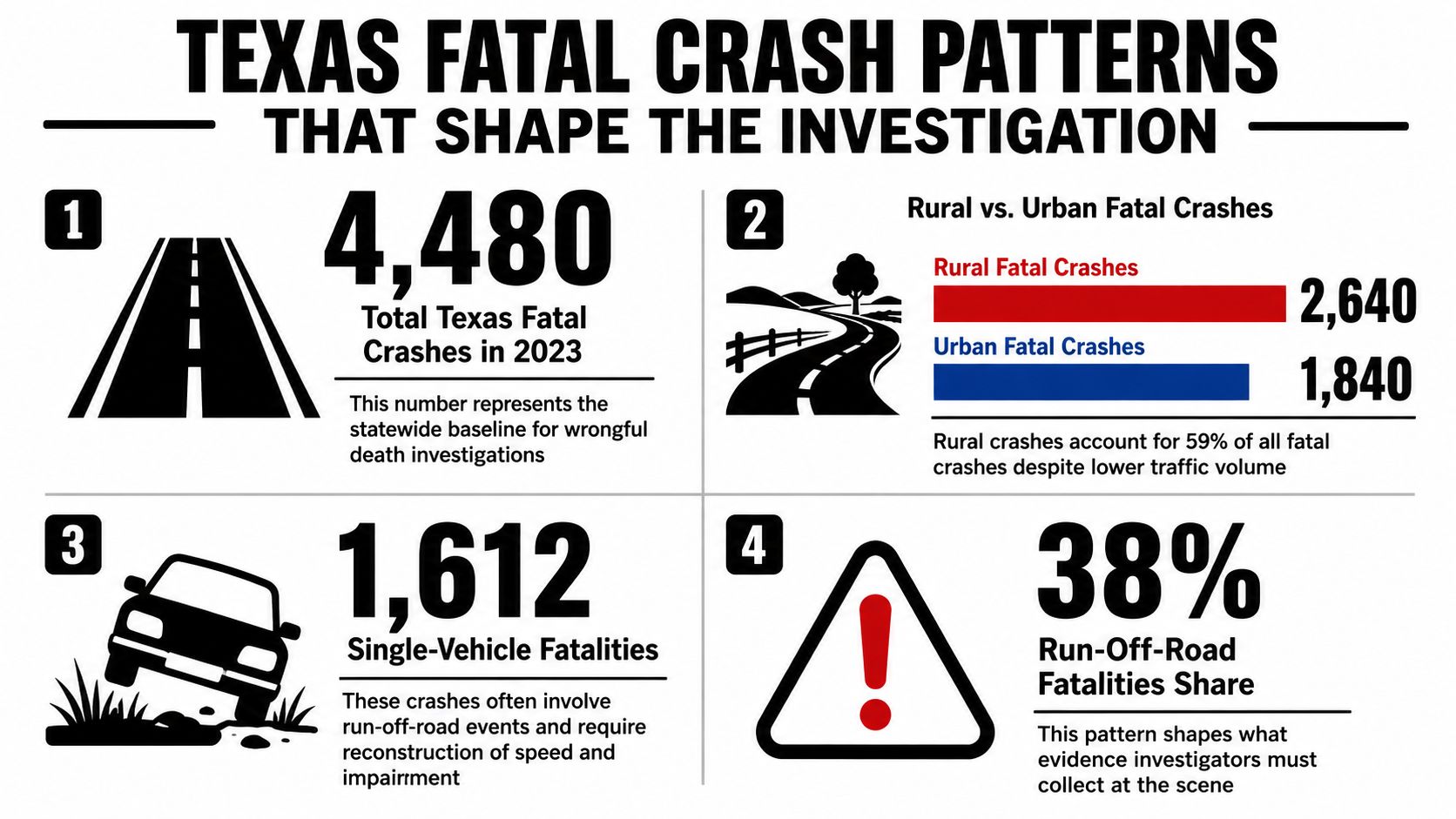
A single-vehicle crash may require investigators to examine the roadway, shoulder, guardrail, signs, lighting, tires, steering, brakes, and vehicle event data. A rural collision may also raise questions about response time, roadway maintenance, and whether a commercial employer failed to supervise or maintain a vehicle.
Recurring risk factors
TxDOT's safety materials identify 1,466 speed-related fatalities, representing 35.4% of traffic deaths, and 1,401 fatalities associated with DUI-related crashes, representing 33.8%. The same summary lists 1,070 unrestrained fatalities, or 25.8%, and 584 motorcycle fatalities, or 14.1%. These figures describe recurring investigation issues, not proof of liability in a particular case. See the TxDOT statewide safety presentation.
Preserve toxicology information, speed evidence, vehicle-event data, phone records when relevant, trucking logs, maintenance records, and witness accounts. If an autopsy question arises, families may also find practical background in Cremation.Green autopsy guidance.
For a closer look at evidence and causation, review how to prove wrongful death. Families dealing with adjusters can also consult Dealing With Insurers After a Houston Accident, which addresses how to protect a claim from Houston-area insurance tactics.
Compensatory Damages Available to Texas Families
Damages are the losses a civil claim seeks to address. In a Texas wrongful-death case, compensatory damages may include both financial losses and personal losses caused by the death. No award restores the relationship or erases grief, but documented damages can help a family manage the consequences.
Common categories include medical expenses before death, funeral expenses, lost earning capacity or financial support, lost household services, loss of companionship and society, loss of care and guidance, and mental anguish. Adult children and parents may need specific evidence showing the relationship and the actual nature of the loss.
| Damage Category | What It Covers | Typical Proof |
|---|---|---|
| Medical expenses | Treatment provided before death | Hospital bills, medical records, insurance statements |
| Funeral expenses | Reasonable services connected to the death | Invoices, contracts, payment records |
| Financial support | Income and benefits the family reasonably expected to receive | Pay records, tax documents, employment history |
| Household services | Work the decedent performed for the household | Family testimony, schedules, service estimates |
| Companionship and guidance | The personal relationship and support the family lost | Testimony, photographs, communications, family records |
| Mental anguish | Emotional suffering caused by the death | Family testimony, treatment records when relevant |
A practical example helps. Suppose a Houston family documents hospital expenses, funeral costs, lost household work, lost support, and relationship-based losses. The family and its lawyer may organize those records into a demand that separates economic damages from non-economic damages rather than presenting one unexplained figure. The precise value depends on the evidence, the beneficiaries, causation, fault allocation, and legal limits that may apply.
A careful review of the evidence is more useful than relying on an online number. Families can read about the factors that affect a claim in wrongful-death settlement amounts, while remembering that no settlement figure is guaranteed.
Compensatory damages also differ from exemplary damages, sometimes called punitive damages. Exemplary damages punish aggravated conduct and require a separate, higher showing under Chapter 41.
Punitive Damages and the 51 Percent Fault Rule
Two Texas rules often get confused. Comparative fault asks how responsibility is divided among the people and entities whose conduct contributed to the harm. Exemplary damages ask whether the defendant's conduct was serious enough to justify punishment.
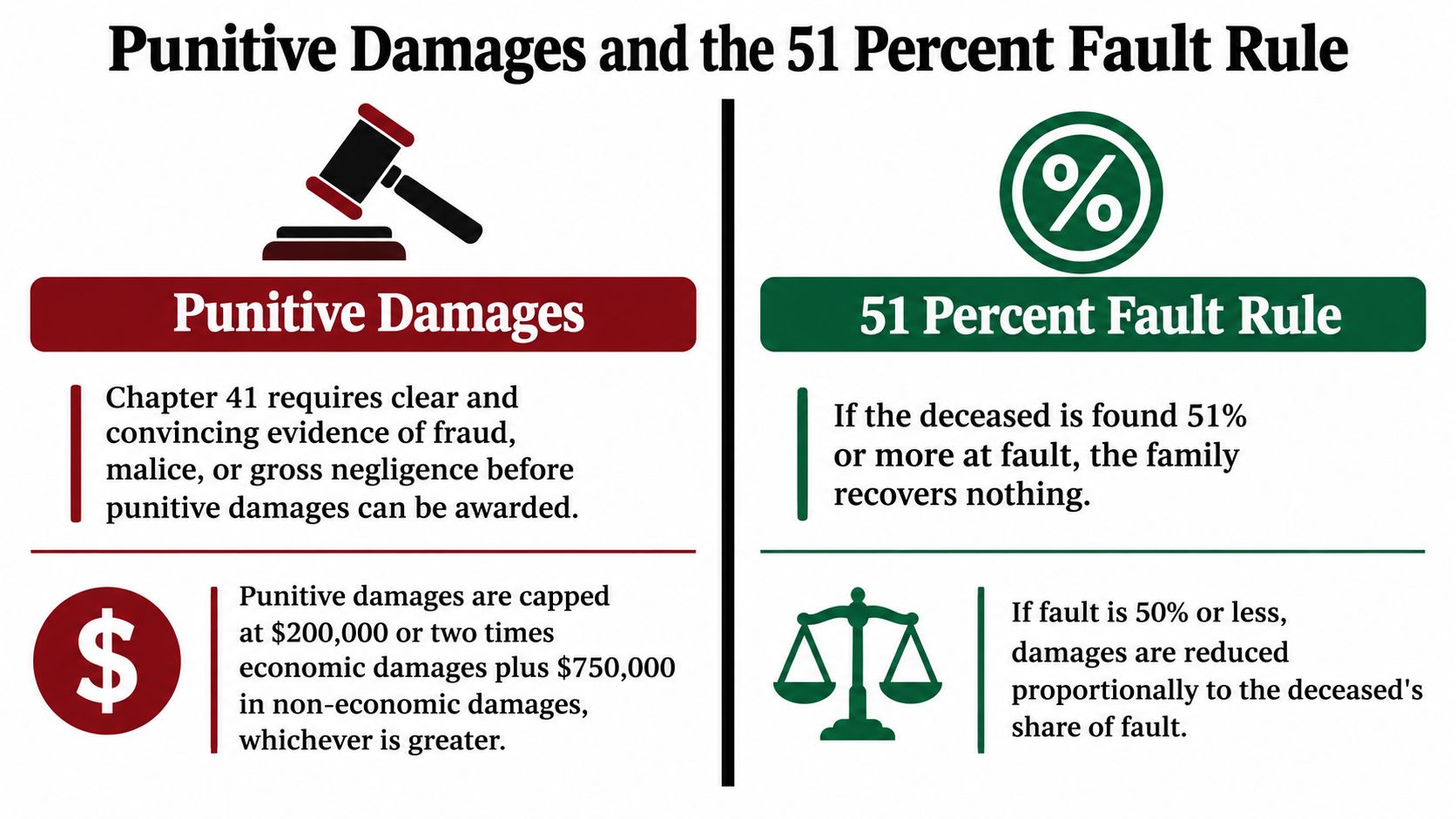
Under Chapter 33, the fact finder assigns whole-number percentages of responsibility to claimants, defendants, settling persons, and properly designated responsible third parties. A claimant can't recover if the claimant's responsibility is greater than 50 percent. If the claimant's responsibility is 50 percent or less, the compensatory award is reduced by that percentage. The statute appears in Texas Civil Practice and Remedies Code, Chapter 33.
How comparative fault affects recovery
Assume a jury finds total damages of $200,000 and assigns a Houston passenger 20 percent responsibility, with the negligent driver assigned 80 percent. The passenger's recovery would ordinarily be reduced to $160,000 before other legal issues are considered.
In a death case, the fault analysis may involve the decedent, a surviving passenger, another driver, an employer, a maintenance company, or a roadway-related party. A defendant may seek designation of a responsible third party. That is why investigators should identify every possible contributor early rather than focusing only on whether one driver received a citation.
The higher standard for exemplary damages
Chapter 41 requires clear and convincing evidence of fraud, malice, or gross negligence before exemplary damages may be awarded. Ordinary negligence, bad faith, or a deceptive trade practice alone isn't enough. Gross negligence generally requires unusually serious misconduct and conscious indifference to the safety or rights of others.
Evidence of severe impairment, extreme speeding, repeated safety violations, or deliberate disregard of an obvious danger may matter. The Texas Civil Practice and Remedies Code, Chapter 41 governs the standard and limitations.
Exemplary damages aren't automatic. The family must first prove compensatory damages and then satisfy the separate burden. Preserve toxicology, employment and trucking records, electronic logs, prior safety information, and witness accounts if they may show more than an isolated driving mistake.
Steps to Take After a Fatal Car Accident in Texas
The first priority is safety and medical care. After that, families should protect information before it disappears and avoid making statements that can be taken out of context.
Get the official records. Request the crash report, photographs, diagrams, citations, medical records, death certificate, and autopsy materials when available. Write down the names of officers, witnesses, hospitals, tow companies, and insurance representatives.
Preserve the physical evidence. Do not authorize repairs, disposal, or destruction of a vehicle before its condition and electronic data have been evaluated. Photograph the vehicle, roadway, signs, lighting, tire marks, debris, and surrounding property.
Identify electronic evidence. Ask about event-data-recorder information, surveillance footage, phone records, commercial-driver logs, dispatch materials, and vehicle-maintenance records. A preservation letter can tell a carrier, employer, business, or public entity to retain relevant material.
Protect communications with insurers. An adjuster may request a recorded statement, medical authorization, or release before the family understands the claim. You can provide necessary information without guessing about fault or signing a settlement that closes future claims.
Calculate losses carefully. Gather pay records, tax documents, benefit information, household bills, funeral invoices, medical expenses, and evidence of the relationship. These records help explain both financial and personal damages.
Track the deadline. The general wrongful-death filing period is two years from the date of death, but a government defendant or another special fact pattern may create additional notice or timing issues. Families should review the date promptly, not near the deadline. See this discussion of the wrongful-death statute of limitations in Texas.
A lawyer may begin with a preservation letter, investigate before filing, prepare a demand, negotiate with insurers, and file suit when negotiation doesn't protect the family's interests. If the case proceeds, discovery, depositions, expert analysis, motions, and trial may follow. For general organization ideas, these insurance claim documentation strategies can help families keep records together.
Families in the Houston area can also review What to Do After a Car Accident in Houston, which focuses on steps to protect health and a claim after a crash.
How a Texas Wrongful Death Attorney Can Help Your Family
A Texas car accident attorney can investigate the crash while your family handles funeral arrangements, work obligations, and grief. The work may include securing vehicle and roadway evidence, locating witnesses, reviewing medical causation, identifying insurance coverage, calculating damages, and determining whether a survival action should accompany the wrongful-death claim.
The attorney also serves as a buffer with insurers. That doesn't mean every case should go to trial or that every demand should be rejected. Settlement can provide certainty and avoid litigation stress, while filing suit may be necessary when an insurer undervalues the evidence or refuses to accept responsibility. The right choice depends on the facts, the strength of the proof, the family's needs, and the legal risks.
The Law Office of Bryan Fagan, PLLC handles Texas auto accident and wrongful-death matters, including negotiations with insurers and courtroom litigation. The firm describes its representation as contingency-fee based, with a free consultation and no attorney fee unless the firm wins the case. Ask what evidence should be preserved now, who may file, what deadlines apply, and how the firm would approach your auto insurance claim.
You don't need to have every document before seeking advice. Bring what you have, explain what you know, and ask for a candid assessment of liability, comparative fault, damages, and wrongful death compensation.
The Law Office of Bryan Fagan, PLLC offers compassionate guidance, evidence preservation, insurance negotiations, and litigation support for Texas families facing a fatal crash. Visit The Law Office of Bryan Fagan, PLLC to request a free consultation and discuss your family's wrongful-death claim with a Texas injury attorney.