A car crash can change your life in seconds, but you don't have to face recovery alone. One minute you're driving home, the next you're shaken, sore, staring at a damaged car, and wondering who's going to pay the bills. That's when the pressure starts, medical treatment, missed work, calls from insurance, and the fear that someone will try to blame you.
A car accident lawyer steps in to do four things that matter: protect evidence, establish fault, document damages, and push the insurance company toward fair compensation. In Texas, those jobs are not paperwork fluff. They're the difference between a claim that gets buried and a claim that gets taken seriously.
When a Crash Changes Everything in a Single Moment
The first hours after a crash are usually the hardest because you don't know yet how badly you're hurt or how much the collision will cost you. Your body is still processing the impact, and your mind is trying to keep up with the questions. How bad is the damage, can you work tomorrow, and what do you say when the adjuster calls?
That uncertainty is exactly why people get trapped into bad decisions early. They sign forms too fast, they guess about fault, or they assume the other driver's insurer will handle everything. That's a mistake.
What a lawyer actually does
A good Houston car accident lawyer does not just “handle the case.” The lawyer builds the case from the ground up. That means locking down photos, crash reports, witness names, vehicle data, medical records, and the proof needed to show how the wreck happened and what it did to your life.
Practical rule: if the other side can rewrite the story, they will. Your first job is to keep the facts from disappearing.
The fear clients feel is simple. They worry about medical bills, lost income, being blamed, and whether they'll be forced to settle before they understand their injuries. A Texas injury attorney should deal with those pressures head-on, not hide behind jargon.
If you want a helpful starting point for the hours right after the wreck, the firm's What to Do After a Car Accident in Houston resource lays out the basics of protecting both your health and your claim. The rest of this guide gives you the decision map so you can judge what happens next and whether a lawyer is worth hiring.
What to Do in the First 24 Hours After a Texas Crash
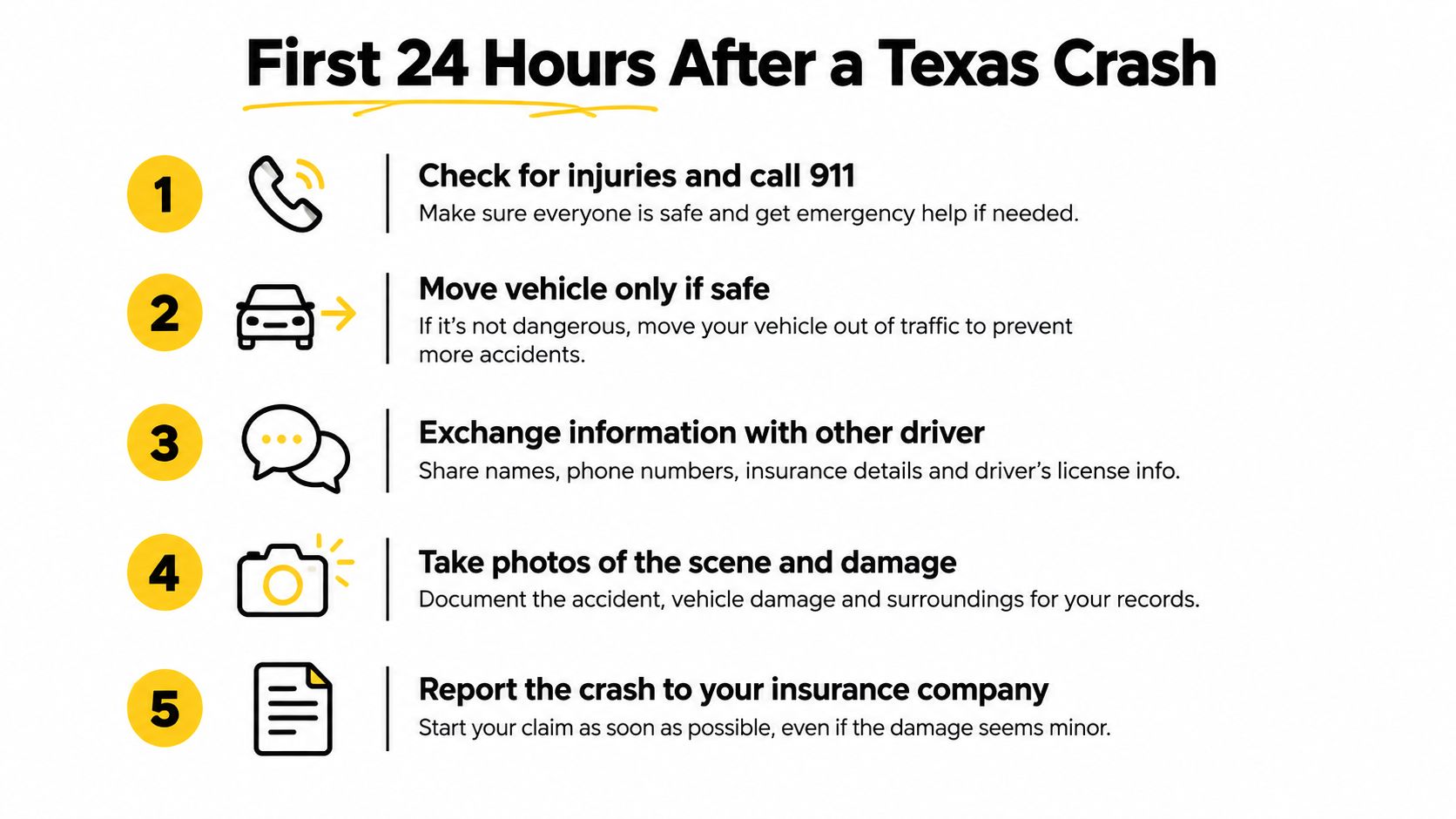
The first day matters because every choice you make can preserve, or weaken, proof. Texas Department of Transportation guidance is straightforward. Check for injuries, give aid when you can, move the vehicle out of traffic if it's safely drivable, exchange identifying and insurance information, document the scene, and call police when the crash involves injury, death, suspected intoxication, a vehicle that can't be moved, no insurance, or a hit-and-run situation TxDOT crash steps.
The checklist I want you to follow
- Check for injuries first. If anyone is hurt, call for help right away. Safety comes before everything else.
- Move the car only if it's safe. Texas guidance says not to wait for police before moving a safely movable vehicle, which helps avoid secondary danger and keeps traffic flowing.
- Exchange complete information. Get names, addresses, phone numbers, driver's-license details, VINs, license plates, and insurance information.
- Photograph everything you can. Damage, skid marks, street signs, debris, traffic lights, and the position of the vehicles all help later.
- Report the crash to your insurer. Give notice, but don't turn that call into a full-blown recorded statement.
The reason this matters is simple. Cars get repaired, towed, or salvaged fast. Once the physical evidence is gone, your lawyer has to work harder to prove what happened and how serious it was.
You should also ask for the peace officer's crash report under Texas Transportation Code Section 550.065 when it becomes available. That report is often one of the first documents an insurer uses to form an opinion about fault.
Do this quickly: preserve the scene before the scene disappears.
If the crash happened in Houston, keep a note of nearby intersections, businesses, and homes with cameras. That's often where the best video evidence comes from. The less time you waste, the better your claim holds together.
Who Is Liable in a Texas Car Accident

Liability means legal responsibility for causing the crash or the injury. In plain English, it answers the question of who has to pay. Texas does not treat that as an all-or-nothing issue, because comparative fault can split responsibility between drivers.
Texas Civil Practice and Remedies Code Chapter 33 uses a modified comparative-fault rule. If you are 50% or less at fault, you can recover damages. If you are 51% or more at fault, you recover nothing. If you are 30% at fault, your damages are reduced by 30%, so $100,000 in proven damages becomes $70,000.
Why the fault fight matters early
A rear-end crash in Houston can look open-and-shut, but don't assume the insurer will see it that way. A Houston driver rear-ended on I-45 might still be accused of an unsafe lane change, sudden braking, or some other contributing act. That's why evidence matters more than opinions.
Photographs, witness statements, vehicle data, medical records, and the crash report are not optional extras. They're the proof that keeps a blame-shift from swallowing your recovery. The moment fault is disputed, the case stops being a simple insurance claim and starts looking like a legal fight.
For a plain-English explanation of how fault gets divided in Texas, see this internal guide on comparative fault definition. If you also want a neutral place to review policy basics, an independent agency for Texas auto policies can be useful background while you sort out coverage questions.
What liability evidence usually proves
- Crash reports show the initial version of events.
- Photos and video show vehicle positions and damage.
- Witness contact information preserves outside accounts.
- Vehicle data can support braking, speed, and impact timing.
- Medical records connect the collision to the injury.
If fault is disputed, the insurer will treat the evidence like a battleground.
That's why a lawyer's first move is usually to preserve the story before the other side has a chance to reshape it.
The Four Stages of a Texas Auto Injury Case
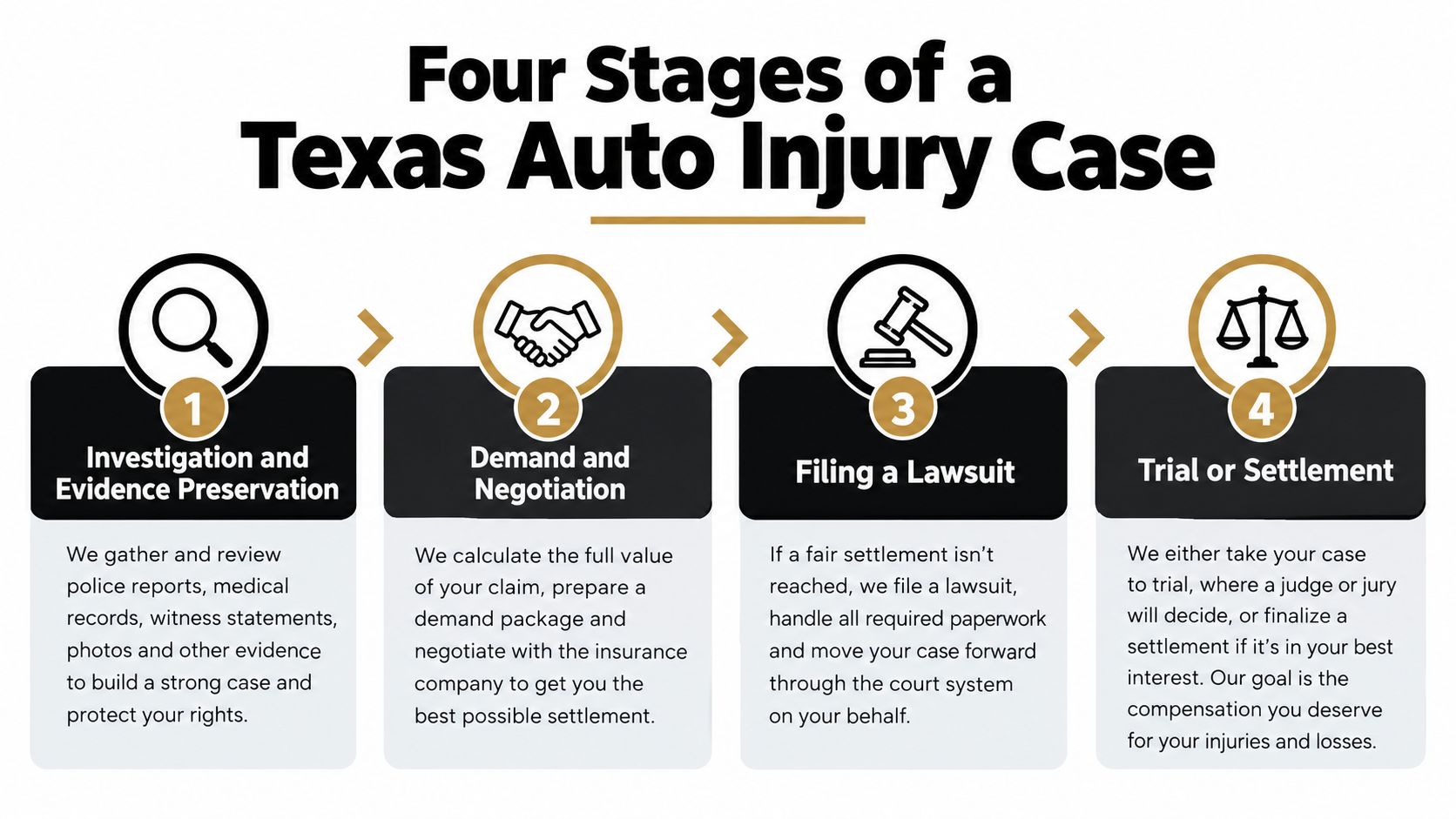
A strong case usually moves through four stages, and each one has a different job. First comes investigation and evidence preservation. Then comes the demand package, where your lawyer sends liability proof and a dollar figure to the carrier. After that comes negotiation, where most cases get resolved. If the insurer won't deal fairly, litigation becomes the next move.
What each stage looks like in real life
Investigation is the quiet stage, but it's the most important. You may be going to doctors and trying to get your life back while your lawyer gathers records, photos, witness information, and crash data. Without prompt action, valuable evidence can be lost.
Demand is where your injury story gets translated into dollars. The lawyer organizes medical records, treatment history, wage loss, and liability analysis into a package the carrier can't ignore. You'll usually feel some relief here because the claim finally looks structured instead of chaotic.
Negotiation is where insurers test you. They may stall, question treatment, or make a low offer to see whether you'll fold. Most cases settle here if the evidence is strong and the injuries are well documented.
Litigation starts when the carrier won't move enough. That means filing suit, using discovery, and preparing for the possibility of trial. It takes longer, but it can be the right answer when the offer is insulting or the liability dispute is serious.
Timeline reality: no honest lawyer should promise a quick finish before the medical picture is clear.
The right moment to settle is usually when treatment has stabilized enough to measure the full damage. That's not delay, that's strategy. If you settle too early, you may leave future care and wage loss on the table.
How Damages Are Calculated and What Your Case May Be Worth
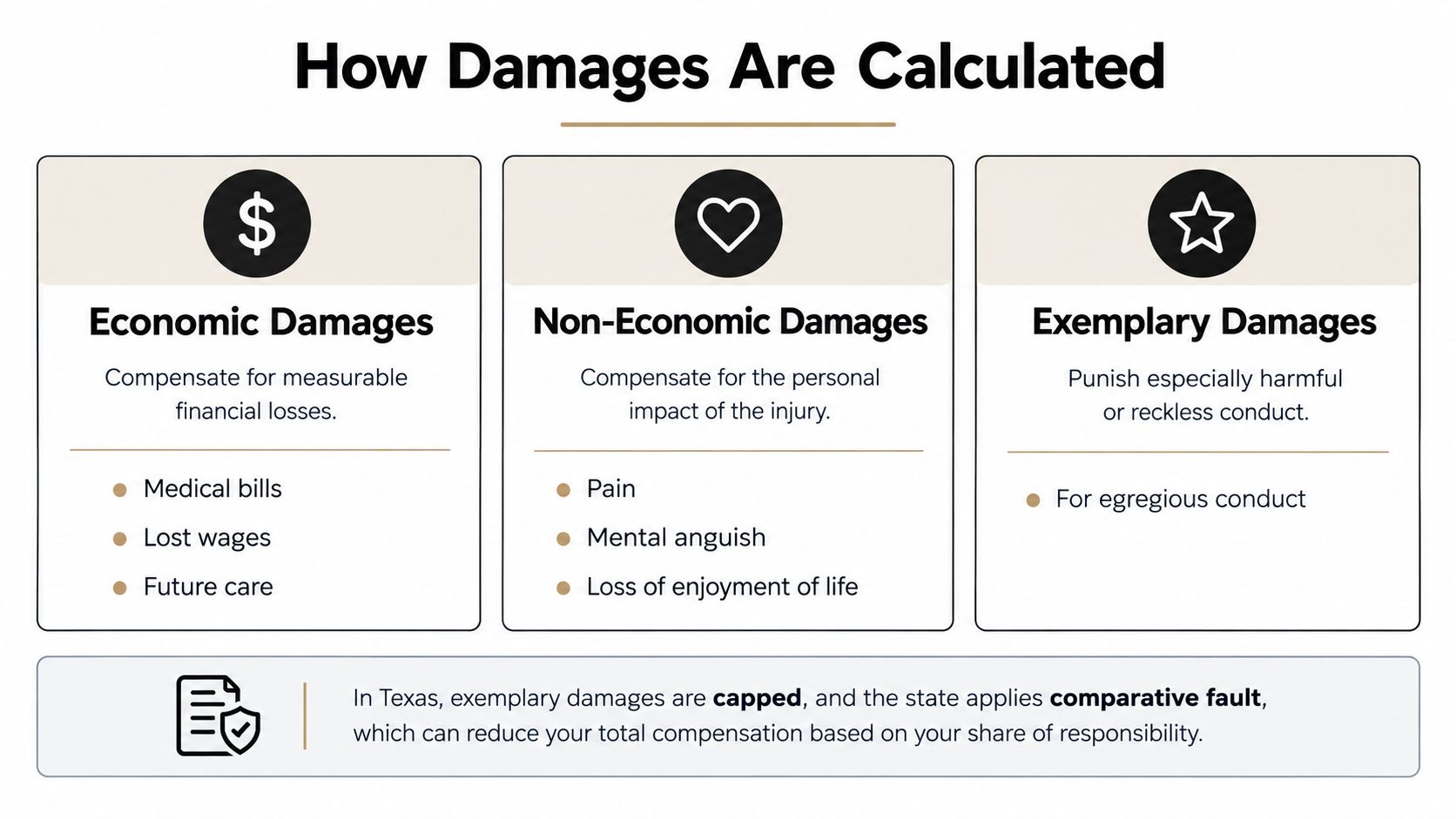
Texas law breaks damages into clear categories. Economic damages cover measurable losses like medical bills, lost income, property damage, and future care when the proof supports it. Non-economic damages cover pain, mental anguish, and the serious disruption a crash brings to daily life. Exemplary damages are different. They punish especially wrongful conduct and require clear and convincing evidence of fraud, malice, or gross negligence under Texas Chapter 41.
Building value the right way
A case is worth what the evidence supports, not what an adjuster guesses over the phone. Start with the medical records, wage proof, treatment history, and the facts that tie the crash to the injury. If the injury leaves lasting limits, the file also needs support for future medical care, rehabilitation, lost earning capacity, and other long-term losses.
Texas Chapter 41 also limits exemplary damages in many cases. Generally, they cannot exceed the greater of $200,000 or two times economic damages plus an amount equal to the non-economic damages found by the jury, up to $750,000. A drunk-driving crash can raise exemplary-damage issues, but intoxication alone does not guarantee that award.
The right way to value a claim is to build the medical-legal record first. Link the crash to the injury, the injury to the treatment, and the treatment to the losses. A torn back, a concussion, or a fracture is not just a diagnosis. It is proof of what the injury costs you in real life.
What should be in your file
- Bills and receipts for treatment and medication.
- Wage proof showing missed work and reduced earning ability.
- Treatment notes from every provider.
- Photos and journals showing pain, limits, and daily disruption.
A Texas case that holds up is built over time. It does not come from a quick negotiation call.
Dealing With Insurance Companies After a Texas Wreck
After a Texas crash, an adjuster may call before your injuries are fully understood. Treat that call as part of the claim process, not as a favor. The insurer's job is to evaluate and limit payment, so a quick statement can create problems before you know what evidence or treatment you will need.
Do not give a recorded statement or sign an early release without reviewing the request carefully. A release can end claims tied to injuries that have not yet appeared or been diagnosed. The risk is greater when the at-fault driver has no insurance or carries too little coverage, because accepting a liability settlement may affect a later uninsured or underinsured motorist claim.
The UM/UIM problem Texas victims miss
Uninsured and underinsured motorist coverage can determine whether you can recover the full value of your losses. The claim may involve several policies, including household or vehicle coverage, while bodily-injury coverage follows different rules from property-damage payment. If you were driving for Uber, Lyft, DoorDash, or Amazon, the insurance analysis can become more complicated quickly.
Texas Department of Insurance materials state that consumers may dispute claim amounts or coverage and request written reasons for a denial. The Texas UM/UIM rate filing memo supports that point. Preserve the other driver's coverage position, review every release for narrow language, and avoid closing the door on a later UM/UIM recovery.
Rising UM rates show why this coverage is getting harder for Texas insurers to write. Texas insurance filings in 2025 showed a proposed 57.1% increase in UM bodily-injury indicated rates, compared with a proposed 4.8% increase in the broader comparison cited in those filings.
Do not let a friendly adjuster push you into an incomplete settlement.
Before you sign anything, review this guide on how to deal with insurance adjusters and make sure the settlement addresses the coverage and injuries at issue.
How Contingency Fees and Free Consultations Actually Work
A contingency fee means the lawyer gets paid from the recovery, not by the hour upfront. In practical terms, that means you're usually not writing a check just to get started. The lawyer advances the case work, and fees are collected only if there's a recovery.
That doesn't mean the case is free. There are still expenses, and a clear agreement should explain how those costs are handled if the case succeeds or fails. Filing fees, expert costs, and medical-record retrieval can all matter, especially in a case that needs real proof instead of guesswork.
What to ask before you sign
- What percentage do you charge? Get the answer in writing.
- Who pays expenses? Find out how filing costs and records are handled.
- What happens if the case loses? You need to know the risk up front.
- Who will work my case? Don't accept vague staffing answers.
A free consultation should feel like a real case review. You should get a candid view of fault, a rough valuation range, likely timing, and a clear fee explanation. If someone pressures you to sign on the spot or promises a specific dollar amount, walk away.
For more detail on fee structure, this internal page on auto accident attorney fees is a useful reference. If you want a broader lens on how firms present injury services to the public, the article on marketing for personal injury attorneys can help you see what good communication should look like.
Choosing the Right Texas Car Accident Lawyer for Your Case
You want a lawyer who can move a claim, not just talk about it. Look for trial experience, local Texas presence, and specific experience with the crash type you're dealing with, whether that's a rideshare wreck, a trucking case, a wrongful death claim, or an uninsured motorist fight. Communication matters too, because if you can't get straight answers early, you probably won't get them later.
| Criterion | Why It Matters | What to Ask |
|---|---|---|
| Trial experience | Insurers value lawyers who can file suit and try a case | “Have you taken Texas car accident cases to verdict?” |
| Local offices | Texas crashes are local fights with local evidence and courts | “Where do you handle cases, and who will I speak with?” |
| Case-type experience | Different crashes need different proof | “Have you handled truck, rideshare, UM/UIM, and wrongful death claims?” |
| Fee transparency | You should know the cost before you sign | “What are the fees, and how are expenses handled?” |
The Law Office of Bryan Fagan, PLLC serves injured people across Texas, including Houston, Dallas–Fort Worth, Austin, and San Antonio, and handles rear-end, T-bone, head-on, multi-vehicle, rideshare, trucking, distracted driving, intoxicated driving, UM/UIM, and wrongful death cases. If you're comparing firms, start with the Houston Car Accident Lawyer page, then look at the I-45 and Gulf Freeway experience the firm discusses in its local materials.
If you've got a crash claim, don't wait until the insurance company has already set the tone. Call for a free consultation, get the fault and coverage issues sorted out, and make sure your claim is being built the right way.
The Law Office of Bryan Fagan, PLLC helps Texas crash victims understand liability, deal with insurance, and pursue the compensation their injuries justify. If you need a Houston car accident lawyer who will look at fault, damages, and coverage together, visit The Law Office of Bryan Fagan, PLLC to schedule a free consultation and get clear next steps for your case.