A car crash can change your life in seconds, but you don't have to face recovery alone. When that crash takes a husband, a mother, or a child, the calls start before the funeral does. An adjuster wants a statement. A tow yard wants the car released. Bills arrive while your family is still making arrangements. You deserve clear answers about your rights, not pressure. A Texas wrongful death claim lawyer can step in early, protect evidence, and help your family decide what to do next at a pace that respects your grief.
What a Wrongful Death Claim Lawyer Actually Does
Most Texas families meet this kind of attorney within days of a fatal collision. You're planning a service, answering relatives, and fielding insurance calls at the same time. Your lawyer's first job is practical. They step between you and the carriers, stop the repeated calls, and find every person or company that may share responsibility.
That list can reach beyond the driver who hit your loved one. It may include an employer, a vehicle owner, a commercial carrier, a bar that overserved a driver, or a public entity tied to a road defect. Fatal crashes are rarely simple. The scale explains why. NHTSA crash data for 2023 recorded an estimated 6,138,359 police-reported collisions, 40,901 deaths, and approximately 2,442,581 injuries nationwide.
The Three Core Jobs
First, your lawyer investigates liability. In plain English, liability means legal responsibility for causing harm. They secure the crash report, photographs, vehicle data, toxicology results, and witness accounts, then test those facts against Texas negligence law.
Second, they calculate damages. Damages means the money awarded for legally recognized losses. That work covers lost financial support, lost household services, medical and funeral expenses, and loss of companionship or guidance, subject to Texas law.
Third, they negotiate or litigate. Insurers staff these cases with experienced defense teams. Your Texas injury attorney presents evidence, answers coverage arguments, and prepares for trial if a fair settlement isn't offered.
Your lawyer should turn a chaotic loss into a structured claim, with named defendants, preserved proof, and a documented value.
This is narrower work than general personal injury practice. A Houston driver rear-ended on I-45 with survivable injuries needs medical and wage documentation for their own auto insurance claim. A fatal I-45 crash raises different questions about who can sue, whose losses count, and how fault is divided.
Texas law frames much of that analysis. Chapter 33 of the Texas Civil Practice and Remedies Code governs proportionate responsibility. Chapter 41 governs exemplary damages in cases involving heightened misconduct. You'll hear both chapters discussed as your case develops, and your lawyer should explain them in ordinary language before asking you to make decisions.
Who Can File a Wrongful Death Claim in Texas
Love alone doesn't create legal standing in Texas. That's hard to hear when a sibling, grandparent, or longtime partner is grieving. But Texas wrongful death standing rules in Chapter 71 limit statutory beneficiaries to the deceased person's spouse, children, and parents.
If no eligible person files within three months, the executor or administrator of the estate generally must pursue the claim unless all eligible beneficiaries ask otherwise. Texas also permits one or more beneficiaries to bring one action for everyone's benefit. That rule matters more than most families expect.
The hierarchy below shows who Texas law authorizes, and who acts only in a representative role.
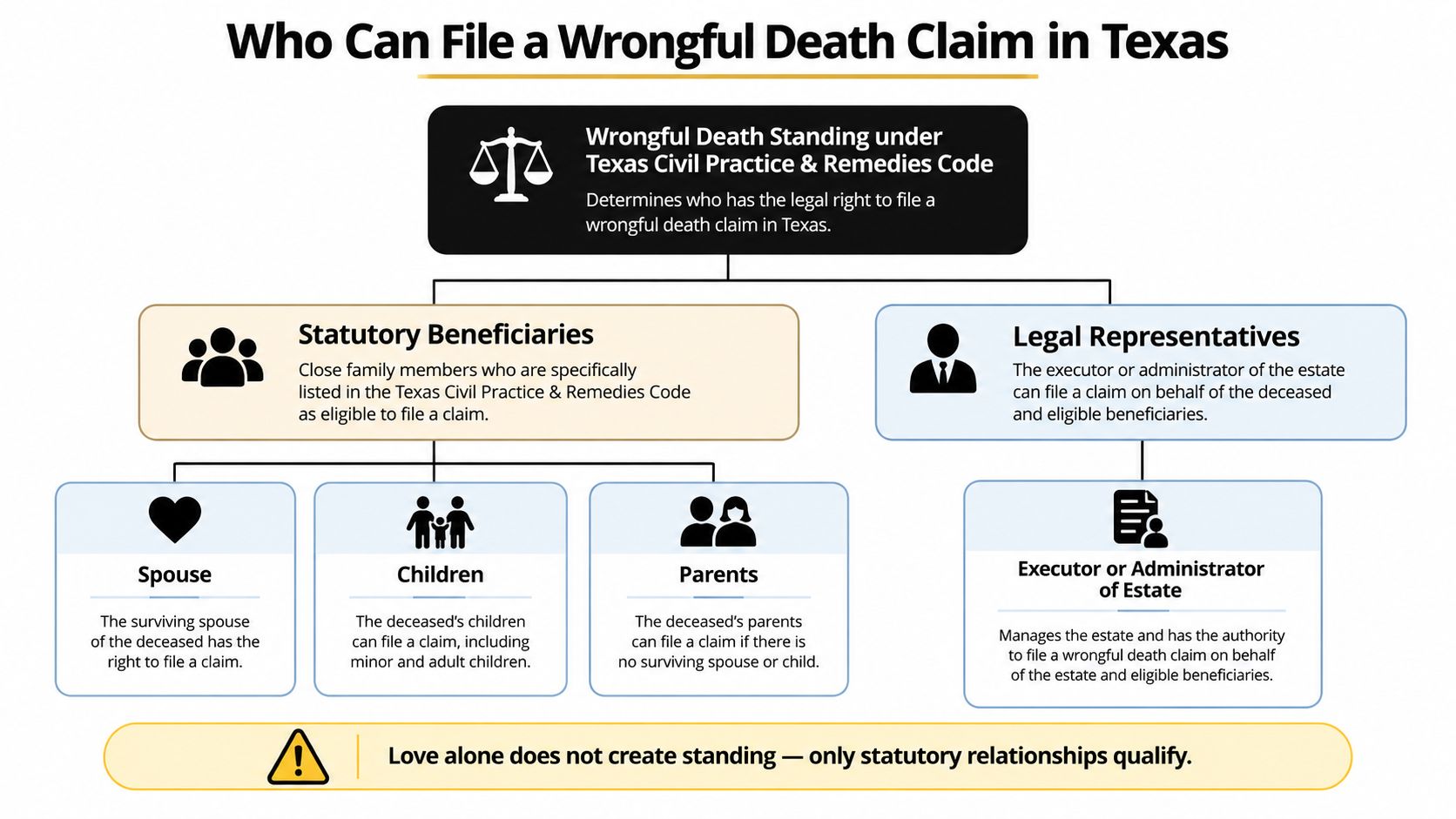
Consider a married father killed on I-45 in Houston. His wife and children are beneficiaries. His parents are also beneficiaries. If his wife hires counsel first, that case can affect the recovery rights of the children and parents too, even if they live in Dallas or out of state.
When Beneficiaries Disagree
Blended families expose the pressure points. A separated spouse may want a quick settlement. Adult children from a prior marriage may want trial. Parents may distrust both choices. Unity isn't required for a case to move forward, but unresolved conflict can damage strategy and distribution.
Ask these questions before anyone signs:
- Who is the client: Is the firm representing one beneficiary, several jointly, or the estate?
- Who approves settlement: Whose consent is required, and what happens if someone refuses?
- How are proceeds divided: Will a court or jury allocate shares, or will the family negotiate an agreement?
- When is separate advice needed: Should a beneficiary with conflicting interests hire independent counsel?
Our related guide on who can file a wrongful death lawsuit in Texas walks through eligibility in more detail. For local representation, a Houston Wrongful Death Lawyer provides representation for Houston families who lost a loved one to negligence.
Don't assume the relative who calls first controls everything. Ask your Houston car accident lawyer to map every beneficiary in writing at the first meeting. That map prevents painful surprises later.
Key Deadlines and Why the Two-Year Rule Can Mislead You
Texas generally gives families two years to bring a wrongful death action. That deadline is the statute of limitations, which in plain English means the legal time limit for filing suit. Two years sounds generous. It often isn't.
This timeline shows the headline deadline and the traps that can shorten your real window.
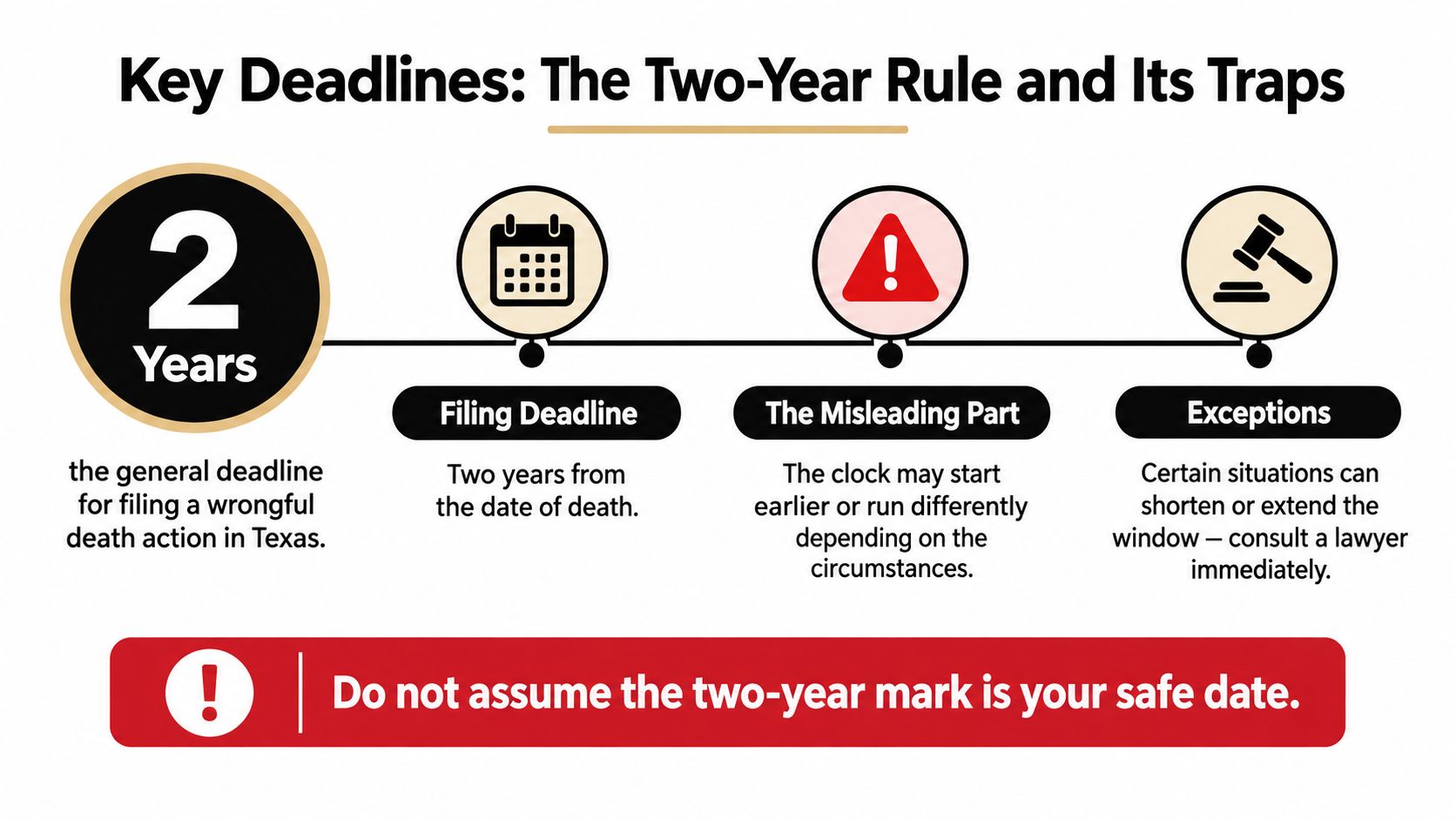
Governmental defendants change the math. The Texas Tort Claims Act can impose substantially earlier notice requirements, and municipal rules may create even shorter periods. If a county-owned truck ran a light, or a known road defect contributed to a fatal crash, your family may need to give formal notice long before the two-year suit deadline. Miss that notice, and the public-entity claim can be lost while the case against a private driver continues.
Commercial cases add similar urgency. Carrier records, driver logs, and vehicle data need prompt preservation demands. A discussion of fatal 18-wheeler crashes and stalled vehicles in Texas illustrates how quickly the factual picture after a truck collision can become disputed.
The Evidence Clock Starts Immediately
Surveillance video can be overwritten. Witness memories fade. Roadway conditions change after the next rain or repair crew. None of that waits for your filing deadline.
This short video walks through deadline issues families should discuss early with counsel.
Act on this checklist this week:
- Get the crash report: Request the Texas report and note every driver, owner, and insurer listed.
- Identify public entities: Flag any city, county, state, transit, or road-maintenance involvement.
- Preserve records: Keep photographs, medical bills, funeral receipts, and insurer letters together.
- Pause recorded statements: Don't give one before you get legal advice.
Deadline discipline matters across injury practice, whether the claim involves a fatal crash or representation by a Houston Slip and Fall / Premises Liability Lawyer for injuries caused by unsafe property conditions in Houston. Your safe date is whichever deadline expires first, not the longest one you've heard about.
Damages Texas Families Can Pursue After a Fatal Crash
Wrongful death compensation is the legal translation of your family's loss. It isn't a wish list, and it isn't based only on how much you miss your loved one. A Texas jury values specific, documented harms.
Compensatory damages may include lost financial support, lost household services, loss of companionship and guidance, mental anguish, and related medical and funeral expenses. NHTSA fatality data for 2023 shows why these cases so often involve impairment and speed, with 12,429 alcohol-impaired-driving deaths and 11,775 speeding-related deaths that year. Those fact patterns affect liability proof, but your damages still depend on your family's records.
Two Claims and Two Measures of Loss
Texas families often pursue a wrongful death claim and a survival claim together. They measure different things. The National Academies damages reference explains that wrongful death damages focus on the effects of death on persons other than the decedent, while survival damages continue the decedent's own cause of action.
| Question | Wrongful Death Claim | Survival Claim |
|---|---|---|
| Whose loss is valued? | The surviving spouse, children, and parents | The deceased person's estate |
| What does it cover? | Lost support, services, companionship, guidance, mental anguish | Pre-death medical expenses, conscious pain, lost earnings before death |
| Who benefits? | Statutory beneficiaries | The estate, for distribution under estate law |
Your lawyer should build separate schedules for each claim. One models what your loved one would have contributed to you. The other documents what they personally lost before death. Separate schedules prevent double counting and make expert testimony easier to defend. Employment, tax, benefits, education, health, and life-expectancy records drive that math.
Comparative Fault and Exemplary Damages
Comparative fault means the court or jury compares everyone's responsibility for the crash. Under Texas Chapter 33 proportionate responsibility rules, a defendant generally pays only the percentage of damages matching that defendant's percentage of responsibility. If a jury finds a truck driver 80% responsible and the decedent 20% responsible, the defendant's ordinary share follows that 80% allocation.
Exemplary damages are different. Under Texas Chapter 41 exemplary damages rules, they punish especially wrongful conduct and deter similar behavior. Ordinary carelessness doesn't automatically qualify. The evidence must support conduct such as fraud, malice, or gross negligence as Texas defines it, and statutory limits apply.
For context on how these categories are valued, see our overview of wrongful death settlement amounts. No honest lawyer should quote you a number before the records are in.
The Step-by-Step Wrongful Death Claims Process in Texas
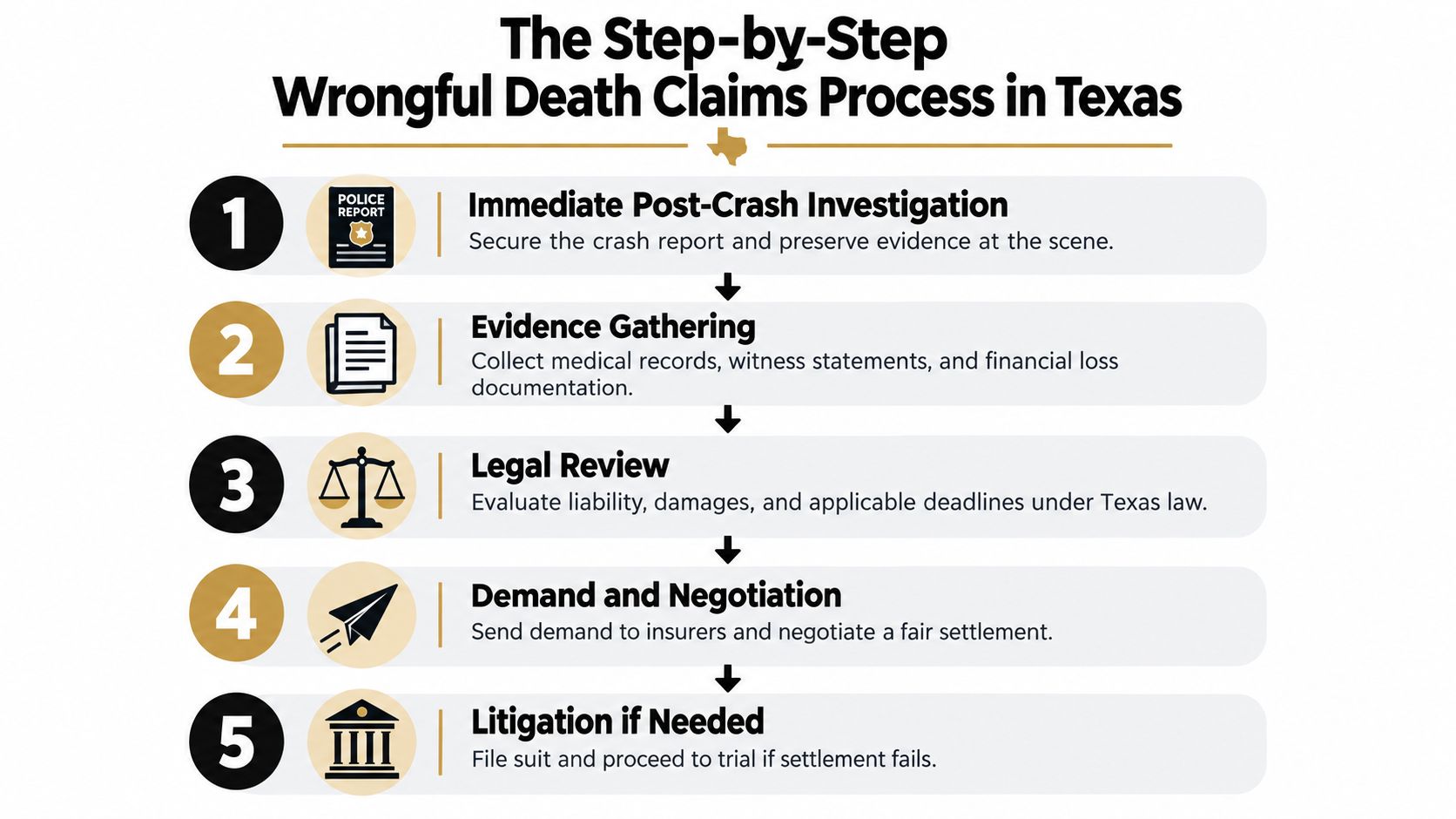
Take a representative Harris County case. A father is killed when a commercial van crosses the center line at night. His wife calls counsel three days later. What follows shows the work your family won't see.
The flow below tracks the sequence from investigation through litigation.
Investigation and Claim Building
- Preserve and investigate: Counsel secures the crash report, sends preservation letters to every defendant and insurer, and hires a reconstruction expert before vehicles are repaired or scrapped.
- Identify all defendants: The van driver is obvious. His employer, the vehicle owner, and a maintenance contractor may also bear responsibility. Coverage analysis tells you which policies apply.
- Build the damages file: Your lawyer gathers employment, tax, benefits, medical, and funeral records. An economist models lost support and household services over your loved one's expected working life.
Demand, Negotiation, and Suit
Next comes a structured demand package to the at-fault insurer. It presents liability evidence, the separate wrongful death and survival schedules, and a settlement figure tied to documentation. Insurers rarely pay full value on the first exchange. Expect counteroffers and arguments about comparative fault.
Your decision points: You choose whether to accept an offer, attend mediation, or authorize suit. Your lawyer handles filings, deadlines, and expert work.
If negotiation stalls, counsel files suit in the appropriate Texas county. Discovery follows. Both sides exchange documents, take depositions, and disclose experts. The van driver's phone records, hours, and driving history become fair game.
Many cases settle at mediation after discovery sharpens the evidence. Others go to trial, where a jury allocates fault and values damages. A structured settlement can spread payments over time for minor children.
Set realistic expectations. These cases usually resolve over months, not weeks. A fast offer in the first month usually means the insurer wants your signature before you know what your claim is worth. Patience, backed by steady case building, protects your family better than speed.
Evidence to Gather After a Fatal Texas Crash
You don't need to build the whole case yourself. But the items your family saves in the first weeks often decide what your lawyer can prove later. Start with what you can reach from your kitchen table.
What Your Family Can Collect
- Texas CR-3 crash report: It identifies drivers, owners, insurers, and the investigating officer's initial findings.
- Photographs and video: Save phone photos, dashcam files, and home security footage before anything is deleted.
- Employment and tax records: Pay stubs, benefits statements, and recent returns support the lost-support calculation.
- Medical and funeral records: Hospital bills and burial documentation support both the survival claim and expense recovery.
- A written timeline: Note who called you, what insurers said, and how the loss has changed daily life at home.
If your loved one carried separate accidental death coverage, policy terms can affect what other benefits your family should claim, and this resource on accidental death insurance explained helps you understand how that coverage works alongside a legal claim.
What Your Lawyer Handles
The technical layer requires legal tools. Vehicle event data recorders can capture seconds of pre-crash dynamics, driver inputs, restraint use, and air-bag deployment. NHTSA event data recorder guidance notes that recorders may capture only a brief period before, during, and after a collision, so the download must be preserved before it's overwritten and matched against physical evidence.
Your lawyer also pursues cellphone records, toxicology results, commercial-driver hours-of-service logs, and reconstruction analysis. Each item can move comparative fault percentages, which directly changes recovery.
Don't give a recorded statement to the other driver's insurer, sign a broad medical authorization, or accept an early offer before counsel reviews the full picture.
Those three mistakes destroy value. A recorded guess about speed becomes an exhibit. A broad authorization hands the insurer years of unrelated records. An early release ends claims against defendants you haven't identified yet. Route every request through your lawyer.
Choosing the Right Texas Wrongful Death Claim Lawyer
Interview counsel the way you'd interview anyone trusted with your family's future. Bring four questions. Write down the answers.
First, ask about comparable cases. Has the firm handled Texas wrongful death claims involving commercial vehicles, government defendants, or multi-party liability? Ask them to describe how those cases were investigated and resolved. Vague answers are a warning sign.
Second, ask who handles your case daily. You should know the name of the attorney returning your calls, how often you'll get updates, and who explains settlement offers. Grieving families shouldn't chase their own lawyer for basic information.
Conflicts, Fees, and Liens
Third, ask how beneficiary disagreement is handled. If your spouse's parents want trial and you want settlement, what's the plan? Ask whether joint representation is appropriate, when separate counsel is recommended, and how settlement authority works. A firm that raises this before you do understands Texas practice.
Fourth, ask about money in plain terms. Most wrongful death cases use a contingency fee, which means you don't pay an attorney fee unless there's a recovery. Confirm who pays case costs if the case is lost, how costs are approved, and how health-insurance liens or subrogation claims are resolved from any settlement.
- Fee clarity: Get the contingency terms and cost policy in writing.
- Communication: Ask for a realistic update schedule.
- Local knowledge: Confirm experience in the county where suit would be filed.
The Law Office of Bryan Fagan, PLLC is one Texas option to evaluate with these questions. The firm represents families in wrongful death and serious crash cases across the Houston area and offers a free consultation with contingency-fee representation. Compare any firm you meet against the same four questions, and choose the team that answers directly, in language you understand, without promising a result no one can guarantee.
Common Questions Texas Families Ask After a Fatal Crash
What's the difference between a wrongful death claim and a survival claim? Your wrongful death claim values what you lost when your loved one died. The survival claim preserves what your loved one could have claimed if they had lived, paid through the estate. Pursuing both lets you present the complete loss without mixing separate harms into one number.
How should we deal with the other driver's insurer? Politely, briefly, and through counsel. Confirm basic contact details if needed, but don't discuss fault, speed, medical history, or settlement. Don't sign releases or authorizations in the first weeks. Every early conversation is documented by the carrier, and small errors become comparative fault arguments later.
What if beneficiaries live in different states and disagree? Distance doesn't remove anyone's rights. Eligible spouses, children, and parents keep their beneficiary status wherever they live. Your lawyer should hold a joint call early, explain settlement authority, and document how proceeds will be allocated. If interests conflict, separate counsel protects each person's position.
Disagreement doesn't stall a Texas claim, but silence about it will surface at the worst possible moment, usually mediation.
What changes when a government entity is involved? Notice comes first, suit second. A city, county, transit authority, or state agency may require formal notice far earlier than the two-year deadline, and damages against governmental units can be limited. Tell your lawyer immediately if a public vehicle, public employee, or road condition played any role.
You don't need every answer today. You need preserved evidence, protected deadlines, and counsel who explains each choice before you make it.
If your family lost a loved one in a fatal Texas crash, The Law Office of Bryan Fagan, PLLC can review who may file, which deadlines apply, and what evidence needs protection right now. Contact the firm for a free, no-obligation consultation, and get direct answers about your wrongful death claim before an insurer asks you to decide alone.