 Skip to content
A car crash in a Houston Galleria-area parking garage may involve more than the driver who struck you. The driver is usually liable, but the garage owner, operator, or maintenance contractor can also share responsibility when a dangerous property condition contributed to the collision, and Texas generally gives you two years to file a personal-injury lawsuit.
You may be dealing with pain, vehicle damage, medical bills, and an insurance company asking for answers before you understand what happened. A garage crash can feel especially confusing because the collision may have resulted from both driver conduct and conditions inside the structure. Poor lighting, blocked sightlines, a malfunctioning gate, confusing lane markings, or a dangerous ramp can change the legal analysis.
This guide explains galleria area parking garage crash liability in Houston in plain language. It also shows what evidence matters, how Texas comparative fault works, and why you shouldn't assume that the other driver is the only person or company worth investigating.
Who Can Be Liable After a Galleria Parking Garage Crash
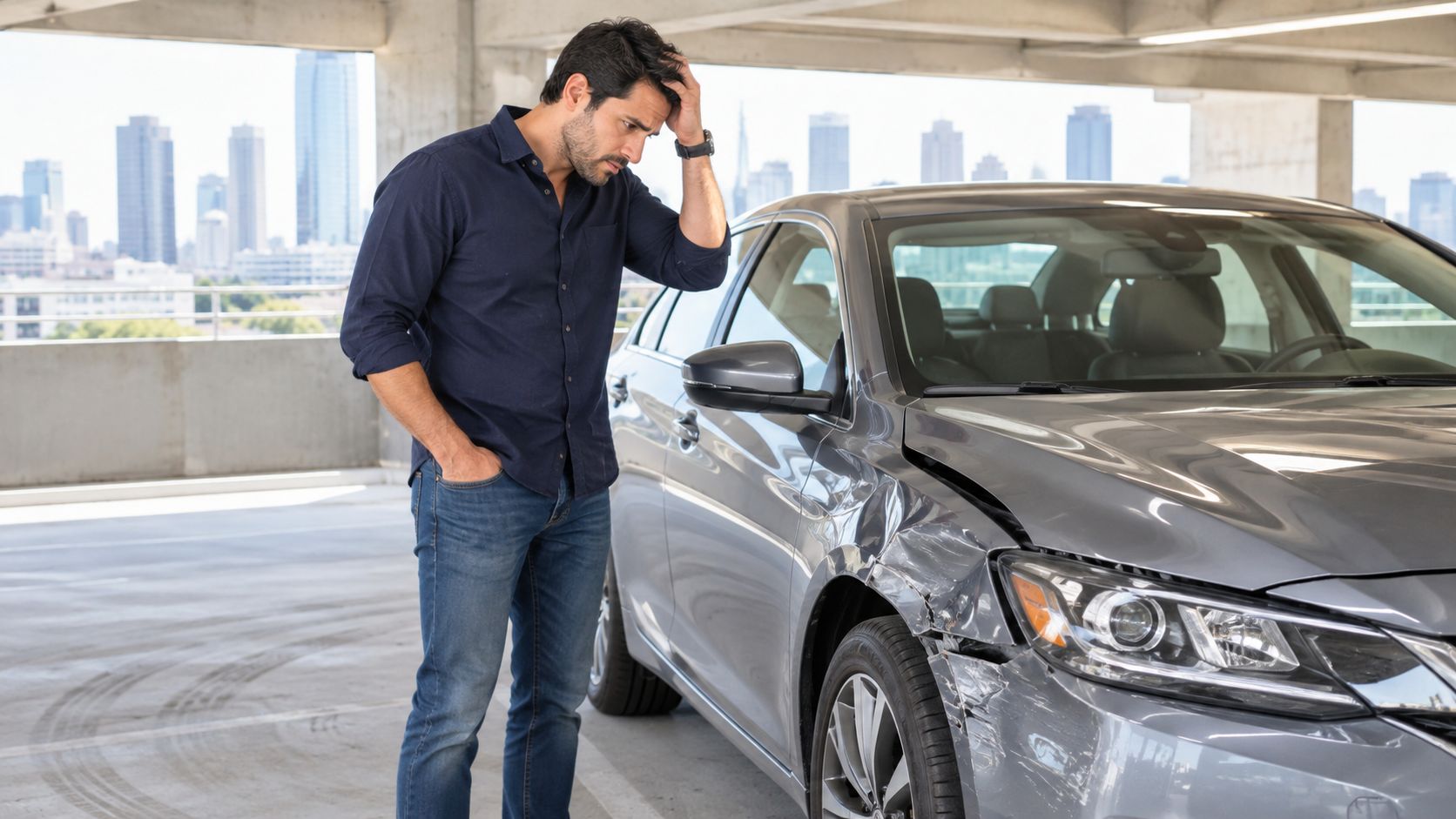
A driver backs out of a parking space near the Galleria. The lane is dim, a concrete column blocks the view, and the painted arrows are difficult to see. As the driver reverses, the vehicle strikes your car. The driver may have failed to look carefully, but the condition of the garage may also have made the collision more likely.
That doesn't mean the garage owner is automatically liable. Texas appellate authority explains that a premises owner generally doesn't owe a duty to protect people who leave the property and are injured on an adjacent public roadway. The same authority recognizes that an exception may apply when the property owner created a hazardous condition that caused or contributed to the injury. Texas appellate authority on premises duties and roadway injuries
The parties worth investigating
The striking driver is often the first person examined. Driver negligence can include speeding in a confined lane, distraction, intoxication, failure to yield, unsafe backing, or driving too fast for the available sight distance.
Other potentially responsible parties may include:
- Garage owner: The owner may face a claim if a dangerous condition under its control contributed to the crash.
- Management company: A property manager may have handled inspections, repairs, warnings, traffic flow, or vendor supervision.
- Parking operator: A parking-management company may control lanes, gates, payment systems, attendants, or access records.
- Maintenance contractor: A contractor may be relevant if it failed to repair lighting, barriers, gates, signs, or other equipment.
- Security company: Security personnel or security policies may matter when traffic control, access control, lighting, or a related safety risk is part of the claim.
- Gate or equipment vendor: A malfunctioning gate or control system may require investigation into installation, inspection, or repair responsibilities.
This is a multi-party causation problem. Liability means legal responsibility for causing harm. The fact that your crash happened inside a private garage doesn't establish liability by itself. You must connect a particular person's conduct or a condition controlled by a particular entity to the collision and your injuries.
Practical rule: Identify who controlled the exact lane, barrier, gate, light, sign, or maintenance task involved in the crash. Ownership and control aren't always held by the same company.
A written preservation request can be important because property operators and vendors may have policies governing surveillance footage, incident reports, and maintenance records. For broader risk-control considerations, readers may also find this resource on mastering liability management at properties useful.
If you were hurt in a structure or lot connected to a shopping center, a focused investigation can be different from a standard roadway case. You can review related guidance about a Houston parking lot accident lawyer while gathering your records and considering legal advice.
Texas Premises Liability and Negligent Activity in Parking Structures
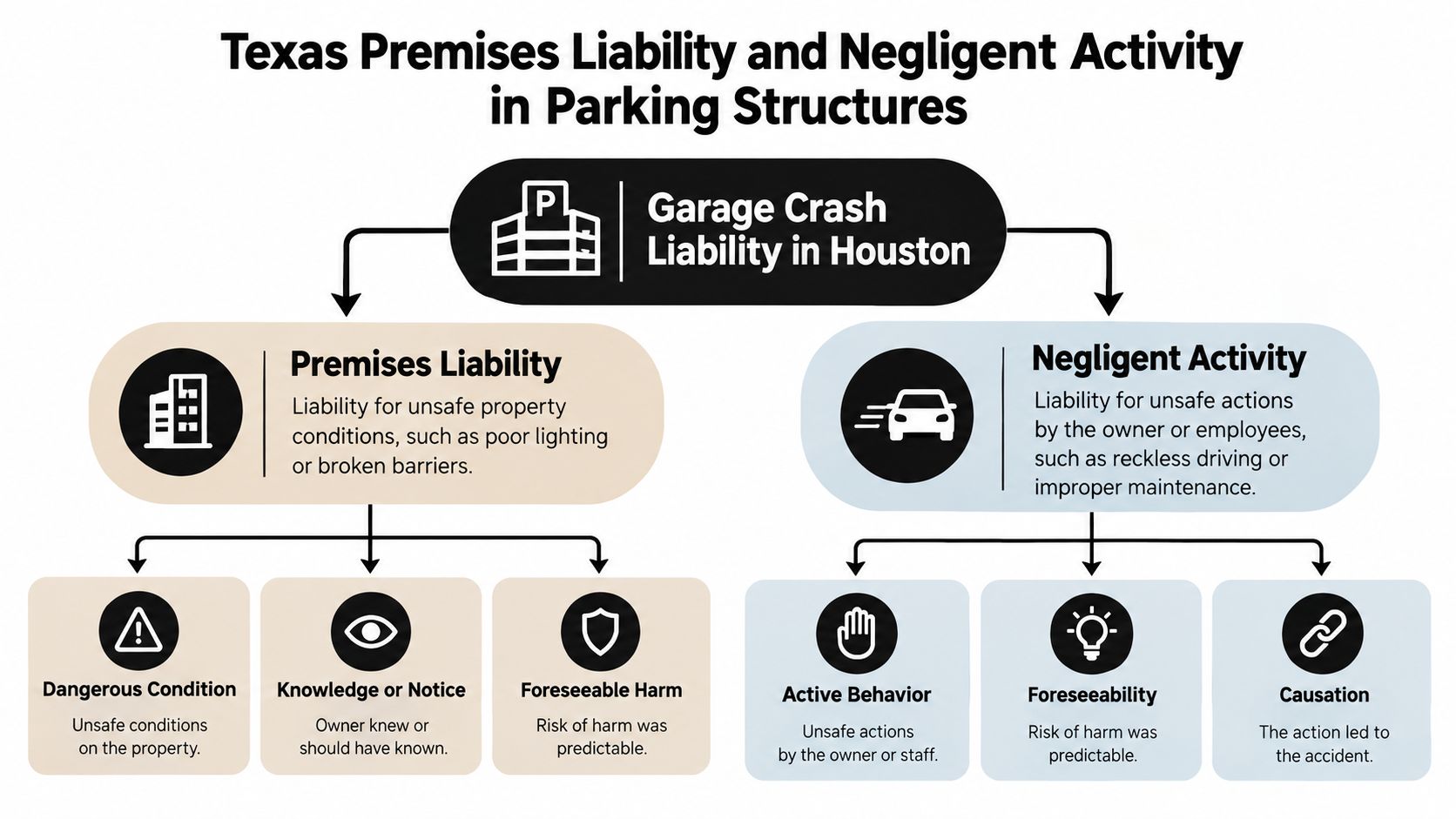
Texas law separates two related but different theories: premises liability and negligent activity. Understanding the difference helps determine what evidence your claim needs.
Premises liability concerns a dangerous condition on property. In a parking structure, the condition might be inadequate lighting, an obstructed sightline, a defective gate, poor traffic markings, a dangerous ramp, a wet surface, a missing warning, or a failed barrier. A claimant generally needs to show that the condition created an unreasonable risk, the owner or operator knew or reasonably should have known about it, the responsible party failed to use reasonable care to correct or warn, and that failure proximately caused the collision or injury.
Negligent activity involves affirmative conduct happening at the time of the incident. For example, an attendant might direct vehicles into the same conflict point, or an employee might operate a gate or traffic-control device negligently. A claim based only on a preexisting condition generally belongs under premises liability rather than negligent activity. The Texas Supreme Court recognizes these as distinct theories with different proof requirements. Texas Supreme Court discussion of premises liability and negligent activity
Why the distinction changes the investigation
Suppose a driver turns into an oncoming vehicle because a one-way arrow is missing and the lighting is poor. The property-related theory may focus on the physical condition of the garage, prior notice, inspection practices, and whether a warning or repair would have reduced the risk.
Now suppose an attendant waves two vehicles forward into the same narrow lane. The investigation may focus on what the attendant did, what training or instructions applied, and whether that conduct directly caused the impact.
In either situation, location alone isn't enough. Evidence must show how the garage condition or active conduct affected the collision. Investigators may need:
- Surveillance footage from the relevant level, lane, entrance, or exit
- Access-control and gate records
- Maintenance and inspection logs
- Lighting or gate-repair records
- Incident reports and prior complaints
- Photographs of signs, barriers, lane markings, ramps, and sightlines
- The garage's traffic-control plan
- Lease and operating agreements identifying responsibility
A customer entering a shopping center for the mutual benefit of the customer and the property is generally treated as an invitee, which can create a higher duty regarding dangerous conditions the owner knew or reasonably should have known about. But every claim still depends on duty, breach, notice, causation, and damages.
The embedded video below may help you understand the difference between a dangerous condition and active negligent conduct.
A code violation or feature that looks unsafe may support an investigation, but it doesn't automatically prove that the feature caused your crash. The central question remains practical: What happened, who controlled the risk, and how did that risk contribute to your injury?
Evidence You Must Preserve After a Houston Garage Crash
Evidence in a mixed-liability garage crash can disappear before you decide whether to hire a lawyer. A police report may describe the immediate driver conduct, but it often won't document the garage's maintenance history, prior complaints, lighting failures, or traffic-control practices.
Start with the scene if you can do so safely. Take photographs from several angles, including the damage to every vehicle, debris, skid marks, lane markings, signs, barriers, columns, gates, ramps, and the positions of the vehicles. Record the exact garage name, level, lane, entrance or exit, and nearby businesses or landmarks.
A preservation checklist
Request surveillance footage quickly. Ask the owner or operator in writing to preserve video from the relevant cameras. Include the approximate time, garage level, lane, entrance, and vehicle descriptions. Footage may be overwritten under routine retention practices.
Obtain the garage incident report. Ask for the report number and identify the employees, attendants, security personnel, or managers who responded. The report may help identify witnesses and the companies involved.
Preserve maintenance and inspection records. Lighting inspections, gate repairs, barrier work, cleaning records, and complaints may show whether the operator knew or should have known about a dangerous condition.
Collect witness information. Get names, phone numbers, and email addresses from drivers, pedestrians, passengers, employees, and security personnel. A witness may remember whether a gate failed, a light was out, or traffic was directed incorrectly.
Keep payment and trip records. Parking receipts, payment records, shopping receipts, rideshare information, and phone location records can help establish when you entered and where you were.
Document your injuries and losses. Keep medical records, bills, prescriptions, therapy records, vehicle repair estimates, and records showing missed work. Tell medical providers about symptoms that began or worsened after the crash.
Preserve first, argue later. A written request for records can be valuable even when you aren't yet sure whether the garage played a role.
Don't repair or sell a damaged vehicle before photographs, estimates, and relevant vehicle data have been preserved. If the vehicle must be repaired, keep invoices, replaced parts when possible, and photographs taken before the work began.
You can also review this guide about how to obtain police records. A police report is useful, but it shouldn't be treated as the complete investigation into a garage's condition or operating history.
How Texas Comparative Fault Rules Affect Your Recovery
Comparative fault, also called proportionate responsibility, means that more than one person or entity can receive a share of legal responsibility for an injury. Texas Chapter 33 requires the fact-finder to assign whole-number responsibility percentages to the claimant, defendants, settling persons, and properly designated responsible third parties. Texas Civil Practice and Remedies Code Chapter 33
In a Galleria-area crash, the allocation might require examining the striking driver, the injured driver, another motorist, a garage operator, or a contractor. The garage doesn't have to be completely responsible for its conduct to matter. A dangerous design or failed maintenance may have contributed even when the other driver made the immediate mistake.
What the 51% bar means
Your recovery is reduced by your assigned percentage of responsibility. If a jury awards $100,000 in damages and assigns you 20% responsibility, the award would generally be reduced to $80,000. If your responsibility is greater than 50%, Texas's 51% bar prevents recovery.
That rule makes evidence about your own conduct important. A defense may argue that you were speeding, failed to use headlights, ignored a warning, or entered a restricted lane. Those allegations don't automatically defeat your claim, but they can affect the amount you recover if supported by evidence.
The question isn't always who made the last mistake. It may be which conditions and decisions combined to make the collision happen.
How investigators separate fault
A Houston car accident lawyer may need to obtain lease and operating agreements, identify who controlled a lane or piece of equipment, compare the layout with applicable safety standards, and reconstruct the collision. Useful questions include:
- How fast was each vehicle traveling?
- Could the drivers see one another in time to stop?
- How far was the available stopping distance?
- What were the impact angles?
- Did a gate or warning device activate at the right time?
- Were signs visible from the driver's approach?
- Did a column, vehicle, or fixture obstruct the sightline?
A hazard that looks obvious doesn't automatically eliminate recovery, particularly when a visitor had to confront it and the owner should have anticipated that avoiding it was impractical. The opposite is also true. A code violation or hazardous-looking feature doesn't establish causation without proof that it contributed to the crash.
For factual context, Houston Car Accident Lawyer describes representation for car accident victims in Houston and Harris County. Your own facts determine whether a driver claim, premises claim, or both should be pursued.
Filing an Insurance Claim After a Mixed-Liability Garage Crash
An auto insurance claim usually starts with the driver's policy, while a premises claim may be directed to the garage owner, operator, management company, or another business responsible for the condition. These paths can overlap, but they require different proof.
Notify your own insurer according to the policy terms, especially if you may need collision coverage or uninsured/underinsured motorist coverage. Give accurate facts, avoid guessing about fault, and don't minimize your injuries. You don't have to decide the complete legal theory during the first call.
Common claim paths
| Possible path | What it generally addresses | Evidence that may matter |
|---|---|---|
| Claim against the striking driver's policy | Driver conduct such as unsafe backing, speeding, distraction, or failure to yield | Photos, vehicle damage, witnesses, video, and the police report |
| Premises claim against the garage operator | A condition or operation that contributed to the collision | Lighting records, gate logs, maintenance files, complaints, layout evidence, and surveillance |
| Uninsured or underinsured motorist coverage | Available protection when the responsible driver's coverage is absent or insufficient, if applicable | Your policy, notice records, medical documentation, and evidence of fault |
A claims representative may ask for a recorded statement, medical authorization, or broad access to your records. Read documents carefully and consider speaking with a Texas injury attorney before signing anything that could limit your rights. Be truthful, but don't speculate about facts you haven't confirmed.
Send the garage a written preservation request identifying the relevant cameras, level, lane, date, and approximate time. Keep a copy and proof of delivery. Also preserve your communications with the driver, garage, insurer, repair shop, and medical providers.
Filing an insurance claim isn't the same as filing a lawsuit. Texas generally requires a personal-injury lawsuit within two years after the cause of action accrues, although specialized rules can apply to particular claims and defendants. Claims involving a defective or unsafe condition connected to construction or repair may raise a 10-year repose period measured from substantial completion, while Texas's residual limitations provision sets a four-year period for actions without another express deadline. These dates aren't interchangeable. Texas limitations and repose provisions
The deadline may differ depending on the legal theory, defendant, injury, and facts. Public ownership can also create early notice concerns, so don't wait for medical treatment or settlement talks to end before obtaining legal advice.
Typical Damages and When to Contact a Houston Accident Lawyer
Damages are the losses the law may compensate after a legally caused injury. Texas Chapter 41 separates economic damages, noneconomic damages, and exemplary damages.
Economic damages are measurable financial losses. They may include medical expenses, rehabilitation costs, property damage, and lost income. Noneconomic damages address losses that are harder to price, such as physical pain, mental anguish, and impairment.
Exemplary damages have a higher standard
Exemplary damages, also called punitive damages, are intended to punish especially wrongful conduct rather than only compensate you. A routine mistake in a parking garage doesn't automatically support them. A claimant generally must satisfy Chapter 41's heightened requirements and prove qualifying misconduct by clear and convincing evidence.
Texas's statutory formula limits exemplary damages to the greater of two times the economic damages plus noneconomic damages up to $750,000, or $200,000. For example, if a jury awards $80,000 in economic damages and $120,000 in noneconomic damages, the first formula would permit up to $280,000, subject to the statute and the facts. Texas Civil Practice and Remedies Code Chapter 41
The value and strength of a claim depend on evidence. Medical records should connect your symptoms to the crash. Bills and wage records should show financial losses. Photographs, vehicle data, witness accounts, and garage documents may establish how the collision occurred and which parties contributed.
Contact a lawyer promptly when the crash involves serious injury, disputed fault, a commercial garage, a public entity, a fatality, multiple insurers, or evidence that may be overwritten. Families may also need advice about wrongful death compensation after a fatal crash, because wrongful-death claims involve additional procedural and damages issues.
You don't need to know the legal answer before asking for help. A careful review can identify the available insurance, preserve garage evidence, evaluate driver and premises theories, and explain how comparative fault may affect recovery. If a truck, rideshare vehicle, pedestrian, or delivery driver was involved, the investigation may also require examining employment, vehicle, and commercial-insurance records.
The Law Office of Bryan Fagan, PLLC offers free consultations for people injured in Houston-area crashes and can help investigate both driver negligence and garage-related conditions. Contact The Law Office of Bryan Fagan, PLLC to discuss preserving evidence, pursuing the appropriate insurance claims, and protecting your rights after a Galleria parking-garage collision.


