A car crash can change your life in seconds, but you don't have to face recovery alone. If you were rear-ended on I-45, taken by ambulance to a Houston emergency room, and later received a bill showing a large facility fee, it's understandable to feel confused and worried.
One ER visit can create several charges. The hospital may bill for use of the emergency department, while an emergency physician, radiologist, or other specialist may send a separate bill. This guide explains Houston ER facility fee balance billing after a crash, how Texas and federal protections may limit what you owe, and how the bill connects to your auto insurance claim and possible personal injury case.
What Happens When You Go to the ER After a Houston Crash
You're driving home on I-45 when another vehicle hits you from behind. Your neck hurts, your head feels foggy, and someone calls 911. Paramedics take you to a nearby emergency room because some crash injuries aren't obvious at the scene.

At the hospital, you may receive imaging, an examination, medication, and monitoring. The medical care may be necessary, but the bills can arrive weeks later and look nothing like the amount you expected. One statement might list a hospital facility fee, while another comes from the emergency physician group. A third may come from a specialist who reviewed your scans.
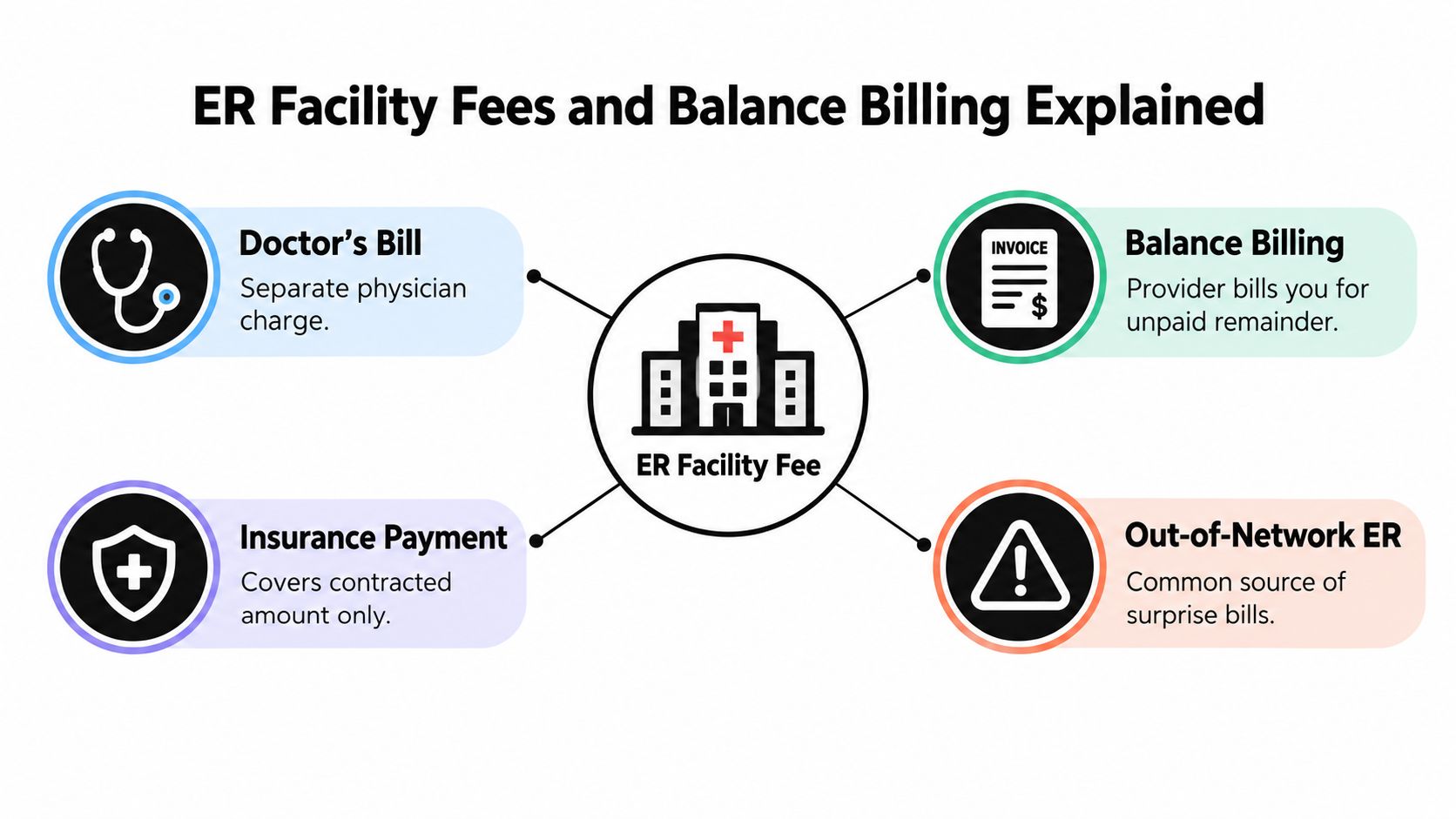
A facility fee generally relates to the hospital's emergency department. It isn't necessarily the doctor's fee, and it doesn't automatically mean you've been balance billed. Balance billing happens when a provider seeks the unpaid difference between its charge and the amount the health plan paid, usually because the provider was out of network.
Practical rule: Don't assume a large ER bill is correct simply because it came from a hospital. Compare it with your Explanation of Benefits and ask how the emergency claim was processed.
Your health insurance plan, the hospital's network status, the emergency nature of the visit, and federal or state protections can all affect what you owe. Your auto policy may also contain coverage that helps with medical expenses, depending on its terms.
A crash-related ER bill can also become part of your injury claim. Keep the bill, medical records, discharge papers, and insurance correspondence. If you need help understanding an ambulance charge as well, review this information about an EMS bill after a Houston crash.
ER Facility Fees and Balance Billing Explained Simply
An ER facility fee is a charge for using the hospital's emergency department. It may cover services and resources connected with the facility, such as emergency staff support, rooms, equipment, and hospital operations. The fee is separate from the emergency physician's professional charge.
That separation causes confusion. You may believe you visited one provider, but the hospital and physician group can be separate businesses. A hospital can be in your health plan's network while the emergency physician is not. You could then receive a hospital statement, a physician statement, and separate claims information from your insurer.
Balance billing is different from ordinary cost-sharing. A deductible, copay, or coinsurance amount may be your responsibility under the plan. A balance bill is the provider's attempt to collect the difference between the provider's full charge and the amount the insurer paid.
Why emergency bills became confusing
Historical Texas data show why crash victims often received unexpected charges. A Texas policy analysis found that 27 percent of emergency room visits in Texas were likely to result in a surprise bill. The same analysis cited a national study in which 22 percent of emergency department visits involved care by an out-of-network physician. Earlier Texas legislative materials also reported that, among the state's three largest health insurers, 41 percent to 68 percent of dollars billed at in-network facilities were billed as out-of-network emergency room physician services, while 21 percent to 59 percent of in-network hospitals had no in-network ER physicians. These figures appear in the Texas surprise medical billing policy analysis.
For a Houston crash victim, the practical lesson is simple. Going to an in-network hospital didn't always mean every person involved in emergency treatment was in network. The hospital could charge a facility fee, and the ER physician or another specialist could bill separately.
A bill isn't automatically unlawful because it's high or because one provider was out of network. The important questions are whether the visit involved emergency services, which law governs your health plan, how the claim was coded, and whether the provider is trying to collect an amount that the law protects you from paying.
Texas Rules and Federal Protections After an Emergency Visit
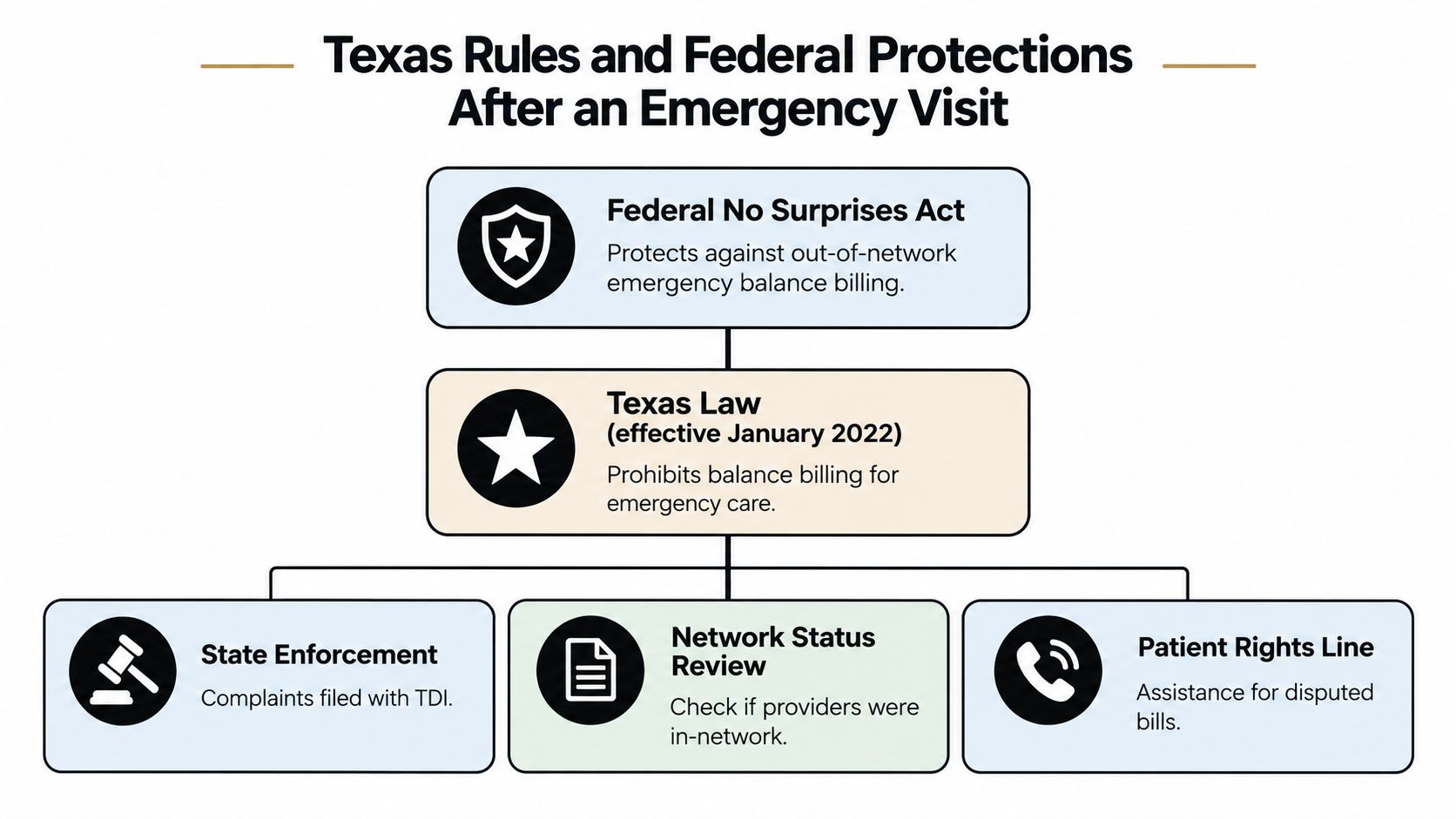
After a Houston crash, an ER facility may send a large charge even when the hospital is out of network. Texas law may prevent that charge from becoming your responsibility. For emergency care received on or after January 1, 2020, and emergency ground ambulance services received on or after January 1, 2024, Texas prohibits balance billing for covered claims. An out-of-network provider or facility must use a state or federal dispute process instead of billing you for the difference. The Texas Department of Insurance explanation of provider requirements outlines these protections and dispute duties.
The federal No Surprises Act may provide similar protection. If an out-of-network facility treats an emergency medical condition, your responsibility generally stays at the in-network deductible, copay, or coinsurance required by your plan. The final result depends on the plan, the claim, and what happened during the visit.
The plan type matters
Texas protections do not cover every health plan in the same way. Some Texans have state-regulated insurance, while others have federal coverage or self-funded employer plans governed mainly by federal rules. Check your plan documents and ask the insurer which law applies before assuming a provider may collect the full balance.
The protections usually depend on the visit being treated and processed as emergency care. They may also cover post-stabilization services unless you give written consent to waive those rights. A provider generally should not ask you to waive protection before you understand the treatment and its financial effect.
The provider obligations for emergency care help explain why an improper balance bill should usually be addressed through the provider and health plan, rather than collected directly from you.
A facility can initially submit a substantial charge. For a state-regulated plan, the patient generally remains responsible only for applicable in-network cost sharing, while the insurer and provider negotiate the remaining amount or use an independent dispute resolution process. Keep the bill, explanation of benefits, and crash records together. Those documents can affect both the billing dispute and the legal claim seeking compensation from the responsible driver. Houston Car Accident Lawyer information may also help you identify questions about accident-related medical bills.
How Your Health Insurance and Auto Coverage Handle ER Bills
Health insurance and auto coverage serve different purposes after a Houston crash. Your health plan usually processes the ER claim according to its network rules, emergency-care rules, deductible, and cost-sharing terms. Auto coverage may provide another source of payment under policy provisions such as medical payments coverage or personal injury protection, if your policy includes them.
Neither path guarantees that every charge disappears. The result can depend on the policy language, whether the claim was submitted as emergency care, the plan type, and whether another driver is legally responsible. Accurate coding matters because an incorrectly processed emergency claim can make a protected visit look like an ordinary out-of-network service.
| Coverage Type | Primary Role After Crash | Common Limitation or Condition |
|---|---|---|
| Health insurance | Processes the facility and medical claims under the health plan | Deductibles, copays, coinsurance, network rules, and plan type affect the patient's share |
| Medical payments coverage | May help pay covered medical expenses under the auto policy | Applies only if included and subject to policy terms and limits |
| Personal injury protection | May provide benefits for covered accident-related losses under the policy | Availability and payment rules depend on the policy and applicable requirements |
| At-fault driver's liability insurance | May provide compensation through an injury claim when another driver caused the crash | The insurer may dispute liability, damages, causation, or the value of the claim |
Liability and billing are connected
Liability means legal responsibility for causing the crash. Comparative fault means each person's share of responsibility is measured. Under Texas Civil Practice and Remedies Code Chapter 33, your compensation can be reduced by your percentage of fault, and recovery is barred if you're more than 50 percent responsible. The Texas Department of Insurance discusses these Texas consumer protections, including the effect of fault on an injury claim, in its guidance on protecting consumers from surprise medical bills.
Damages are the losses you may seek in a personal injury claim. They can include reasonable medical expenses, lost wages, and pain and suffering when supported by the facts and evidence. Chapter 41 addresses exemplary damages in appropriate cases, but those damages require a separate legal basis and aren't automatic because an accident caused serious injuries.
A statute of limitations is the deadline for filing a lawsuit. Texas generally gives an injured person two years from the crash date to file a personal injury lawsuit. An insurance claim and a lawsuit are different processes, so don't assume that negotiating with an insurer pauses the legal deadline.
For more detail on how health insurance may interact with an auto claim, see how health insurance covers auto accidents. Keep your health insurer and auto carrier informed, but avoid giving a recorded statement or signing a broad release before you understand what it covers.
Steps to Dispute or Resolve a Facility Fee Balance Bill
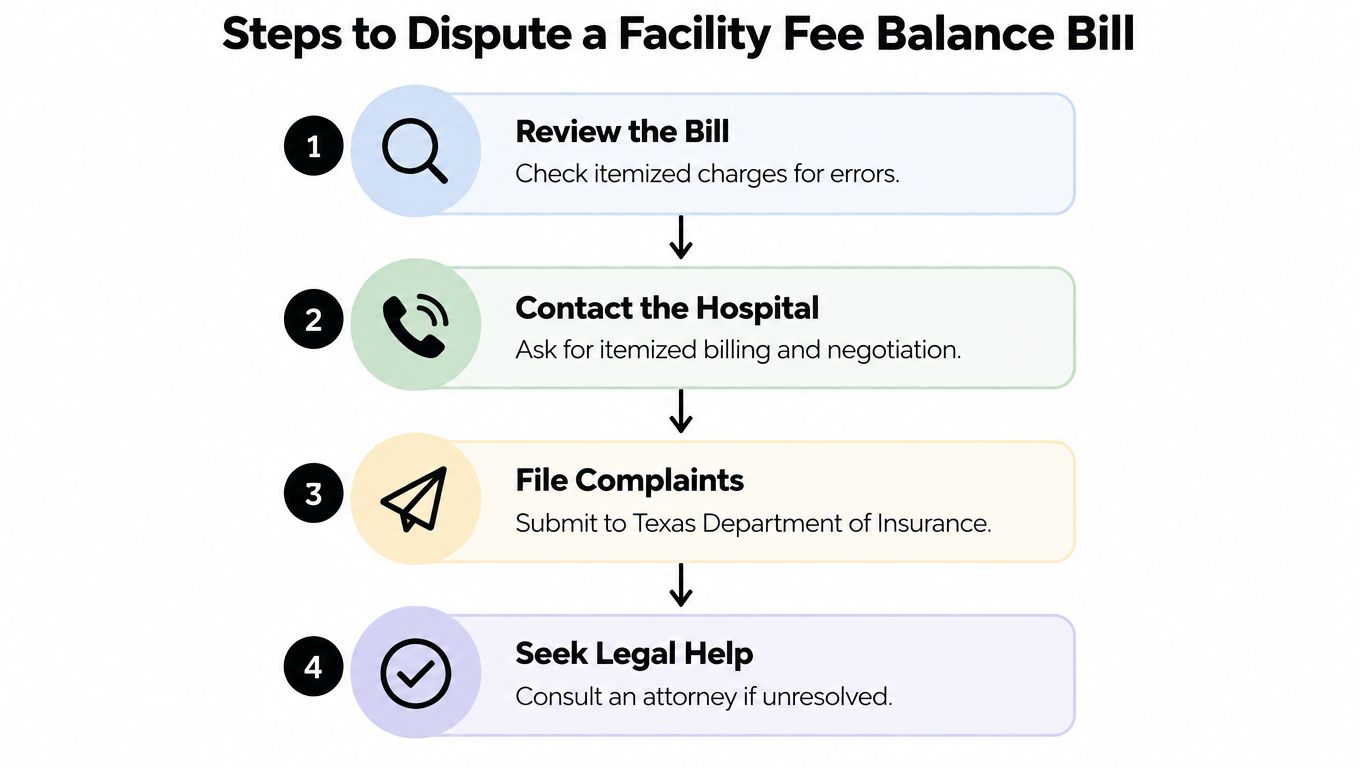
A bill that looks like a balance bill deserves a careful review, not panic. Start by comparing the hospital statement with your Explanation of Benefits, often called an EOB. The EOB should show the billed amount, the amount the plan allowed, the insurer's payment, and the amount the plan says you owe.
Review the claim before paying
Ask the insurer whether the claim was coded as emergency care and whether the hospital and physician claims were processed separately. Ask the billing department for an itemized statement and compare the dates, services, provider names, and insurance adjustments.
Gather a simple file containing:
- The ER records: Keep the discharge papers, treatment notes, imaging records, and follow-up instructions.
- The billing documents: Save the itemized bill, EOB, payment requests, collection letters, and payment receipts.
- The crash evidence: Preserve the police report information, photographs, witness details, vehicle information, and the other driver's insurance details.
- The claim correspondence: Keep emails, letters, appeal forms, and notes showing who you spoke with and when.
Contact the right people in the right order
Call the insurer first if the EOB shows that the emergency claim was denied, processed as out of network, or assigned an amount that seems inconsistent with emergency protections. Request a written explanation and ask how to file an internal appeal. Then contact the hospital's billing office, explain that the visit followed a crash and involved emergency treatment, and request that collection activity pause while the claim is reviewed.
Texas law requires out-of-network providers and facilities to use dispute-resolution pathways for covered emergency claims instead of shifting the disputed amount to the patient. Texas regulators also state that an out-of-network provider cannot require a nonrefundable fee or deposit before the patient chooses care and waives balance-billing protections. The Texas Department of Insurance billing guidance explains these processes.
Don't ignore the statement, but don't pay a disputed balance under pressure without first checking your rights. If the insurer or provider won't correct the claim, consider a complaint to the appropriate regulator or the applicable state or federal dispute process.
A hospital may also assert a lien or claim an interest in settlement proceeds. Before signing a settlement, learn how medical liens can affect the money available to you, including information about Ben Taub and Harris Health lien reduction.
When to Call a Houston Car Accident Lawyer About Your Bills
A facility-fee dispute can be a billing problem, but it can also reveal a larger issue with your accident claim. Call a Houston car accident lawyer when the insurer says your visit wasn't really an emergency, the hospital continues demanding a protected balance, or the other driver's insurer argues that your injuries came from something unrelated to the crash.
Fault disputes deserve early attention. A Houston driver rear-ended on the Gulf Freeway might have medical records showing neck pain immediately after impact, but the insurer may point to a later medical visit or a prior condition. Preserving the crash report, photographs, witness statements, vehicle damage, and complete medical history helps connect the ER visit to the collision.
A lawyer can help request records, review claim coding, communicate with insurers and providers, and identify whether the unpaid bill belongs in a broader injury claim. The lawyer can also evaluate damages, including medical expenses, lost wages, pain and suffering, and future treatment supported by the evidence.
Situations that need closer review
- The emergency claim was denied: Ask why the insurer rejected it and whether the records support emergency treatment.
- The provider threatens collections: Keep every notice and request written confirmation of the legal basis for the charge.
- Post-stabilization bills appear: Check whether you gave written consent to waive emergency billing protections.
- Fault is disputed: Preserve evidence before vehicles, roadway conditions, and witness memories change.
- A family member died: A lawyer can explain potential wrongful death compensation and the claims available to eligible surviving family members.
The Law Office of Bryan Fagan, PLLC handles Texas personal injury matters involving car, truck, and other motor-vehicle crashes. A Texas injury attorney can help you understand whether the ER balance is a separate insurance problem, part of your damages, or both.
Protect Your Recovery After a Houston Crash
After a Houston crash, an ER bill can feel like a second emergency. Compare the facility fee with your EOB, confirm how the emergency claim was processed, and keep collision and treatment records. This paper trail can support an appeal and your injury claim.
Texas and federal protections, auto coverage, and health insurance may affect what you owe. Review guidance after a car accident in Houston and seek advice promptly after a truck crash, fatality, or serious injury.
The Law Office of Bryan Fagan, PLLC offers free consultations about ER facility-fee disputes, insurance claims, and medical expenses. Contact The Law Office of Bryan Fagan, PLLC about your auto claim and legal options while you heal.