A car crash can change your life in seconds, but you don't have to face recovery alone. If you were hit near Westheimer, sideswiped getting into a parking garage, or rear-ended in Galleria traffic, your first instinct is probably to get your bearings, answer messages, and figure out whether you can still make it through the day. Slow down. The choices you make in the first hours can shape your medical care, your insurance claim, and whether you can prove fault later.
A lot of people think the crash itself is the hard part. It isn't. The hard part is what comes after, when pain shows up late, the other driver's insurer starts asking questions, and everyone has a version of what happened. That's where a Galleria area Houston accident lawyer earns their keep, by taking the legal burden off your shoulders while you focus on healing and getting back to normal life.
Houston's crash history is a big reason these claims get complicated. Citywide reporting tied to TxDOT shows 67,644 total car accidents in 2023, including 274 fatal crashes, 290 fatalities, and 1,612 suspected serious injuries. That's roughly 185 crashes per day in one year alone, which helps explain why a wreck near the Galleria is rarely treated as a small, isolated event, even if the damage looked modest at the scene. Houston crash data and injury totals
A careful claim starts with the right facts, not guesswork. If you're also dealing with soreness, swelling, or joint pain after the crash, a practical recovery resource like hot cold therapy for osteoarthritis can help you think through symptom relief while you keep following up with medical care.
Life After a Galleria-Area Crash and What Comes Next
A driver gets clipped near Westheimer, rolls to the shoulder, and sits there with the airbag smell still in the car, trying to decide whether to call a spouse, a boss, or the tow truck first. That's a normal moment after a Galleria-area crash. You're shaken, you may be embarrassed, and you're probably trying to act tougher than you feel.
You don't need to. Texas law gives you real rights, and the job of a Texas injury attorney is to protect those rights while you recover. In plain English, the legal fight is about liability, who caused the wreck, damages, what the crash cost you, and the paper trail that proves both. If those terms feel abstract right now, they won't for long once the insurance company starts pushing its version of events.
The reason a Galleria crash deserves close attention is simple. The area packs together shopping traffic, valet lanes, freeway merges, delivery vehicles, and pedestrians in a tight space. That means fault can involve more than one bad decision, and sometimes more than one defendant.
Practical rule: Don't try to “wait and see” for too long. If your pain grows, the insurer will notice the gap before anyone notices your injury.
This guide walks you through the first things that matter, then the fault rules, then the kind of evidence that changes claim value. It also shows when a Houston car accident lawyer can step in early and keep the claim from drifting into the insurer's favorite outcome, a quick settlement for less than the case is worth. If you're still trying to decide whether legal help is even necessary, the answer is usually yes once there's real injury, disputed fault, or more than one possible source of liability.
What To Do in the First Hours After a Houston Car Crash
The first few hours are for your safety, not for proving a case. Call 911 if anyone may be hurt, and let paramedics check you even if you think it's just shock or soreness. A lot of people feel “fine” at the scene and hurt badly the next day, which is exactly why the medical visit matters. If a police officer responds, give a clear statement, but keep it short and factual.
Then document the scene before anything moves or gets cleaned up. Take photos of the vehicles, skid marks, traffic lights, lane position, the road surface, and any visible injuries. Get the other driver's name, insurance information, plate number, and vehicle description. Ask nearby witnesses for names and phone numbers before they leave.
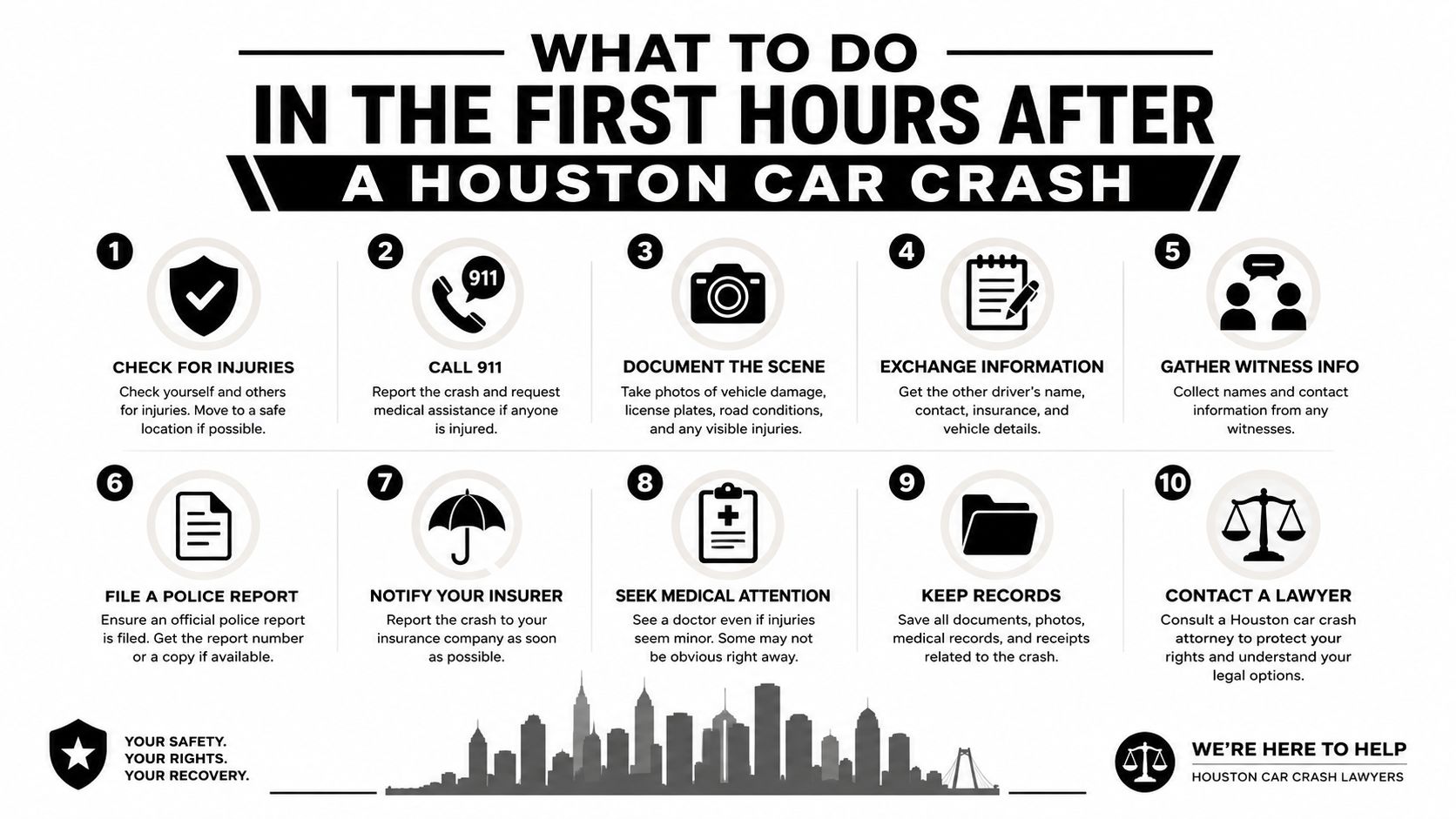
The first 24 to 72 hours are the clean-up window for evidence. Houston-area guidance says immediate scene documentation should include vehicles, road conditions, traffic controls, and visible injuries, plus witness information before people disappear. A practical post-crash step is also getting the Texas CR-3 crash report when the wreck involved injury or significant property damage, because that report becomes key evidence later if the insurer argues over fault or damages. What to do after a car accident and Texas CR-3 report guidance
Don't do three things that can hurt you fast. Don't post about the crash on social media. Don't give the other driver's insurer a recorded statement before you understand your injuries. Don't delay follow-up care just because you made it home on your own.
Once the scene is handled, the next battle is fault and insurance. That's where the claim is really won or lost.
If you remember nothing else, remember this. Scene evidence is cheap to collect and expensive to recreate later. Once cars move, people leave, and memories soften, the insurer gets more room to dispute what happened.
Who Is Liable in a Texas Car Accident and How Fault Is Decided
Liability means legal responsibility. In a Galleria wreck, that could be the other driver, a rideshare operator, a delivery truck company, a property owner, or more than one of them. The question isn't who feels bad. It's who caused the crash under Texas law.
Texas uses modified comparative fault under Civil Practice and Remedies Code Chapter 33. In plain English, you can still recover damages as long as you are not more than 50% at fault. If you're found partly responsible, your recovery is reduced by your share of fault. If you're found more than 50% responsible, you recover nothing. Texas comparative fault rule
That rule matters because insurers know how to weaponize it. If they can push you from 20% fault to 51% fault, they've turned a valid claim into a denial. That's why the evidence from the first section matters so much, especially photos, witness names, the crash report, and medical records that line up with the mechanics of the wreck.
A few everyday examples make the rule easier to understand. A driver who cut too hard across the West Loop may carry most of the blame. A pedestrian who stepped out from between parked cars may share some fault, but that doesn't automatically erase the case. A rideshare passenger hit while getting out of a vehicle may have claims against more than one party, depending on who had control and what the app status was at the time.
The words matter here. Comparative fault is the percentage split of blame. Damages are the losses you can prove, like medical bills, missed work, pain, and future care. When an adjuster says you “might have some fault,” that's not casual talk. It's a strategy to reduce what they pay.
For a plain-language look at how insurers use that playbook, see Dealing With Insurers After a Houston Accident. It's the same pressure tactic in many claims, but it hits harder when the crash happened in a crowded district like the Galleria, where everyone has a theory and few people have the full picture.
Bottom line: Fault is a data problem, not a shouting match. The best claims tie the scene, the injuries, and the witness story together before the insurer rewrites it.
Insurance, Policy Limits, and What Your Claim Is Really Worth
The first number an insurer throws out is not the value of your case. It's the first number they hope you'll accept. Real value comes from the at-fault driver's policy limits, your own underinsured motorist coverage if you have it, and the strength of the proof you build around your injuries and losses.
A common Houston example looks like this. You're rear-ended on I-45 near the Galleria, you later learn you have a herniated disc, and your medical care keeps stacking up. If the at-fault driver only has a basic policy, that coverage can run out long before your losses do. That's when your own coverage, your treatment records, and the quality of your proof start to matter more than the first offer.
Texas firms often describe settlement ranges by injury level, with minor soft-tissue cases landing in one band and surgery or catastrophic injury claims in a much higher one. The question is not what the average settlement is. The question is what evidence moves your case into a stronger band.
| Coverage Type | Minimum Limit | Why It Matters |
|---|---|---|
| Texas personal auto liability coverage | Qualitatively, the basic policy may run out fast in a serious crash | It may not cover a herniated disc, lost wages, and ongoing care |
| Commercial vehicle coverage | Often higher than a personal auto policy | It can create more room for a serious injury claim |
| Your own underinsured motorist coverage | Depends on your policy | It may help when the other driver doesn't carry enough insurance |
The damage package is what turns a claim into a stronger position. That means medical records, imaging, physician notes, therapy bills, wage proof, and a clear timeline of symptoms. It also means not settling before you know whether the pain is temporary or something that will follow you for months.
The contingency-fee piece matters too. In Texas personal injury practice, attorney fees commonly range from 33% to 40% of the recovery, and the fee usually rises once suit is filed or trial preparation becomes necessary. That's why a gross recovery is never the same thing as what lands in your pocket. A $100,000 settlement can shrink materially once fees and case costs are accounted for. Houston settlement and fee discussion
If your case involves a truck or commercial vehicle, a Houston Truck Accident Lawyer page is worth reading because the insurance structure is often different from a standard fender-bender. More coverage can help, but it can also mean a harder fight because the carrier has more reason to defend hard.
How To Choose the Right Galleria Area Houston Accident Lawyer
Choose a lawyer the same way you'd choose a doctor after a bad injury, by asking who handles cases like yours and who will be working the file day to day. A polished website doesn't tell you that. A real consultation does.
Start with the basics. Ask whether the firm handles Houston-area crash cases regularly, whether it knows Harris County courts and local judges, and whether it understands the kind of traffic patterns that show up around the Galleria. Ask about the contingency fee in writing before you sign anything. In Texas, 33% to 40% is a common range, and you need to know whether costs are deducted before or after the fee is calculated. How to choose a car accident lawyer
A good consultation should give you straight answers, not a sales pitch. Ask about likely case stages, the kind of settlement range the facts support, how often the firm files suit, and who answers your calls. Ask what happens if the case loses and who pays case expenses. If the lawyer won't explain that clearly, keep looking.
A smart Houston client also checks for local knowledge beyond the courtroom. A lawyer should understand the providers who treat crash victims, how insurance companies value claims, and how evidence changes from one Houston corridor to another. A firm that can spot the difference between a simple rear-end claim and a parking-lane or valet-lane fault dispute is already thinking one step ahead.
Use a resource like choose Grand Parkway Smiles the same way you'd use any practical consumer guide, as a reminder that the right professional should explain process clearly, answer questions directly, and make you feel informed rather than rushed.
Watch for red flags. Guaranteed results are a bad sign. Pressure to sign immediately is another one. So is vague talk about “handling everything” without telling you who does the work. A strong attorney earns the fee by pushing the case into the higher recovery band through evidence, negotiation, and trial readiness, not by handing you a generic promise.
Common Galleria-Area Case Types and How They Differ
Not every crash near the Galleria should be handled like an ordinary two-car wreck. The local traffic pattern changes the case. Rideshare pickups, commercial deliveries, and fatal collisions each bring their own rules, deadlines, and proof issues.
Rideshare cases are tricky because coverage shifts depending on whether the driver was logged into the app, waiting for a ride, or actively carrying a passenger. That matters in crowded pickup zones near malls, hotels, and restaurants where cars stop, start, and merge in awkward spaces. Uber and Lyft-style claims can turn aggressively defensive fast because the company and the driver often point at coverage layers instead of taking responsibility.
Commercial truck cases are different again. The proof often includes electronic logs, carrier records, and maintenance files, which is why a truck case needs fast evidence preservation. If a West Loop feeder-road collision involves a large truck, the defense can be more complicated than a normal car case because more people and more policies may be in play. The Houston Truck Accident Lawyer resource is useful here because it focuses on those commercial-collision issues directly.
Wrongful death claims are the hardest cases of all. When a family member is killed, Texas law allows certain family members to pursue damages under Civil Practice and Remedies Code Chapter 41, and the filing deadline is controlled by Texas limitations law. The damages can include the kinds of losses that matter most to a grieving family, not just the final medical bills. In a fatal crash, the question is no longer only who caused the wreck, it's how the law values the life that was taken.
Dense retail traffic changes liability. A wreck near a valet lane or parking garage can involve drivers, property owners, or both, depending on how the collision unfolded.
That's why location matters so much around the Galleria. The same crash pattern can become a different legal case once you add ride-hail drop-offs, commercial driveways, or pedestrian-heavy crossings. A lawyer who misses that point is leaving money and opportunity on the table.
Your Next Steps and How a Free Consultation Helps
If you're still sore, still confused, or still waiting for the other driver's insurer to “do the right thing,” keep your focus simple. Go to your medical appointments. Save every bill and discharge note. Don't post about the crash. Don't give a recorded statement without legal advice. Keep whatever evidence you still have, because even one photo or one witness name can matter later.
The smartest move now is a free consultation with a lawyer who handles Houston crashes every day. A no-cost review gives you a place to ask about fault, insurance coverage, deadlines, and whether the case should be pushed now or after more medical proof comes in. If you want a straightforward explanation of what that meeting should look like, Houston accident lawyer free consultation is the kind of resource that helps you prepare.
Contingency-fee representation also gives families breathing room. You shouldn't have to pay upfront to find out whether you have a claim. You should get a clear answer, a direct plan, and a lawyer who treats your case like it matters.
If the crash happened near the Galleria, don't wait for the insurer to define your rights for you. Get legal help now, protect your evidence, and put someone on your side who knows how these claims work.
The Law Office of Bryan Fagan, PLLC helps Houston crash victims sort out fault, insurance, and injury claims after serious wrecks in and around the Galleria. If you need a calm, local legal team that can explain your options and fight for your recovery, visit The Law Office of Bryan Fagan, PLLC to schedule a free consultation.