A car crash can change your life in seconds, but you don't have to face recovery alone. The same is true when a night at a Houston stadium, arena, or concert venue ends with a fall, crowd surge, broken railing, assault, or medical emergency. You may be in pain, worried about medical bills, and unsure whether the venue, event organizer, or another company is responsible.
A Houston stadium and arena event injury premises claim depends on facts that may be difficult to see from the injured person's perspective. The key questions include who controlled the area, what danger caused the injury, whether someone knew or should have known about it, and whether reasonable safety measures were missing. This guide explains those issues, the evidence to protect, Texas deadlines, possible defenses, and practical steps toward compensation.
What Happens When a Houston Event Injury Turns into a Premises Claim
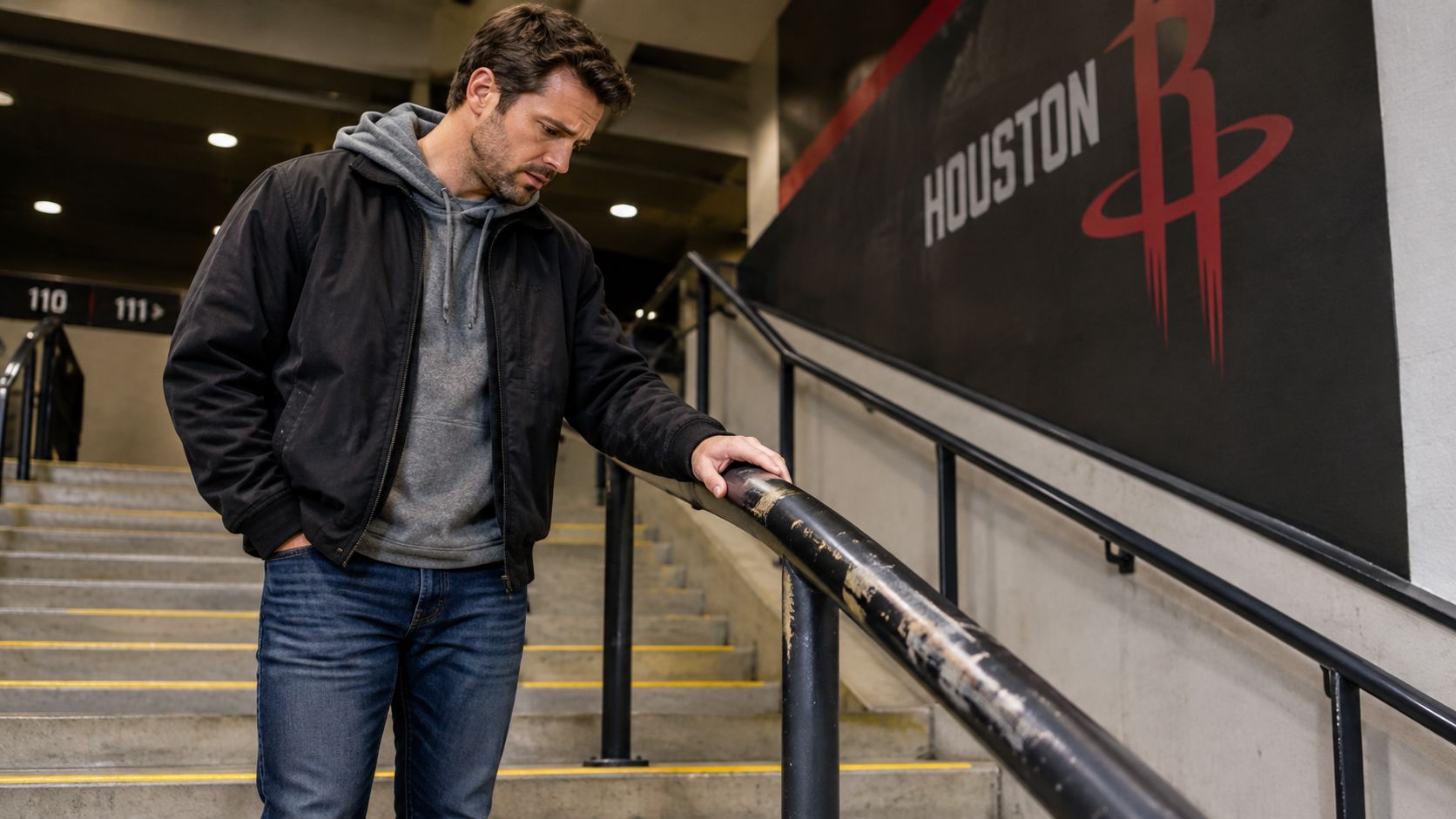
You're walking down a stadium staircase when your hand reaches for a railing that shifts under your weight. You fall several steps, strike your back, and leave the venue by ambulance. Later, the venue's incident form suggests you were careless. That first description doesn't decide what happened or who may be legally responsible.
A different situation may involve a concertgoer caught in a crowd surge at NRG Park. The injury location might be near the stage, but the cause could involve gate placement, barriers, staffing, communications, emergency planning, or restricted movement elsewhere. That's why these cases often require more than a photograph of the place where you were hurt.
Your injury matters, but the legal claim depends on the danger, control, notice, and conduct surrounding it.
Texas premises law can apply to unsafe stairs, aisles, seats, concourses, barriers, lighting, exits, and other venue conditions. Event-related claims can also involve negligent activity, inadequate security, contractor conduct, or a dangerous crowd-management decision. More than one party may share responsibility.
The sections ahead explain how to identify those parties, what you generally must prove, and how comparative fault may affect recovery. They also address the two-year statute of limitations, evidence such as surveillance and event records, defenses including written ticket terms, and special rules that may apply to baseball events or government-owned facilities. If someone died, the family may also need to evaluate a wrongful death compensation claim.
Understanding Premises Liability for Texas Venue Injuries
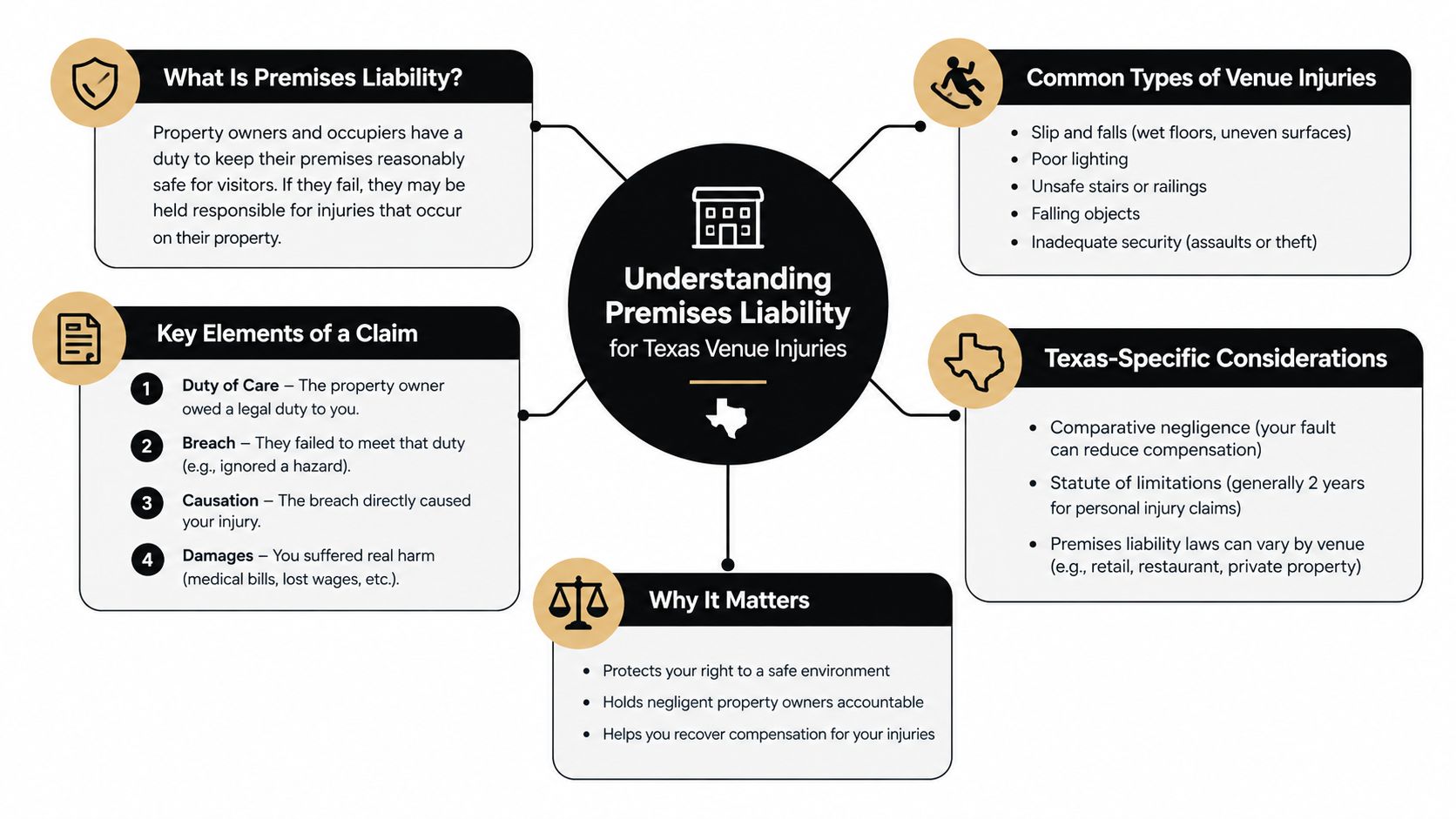
Premises liability means legal responsibility for harm caused by a dangerous condition on property. Consider a wet floor near a concession stand. A paying fan slips, suffers a fracture, and later learns employees may have seen the spill before the fall. The claim isn't established merely because the fan was injured. The evidence must connect the spill to a legal duty and a failure to act reasonably.
Under Texas law, a paying spectator at a Houston stadium or arena is generally an invitee, meaning the person enters under an express or implied public invitation. The venue operator generally must use reasonable care to protect invitees from concealed, unreasonably dangerous conditions it knew about or reasonably should have discovered. See the Texas courts' discussion of invitee duties.
The four questions in an invitee claim
- Knowledge: Did the owner or operator know about the condition, or should reasonable inspections have revealed it?
- Unreasonable risk: Did the condition create a danger that a reasonable venue should have addressed?
- Reasonable care: Did the operator warn guests, clean the area, repair the defect, redirect traffic, or take another sensible safety step?
- Proximate cause: Did that failure cause your injury and resulting losses?
A licensee receives a narrower duty. The owner generally must warn about or make safe a dangerous condition the owner knows about and the licensee doesn't. A trespasser generally has different protections. Your location and purpose matter, especially if you were in a restricted service area, employee-only space, or another place outside ordinary spectator access.
Venue operators increasingly use tools such as sensors, digital inspection systems, and occupancy monitoring. Background information about smart building technology in venues may help explain how modern facilities can identify maintenance and crowd-flow concerns. For a Houston property-condition injury, Houston Slip and Fall / Premises Liability Lawyer is a relevant legal service category for representation involving unsafe property conditions.
Who Can Be Liable for a Stadium or Arena Injury
The party whose name appears on the stadium sign isn't necessarily the only possible defendant. Liability means legal responsibility for harm, but responsibility usually turns on who controlled the specific area, who created the condition, and who had the ability to correct it.
A venue owner may control the building itself, while a management company handles daily inspections. An event promoter may control crowd layout, ticketing, and entry procedures. A security contractor may direct lines and respond to disturbances. A concessionaire may control the floor around its stand, and a maintenance vendor may have responsibility for repairs.
Texas premises cases treat control as a critical technical issue. Responsibility may rest with a lessee, event promoter, contractor, or security operator rather than the property owner, as discussed in this Texas real estate and premises-liability analysis.
Common defendants in a Houston stadium or arena injury claim
| Defendant | Role at the Venue | Why They May Be Liable |
|---|---|---|
| Venue owner | Owns the stadium, arena, or surrounding property | May have responsibility for structural conditions, maintenance, or known hazards |
| Property management company | Runs daily facility operations | May control inspections, cleaning, repairs, and incident reporting |
| Event promoter | Plans and administers the event | May control crowd layout, entry procedures, emergency planning, or staffing |
| Team or event organizer | Presents the game, concert, or gathering | May make operational decisions affecting spectator safety |
| Security contractor | Provides guards and crowd monitoring | May share responsibility for inadequate response, barriers, or crowd direction |
| Concessionaire | Operates food, beverage, or merchandise areas | May control spills, displays, lines, and conditions near its operations |
| Maintenance vendor | Performs repairs, cleaning, or equipment work | May be responsible for defective work or failure to address a reported hazard |
| Governmental entity | Owns or operates a public facility | May face premises and immunity issues governed by specific statutes |
Suppose a Houston fan falls near a blocked exit. The owner may argue that the promoter controlled the event. The promoter may point to the security company. The security company may claim the barrier was placed by venue staff. A careful investigation follows the contracts, staffing plan, radio traffic, inspection records, and video instead of accepting any one party's account.
General information about event safety obligations explained can provide useful context for the kinds of responsibilities event operators may assign among organizations. If the injury occurred in a vehicle or parking-area collision, the relevant service category may instead be a Houston Car Accident Lawyer, which concerns representation for car accident victims in Houston and Harris County.
Common Ways Event Injuries Happen in Houston
A stadium injury isn't automatically a simple slip-and-fall. The cause affects the evidence, the legal theory, and the people whose conduct must be investigated.
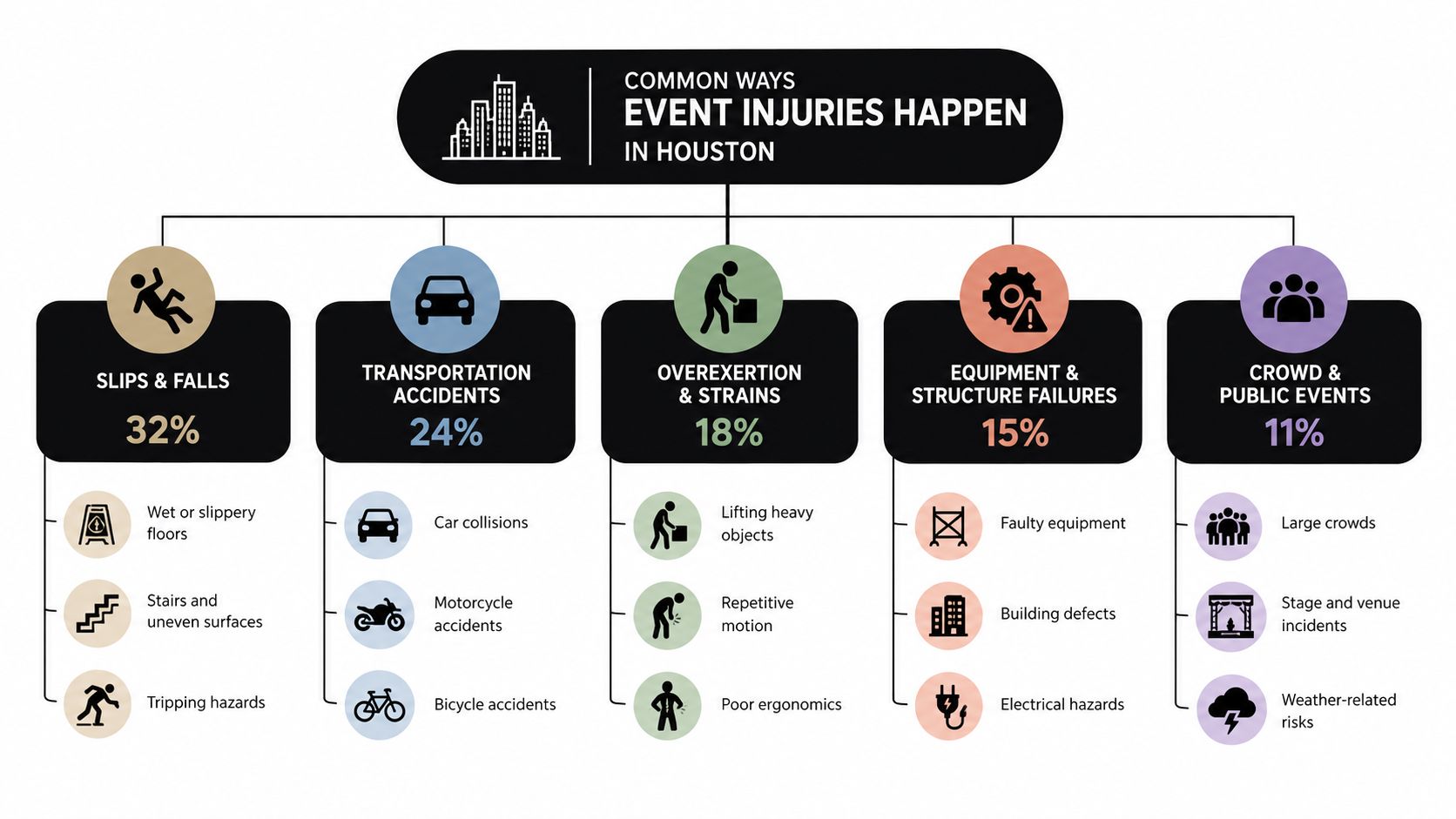
Surface and structural hazards
A wet concourse, uneven walkway, broken stair, defective seat, loose railing, or inadequate lighting looks closest to a traditional premises defect. Useful evidence may include photographs, cleaning and inspection logs, maintenance tickets, employee reports, and witness descriptions of how long the condition existed.
A strong claim still needs proof that the condition posed an unreasonable risk, that the responsible party knew or should have known about it, and that the failure to warn or repair caused your injury. Medical records then connect the event to fractures, head injuries, spinal symptoms, lost income, or other damages.
Crowd movement and blocked routes
Crowd injuries require a wider view. Investigators may need to map gates, queues, corridors, stairs, concessions, barriers, and exits rather than focus only on the final point of impact.
A systematic review identified crowd mood, vulnerable people, counterflow, abnormal conduct, walkway conditions, and unusual timing as recurring stampede-risk variables. It also found that crowd-flow restrictions and compromised entrances or exits were especially influential when occupancy exceeded roughly 80 percent or access points were partially closed. See the Texas Bar materials on crowd-related premises issues.
A crowd surge may involve the promoter, venue operator, security company, and anyone who designed or changed the route. Records can include ticket scans, gate-closure logs, radio communications, training records, security video, emergency-action plans, and evacuation diagrams.
Security, vendors, equipment, and medical response
Security failures may involve an assault, dangerous disorder, poor monitoring, or a delayed response. A concessionaire may leave a spill, create an unsafe queue, or place merchandise where it obstructs movement. Falling speakers, lighting, barriers, or other equipment may point toward a contractor, promoter, or venue operator.
Medical response matters when delayed assistance worsens an injury. The relevant proof may include calls for help, dispatch records, treatment records, staffing plans, and communications among venue personnel.
The safer football events checklist offers general event-planning context for assessing crowd, equipment, and operational risks. You can also review this Houston slip and fall lawyer resource for information about property-condition injuries. The same event may fit several categories, so preserve evidence before deciding which label applies.
Texas Deadlines and Laws That Shape Your Claim
A statute of limitations is the legal deadline for filing a lawsuit. Texas law generally gives an injured person two years to file a premises-liability action arising from a stadium or arena injury under Texas Civil Practice and Remedies Code section 16.003(a). The limitations rule is discussed in this Texas appellate opinion. If you file after the deadline, the claim may be barred even if the underlying facts are strong.
That deadline doesn't mean you should wait. Evidence may disappear, and claims against public entities can involve separate notice requirements and procedural rules. A government-owned venue may raise Texas Tort Claims Act issues, immunity questions, statutory caps, and questions about whether the entity owned, operated, or merely managed the relevant property.
Chapter 33 and comparative fault
Comparative fault, also called comparative responsibility, means a fact finder may assign percentages of responsibility to multiple parties, including the injured person. Chapter 33 of the Texas Civil Practice and Remedies Code generally limits a defendant's responsibility to the percentage assigned to that defendant. A claimant found more than 50 percent responsible may be barred from recovery under the statute. Review the Texas proportionate-responsibility statute.
For example, a jury might decide that an arena operator, maintenance contractor, and spectator each contributed to a fall. The final award can change based on those findings, so photographs, video, footwear information, inspection records, and witness testimony matter.
Chapter 41 and exemplary damages
Damages are the losses caused by an injury. They may include medical expenses, lost income, physical pain, emotional distress, disability, and future care when supported by evidence. Exemplary damages, sometimes called punitive damages, are different. Chapter 41 requires more than ordinary negligence, and gross negligence generally involves an extreme risk that the defendant was aware of but consciously disregarded.
A claim for exemplary damages isn't automatic after a serious event injury. It may depend on repeated complaints, ignored inspection failures, prior similar incidents, or deliberate disregard of a known danger. A prompt review of Texas statutes of limitations can help protect the options available under these rules.
Evidence to Preserve After a Houston Stadium Injury
Start with your health, then preserve what you can without putting yourself at risk. Ask for medical care, report the incident to venue staff, and write down what you remember while the details remain clear. Include the exact location, time, route you took, lighting, warnings, crowd movement, employees nearby, and what happened immediately before the injury.
Create a personal evidence file
Keep digital and physical copies of:
- Admission records: Save the ticket, purchase confirmation, seat assignment, ticket scans, and event messages.
- Scene images: Photograph the surface, stairs, railing, barrier, lighting, signs, and surrounding area when safe.
- Witness details: Record names, phone numbers, social-media contacts, and short descriptions of what each person observed.
- Medical documents: Keep emergency records, prescriptions, bills, referrals, work restrictions, and follow-up notes.
- Venue communications: Preserve texts, emails, claim forms, insurer letters, and messages with security or management.
- Personal effects: Keep damaged clothing, shoes, broken equipment, and photographs showing their condition.
Don't assume the venue will preserve everything automatically. Surveillance video may be overwritten, temporary barriers may be removed, cleaning logs may be stored electronically, and employee recollections may fade.
The 2021 Astroworld Festival at NRG Park shows why event records can matter. At least eight attendees died, and more than 300 people were treated at an on-site field hospital, making evidence about crowd density, entry and exit controls, security staffing, medical response, and venue policies central to a Houston venue-safety claim. See the premises-liability discussion of the Astroworld incident.
Preservation matters: A lawyer may send preservation letters and seek records through subpoenas, but your early photographs, messages, and medical documentation can shape what remains available later.
If police or emergency services responded, information about how to obtain police records may help you locate additional documentation. Avoid posting detailed opinions about fault online or giving a recorded statement to an insurer before you understand the claim.
Defenses and Misconceptions That Can Shrink a Stadium Claim
A stadium injury isn't automatically an ordinary slip-and-fall claim. The event itself may create legal questions about inherent risks, crowd activity, ticket terms, waivers, and the specific duty owed by each defendant.
The baseball rule and event-specific duties
Texas courts have recognized a special baseball rule. In a Houston Astros batting-practice case, the First Court of Appeals held that the stadium owner's duty was limited to providing adequately screened seats for spectators who wanted them. The court treated the rule as applying to both negligence and premises-liability theories. Read the appellate decision involving the Houston Astros.
That ruling doesn't answer every stadium question. A fan struck by a baseball may face a different analysis from someone injured by fireworks, a crowd surge, a falling object, a poorly controlled line, or a security failure. The issue is whether the danger was inherent in the activity and whether the defendant's duty was limited by the event-specific rule.
Waivers, ticket terms, and open conditions
A ticket may contain a waiver, assumption-of-risk language, or instructions about conduct. Those terms don't automatically erase every negligence or premises claim. Their effect depends on the language, the injury, the defendant, and how Texas law applies to the facts.
The venue may also argue that a condition was open and obvious, meaning a reasonable person could see and avoid it. That defense can be important, but it isn't always the end of the case. Lighting, crowd pressure, warnings, emergency conditions, the precise angle of view, and whether you had a reasonable chance to avoid the danger may all matter.
A venue's first incident report may say you were distracted, moved against instructions, or caused your own injury. Treat that statement as one piece of evidence, not a final legal conclusion. Chapter 33 permits comparative-responsibility arguments, but the percentage assigned must come from the facts and evidence rather than an unsupported label.
Government facilities are not automatically off-limits
Government ownership also doesn't automatically defeat a claim. The Texas Supreme Court held that spectating at a competitive sporting event isn't “recreation” for purposes of the Texas Recreational Use Statute. That distinction can matter when a spectator brings a claim against a public entity. Review the Texas Supreme Court's recreational-use decision.
Classification remains important. A spectator, participant, worker, and person using a parking lot or access route may be treated differently. The investigation should ask who owned the property, who operated it, where the hazard was located, and whether the claim involves premises liability, negligent activity, or another theory.
A defense deserves analysis, not automatic acceptance. Written terms, event rules, and comparative-fault arguments can affect a claim, but they don't replace a fact-specific review of duty, control, notice, causation, and damages.
If a family lost someone in an event injury, the legal analysis may include wrongful death claims and survival issues, not only the injured person's medical losses. If your situation also involves a crash, an auto insurance claim, or a driver who caused harm near the venue, a Texas injury attorney can examine those facts alongside the premises issues.
The Law Office of Bryan Fagan, PLLC offers a free consultation to discuss venue injuries, premises claims, auto insurance disputes, and wrongful death compensation, with legal fees handled through contingency representation according to the firm's stated terms. Visit The Law Office of Bryan Fagan, PLLC to share what happened and learn what steps may protect your rights.