A car crash can change your life in seconds, but you don't have to face recovery alone. If you were hurt on the Hardy Toll Road, you may be dealing with pain, vehicle damage, missed work, medical appointments, and insurance calls before you've had time to understand what happened. A Hardy Toll Road accident lawyer can help protect your rights while you focus on healing.
A Crash Can Change Everything But You Are Not Alone
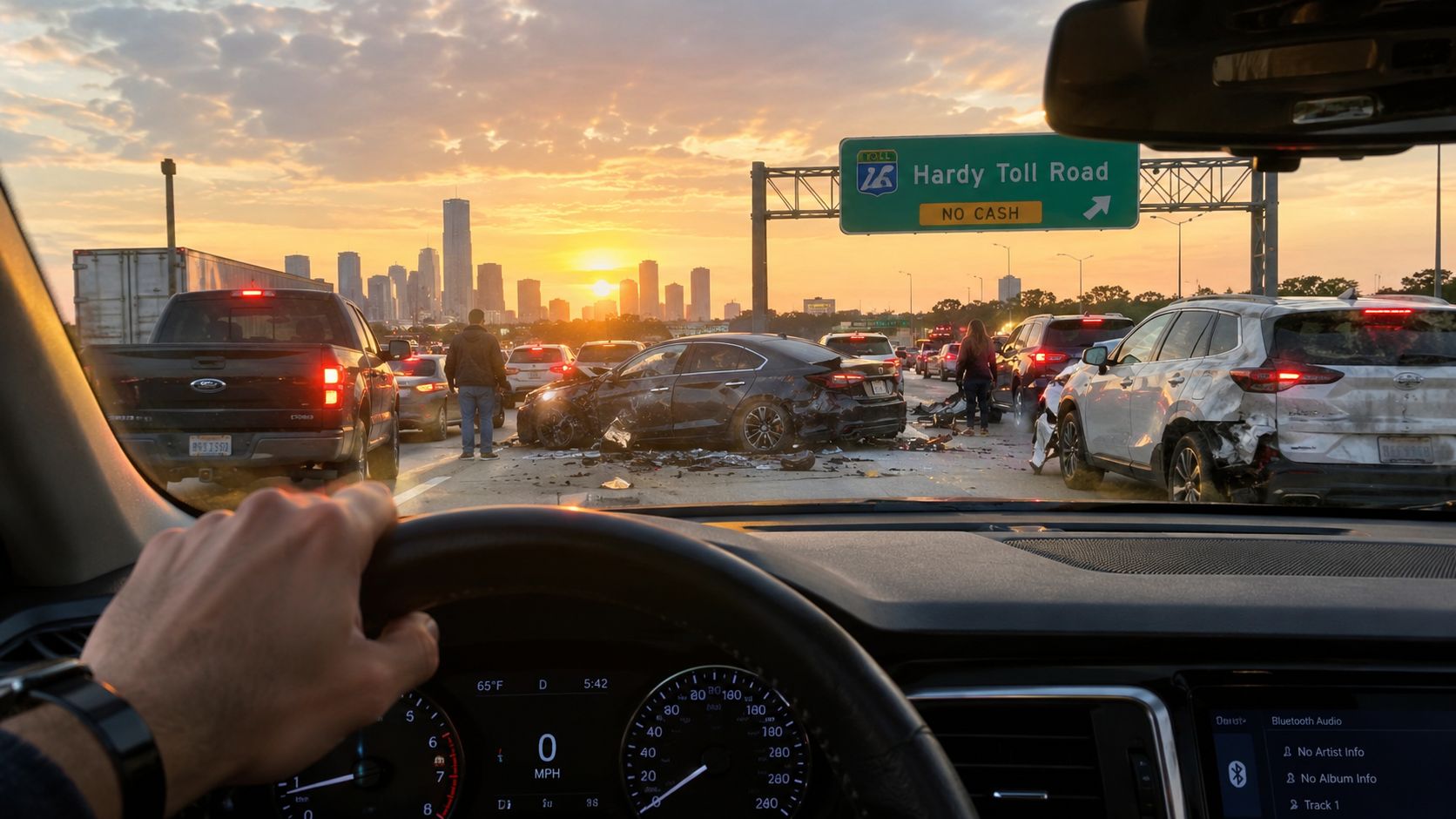
You may have been driving through Houston traffic when brake lights suddenly appeared ahead. A vehicle struck another car, the impact pushed traffic across lanes, and your own vehicle became part of a chain reaction. Emergency lights reflected off concrete barriers while you tried to understand whether your passengers were safe and whether you could move without worsening your injuries.
That confusion is common after a toll-road collision. High-speed impacts can cause serious harm even when the vehicle looks repairable. You might feel fine at the scene because adrenaline hides pain, only to develop headaches, neck stiffness, back pain, or emotional distress later. At the same time, you're wondering how you'll work, pay medical bills, repair your car, or care for your family.
The scale of roadway injuries explains why these claims deserve careful attention. The World Health Organization reports that road traffic crashes kill about 1.16 million people worldwide each year and injure between 20 million and 50 million more. Road traffic injuries are also the leading cause of death for children and young adults aged 5 to 29, and more than half of road deaths involve vulnerable road users such as pedestrians, cyclists, and motorcyclists.
Texas law gives injured people ways to seek compensation when another person's negligence caused the crash. Depending on the evidence, a claim may involve another driver, a commercial trucking company, a roadway manager, a maintenance contractor, a vehicle manufacturer, or your own uninsured or underinsured motorist coverage.
This guide explains what to do immediately, how liability works, how comparative fault can affect recovery, what compensation may be available, and why insurance companies should not control the process. Seeking reliable information is already a meaningful step. You don't have to investigate a complex toll-road collision or negotiate with insurers by yourself.
Critical Steps to Take Immediately After a Hardy Toll Road Crash
Your first priority is safety. Turn on your hazard lights, check for immediate danger, and move the vehicle to the shoulder only if you can do so safely. Call 911 and give dispatchers the Hardy Toll Road location, direction of travel, nearby entrance or exit, and any visible injuries.
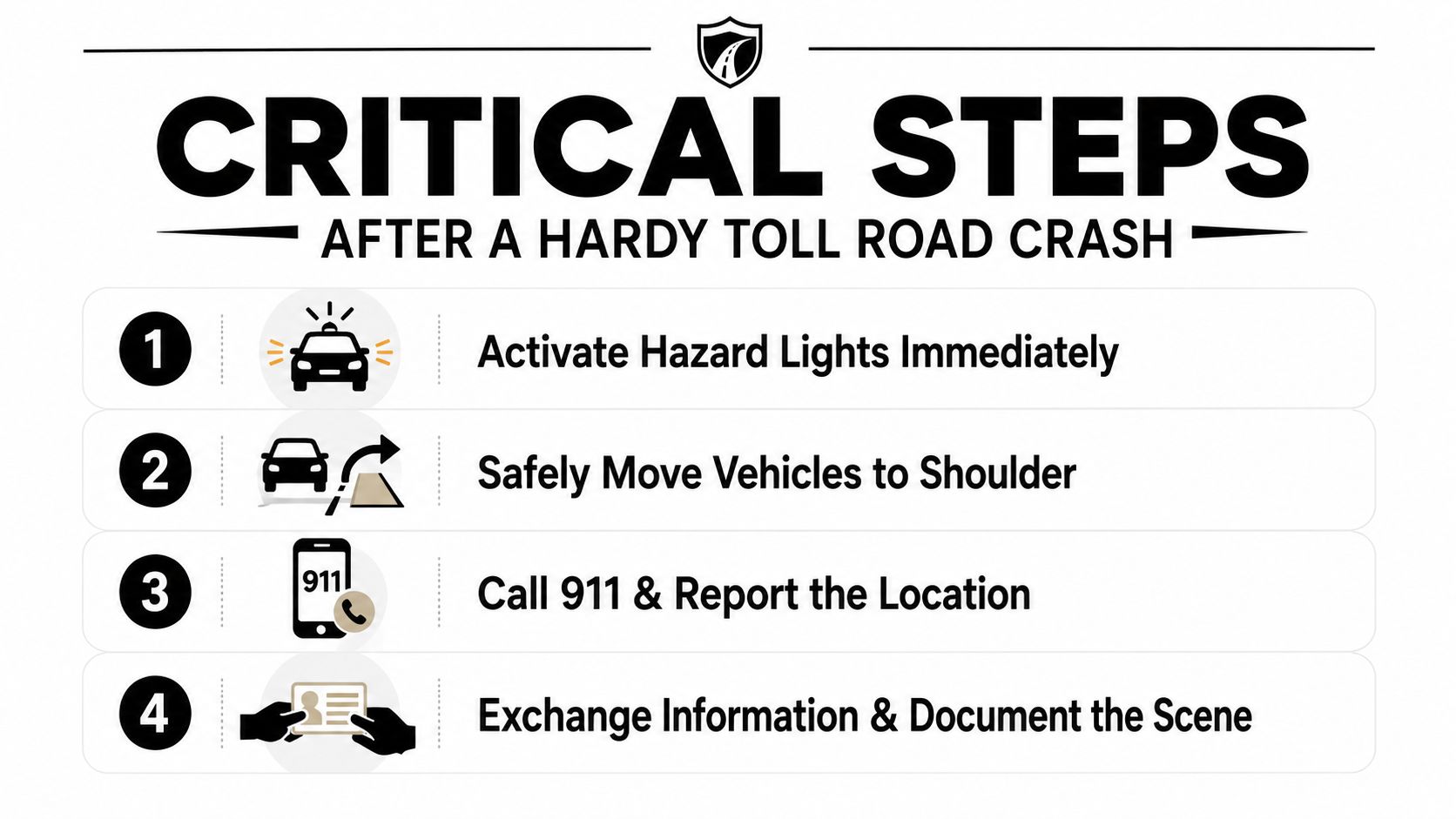
Once you're out of immediate danger, follow these steps:
Document the scene. Photograph vehicle positions, damage, skid marks, debris, toll-road signs, lane markings, concrete barriers, barrier damage, weather conditions, and visible injuries. Take wide photos that show the roadway and close photos that show specific damage. Scene conditions can change quickly after vehicles are removed.
Exchange information carefully. Get the other driver's name, contact information, license information, vehicle details, and insurance information. Be polite, but don't apologize, admit fault, or guess about the cause. You may not know whether another vehicle struck the driver first or whether a roadway condition contributed.
Identify witnesses. Ask witnesses for their names and phone numbers. Write down what each person saw without trying to direct their answers. Also ask the responding officer for the crash report number and the agency handling the report.
Get medical care promptly. Seek evaluation even if your injuries seem minor. Adrenaline can hide symptoms, and medical records help establish a clear timeline between the crash and your treatment. Follow prescribed care and keep records of appointments, medication, mileage, and out-of-pocket expenses.
For practical guidance on documenting injuries and handling the first conversations after a collision, review these MedAmerica Rehab Center accident care tips. You can also learn about how to obtain police records when you need the official report.
Don't post crash details, photographs, or opinions on social media. Don't give a recorded statement to the other driver's insurer before you understand your rights. You should notify your own insurer as required by your policy, but keep your account accurate and limited to known facts.
Preservation matters: Evidence collected early can answer questions that witness memory and roadway conditions may not answer later.
A Houston Car Accident Lawyer provides representation for car accident victims in Houston and Harris County. Early legal guidance can also help preserve video, vehicle data, photographs, and records that may be important to your claim.
Understanding Texas Liability and Comparative Fault Laws
Liability means legal responsibility for causing harm. In a Texas personal injury claim, you generally must show that another person or entity owed you reasonable care, failed to use it, and caused your injuries and losses. A driver may breach that duty by speeding, following too closely, changing lanes unsafely, driving while impaired, or failing to respond to traffic.
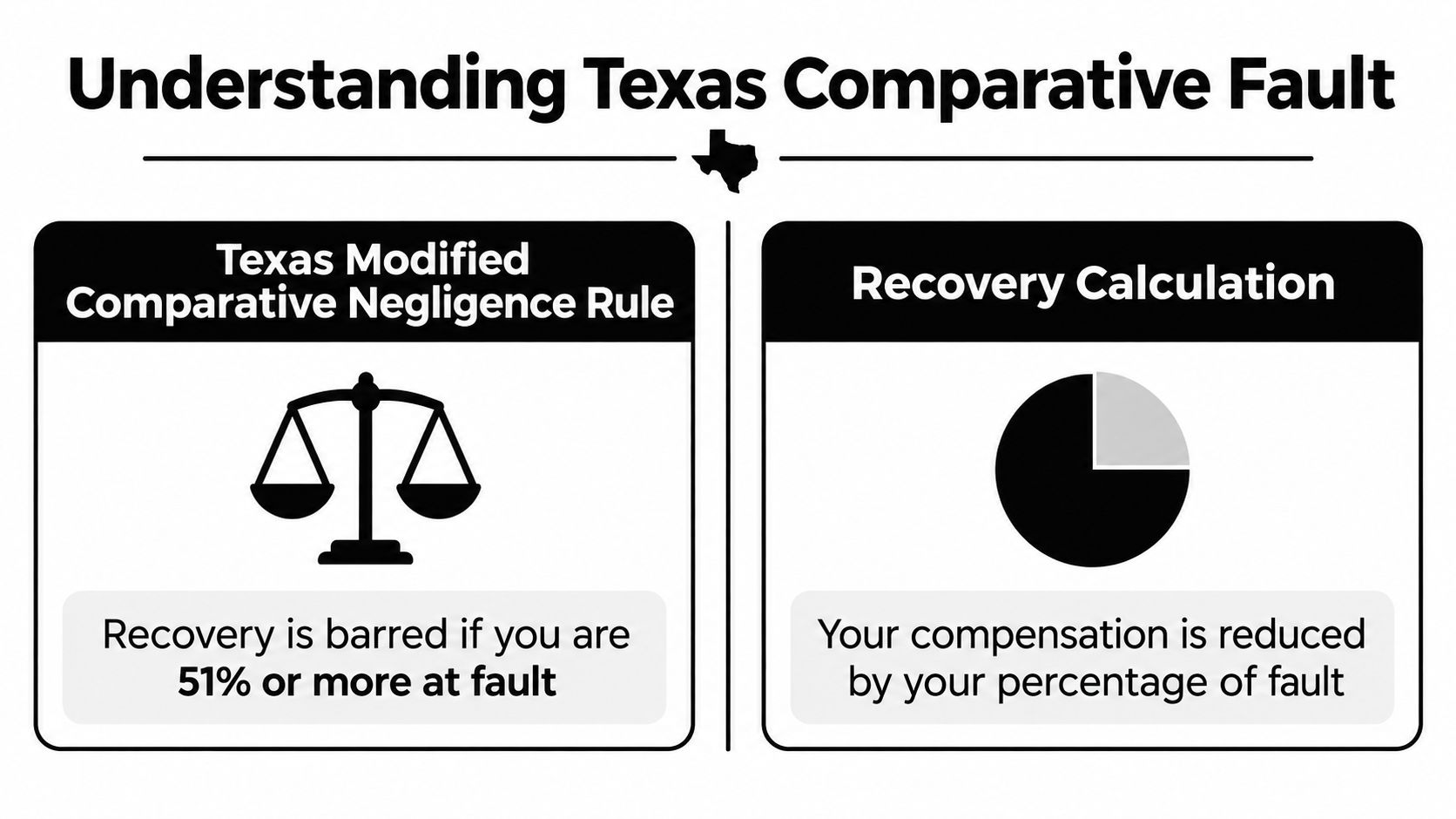
Comparative fault means responsibility can be divided. Under Texas Civil Practice and Remedies Code Section 33.001, a claimant can't recover damages if the claimant's responsibility is greater than 50%. If the claimant's responsibility is 50% or less, the recovery is reduced by that assigned percentage.
For example, suppose a jury awards $200,000 in damages after a Hardy Toll Road collision but finds you 20% responsible for following too closely. Your recovery would be reduced by that share, leaving $160,000. If the factfinder determines you were more than 50% responsible, you can't recover damages under the statute.
How fault gets assigned
A toll-road crash may involve several vehicles. One driver may have caused the first impact, another may have struck you from behind, and a roadway condition may have affected how vehicles moved after the collision. Texas law allows the factfinder to assign responsibility among claimants, defendants, settling persons, and designated responsible third parties.
Insurance adjusters understand this system. They may argue that you were distracted, changing lanes, speeding, or too close to the vehicle ahead because increasing your fault percentage can reduce what the insurer pays. Don't accept an adjuster's conclusion as a final finding of responsibility.
A Hardy Toll Road accident lawyer may use vehicle damage, roadway measurements, traffic-camera footage, witness testimony, electronic data recorders, and accident reconstruction analysis to test each version of events. The goal isn't to shift blame unfairly. It's to make sure the evidence, not an insurer's estimate, determines responsibility.
Unique Liability Issues in Hardy Toll Road Accidents
A Hardy Toll Road crash can involve more than a driver's mistake. Limited access points, high speeds, merge areas, concrete barriers, toll equipment, roadway surfaces, and commercial traffic may affect both the collision sequence and the severity of your injuries.
A vehicle may slow suddenly near a tolling area and trigger a rear-end impact. An unsafe lane change near an entrance or exit can cause a sideswipe or chain reaction. A commercial truck can strike a smaller vehicle, creating severe occupant injuries and an underride risk.
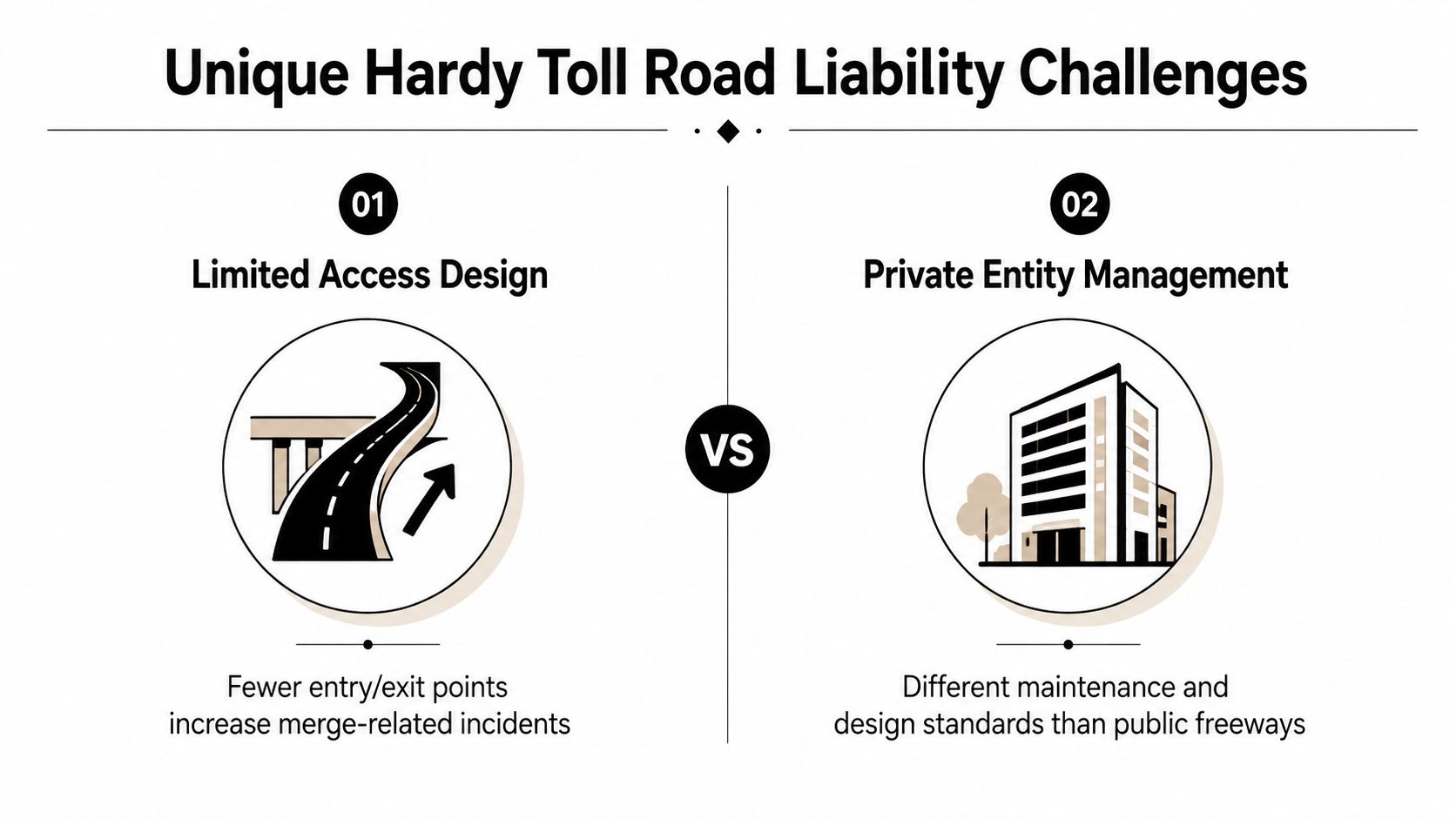
Roadside barriers deserve close examination. A French study of toll motorways reported lower injury risk in some run-off-road crashes when a longitudinal barrier was present. The study's source link must be verified before relying on that finding, because the provided crash statistics database does not, by itself, establish that it contains the French research.
The broader point remains important. Barrier placement, condition, design, and relation to the vehicle path may show whether a barrier contained a vehicle, redirected it into another lane, or failed to reduce the impact. Those facts can support a claim involving roadway design or maintenance.
More than one party may share responsibility
Potentially responsible parties include:
- Another driver, for unsafe speed, distraction, impairment, tailgating, or an improper merge.
- A trucking company or carrier, when driving conduct, maintenance, training, or supervision contributed.
- A roadway authority or contractor, if a dangerous surface, missing warning, defective barrier, or malfunctioning toll equipment played a role.
- A vehicle or parts manufacturer, when a defective component contributed to lost control or injury.
Multi-vehicle crashes require a coordinated reconstruction. The multiple-vehicle collision resource explains why the sequence of impacts, damage locations, and each driver's movement matter when Texas comparative fault rules divide responsibility.
Preserve photographs, vehicle data, witness details, medical records, and roadway observations. A Hardy Toll Road accident lawyer can use that evidence to test competing accounts and identify every party whose conduct or property contributed to your recovery.
How to File an Insurance Claim and Deal with Adjusters
Texas follows a fault-based system for collision claims. You should notify your own insurer according to your policy, then identify the at-fault driver's available coverage. If the other driver has no insurance or insufficient coverage, your policy may include uninsured or underinsured motorist protection, subject to its terms and the facts of the claim.
Start with a written record. Keep the claim number, adjuster's name, insurer, phone number, email address, and every communication date. Save photographs, medical records, repair estimates, wage documentation, prescriptions, and receipts in one secure folder.
What to say and what to avoid
Tell the insurer that a crash occurred, where it happened, who was involved, and where you received medical care. Don't speculate about speed, fault, injury severity, or the full extent of future treatment. Don't guess if you're unsure. “I don't know” is more accurate than an answer that an adjuster later presents as an admission.
You're not required to help the other insurer build its defense. Be cautious with recorded statements, broad medical-record authorizations, and requests for unrelated personal information. An insurer may use an early statement to argue that you felt fine, caused the collision, or had a preexisting condition.
Read settlement offers carefully
A quick offer may not account for continuing treatment, missed income, vehicle losses, or permanent limitations. Once you sign a release, you may give up claims for losses that haven't fully developed. Don't sign just because bills are arriving or the adjuster sounds confident.
Insurance companies may also delay evaluation, request repeated documentation, or dispute the need for treatment. Those tactics don't prove that your claim lacks value. They show why a Texas injury attorney should review the evidence before you accept an offer.
Your claim is more than the first bill: Document how the crash affects your treatment, work, mobility, sleep, and daily responsibilities.
When negotiations stall, counsel can prepare a formal demand supported by liability evidence and damages records. In a serious toll-road collision, legal representation also helps coordinate communications when several drivers and insurers are involved.
Types of Compensation Available Under Texas Law
Damages are the losses you seek to recover after an injury. They can include financial costs, personal harm, and, in limited circumstances, exemplary damages. A settlement should account for the full impact of the crash, not only the bills that have arrived.
| Damage Type | Examples | Texas Legal Notes |
|---|---|---|
| Economic damages | Medical care, rehabilitation, lost wages, reduced earning capacity, vehicle repair or replacement, transportation, and other out-of-pocket costs | These losses are tied to financial harm and should be supported with records. |
| Noneconomic damages | Physical pain, emotional distress, loss of enjoyment of life, and disfigurement | These losses are personal and may require medical evidence and testimony about daily effects. |
| Wrongful death damages | Funeral expenses, loss of companionship, and loss of financial support | Families may pursue wrongful death compensation when a fatal crash meets Texas legal requirements. |
| Exemplary damages | Punishment-focused damages in qualifying cases involving gross negligence | Chapter 41 imposes a statutory cap. |
Economic damages may include future medical treatment and future loss of earning capacity when the evidence supports those claims. Noneconomic damages address what the injury has taken from you, including independence, comfort, recreation, and emotional stability.
For a general framework on how to calculate accident damages, keep in mind that an online estimate can't replace a case-specific review. Medical records, work history, expert opinions, photographs, and testimony may all affect the analysis.
Texas Chapter 41 limits exemplary damages to the greater of two times economic damages plus noneconomic damages up to $750,000, or $200,000, as explained in Texas Civil Practice and Remedies Code Section 41.008. Punitive damages aren't automatic, and ordinary negligence alone doesn't guarantee them.
If the at-fault driver lacks adequate coverage, review your policy and consider uninsured motorist coverage in Texas. Coverage disputes require careful attention to policy language, notice, consent, and the facts of the crash.
Why You Need a Hardy Toll Road Accident Lawyer
A high-speed Hardy Toll Road crash can involve several vehicles, conflicting accounts, and evidence that disappears quickly. Camera footage may be overwritten, damaged vehicles may be repaired, toll records may require a formal request, and witnesses may recall the sequence differently within days. Your lawyer should send preservation requests, identify available records, and build a collision timeline before key evidence becomes difficult to obtain.
Public crash information can provide useful context. TxDOT maintains a statewide automated crash database and offers public CRIS records covering the previous 10 years plus the current year, according to the Federal Highway Administration crash-data resource. TxDOT also publishes annual Texas crash summaries, with the previous 10 years of data available by June of the following year. Its archive includes 2025 crash statistics on the crash data analysis and statistics page.
Those records do not establish fault by themselves. They can help investigators examine roadway design, lane configuration, time of day, contributing conditions, and collision patterns near a location. A well-supported claim connects that public information with physical evidence, vehicle downloads, photographs, witness accounts, medical records, and accident-reconstruction analysis.
Texas comparative fault makes this review important. If an insurer assigns you an inflated share of responsibility, your recovery may be reduced or barred depending on the percentage assigned. Your lawyer should test each driver's conduct, including unsafe lane changes, following distance, speed, and actions that triggered a chain-reaction crash.
Coverage can be complicated too. A multi-vehicle collision may involve several liability insurers, a commercial policy, your uninsured or underinsured motorist coverage, and potential roadway claims. An attorney can evaluate each possible source of recovery, prepare the claim, negotiate with insurers, preserve evidence, and pursue litigation when a fair resolution is unavailable.
The Law Office of Bryan Fagan, PLLC offers contingency-fee representation. Clients pay no upfront fees, and the firm collects a fee only upon securing compensation, as outlined in the representation agreement.
Take the First Step Toward Recovery Today
You don't need to have every answer before speaking with a lawyer. You can start with what you know: where the crash happened, when it occurred, who was involved, what injuries you're treating, and which insurers have contacted you.
A consultation should help you understand the practical issues in your case. That includes possible liability, comparative responsibility, insurance coverage, damages, evidence preservation, and the filing deadline. Texas personal injury claims are generally subject to a two-year statute of limitations under Section 16.003, which means suit generally must be filed no later than two years after the cause of action accrues. Review the rule in Texas Civil Practice and Remedies Code Section 16.003 and don't wait until the deadline is close.
Bring your crash report information, insurance correspondence, photographs, medical records, bills, wage documentation, and policy information if you have them. If you don't have everything, reach out anyway. Early advice can prevent an avoidable statement, preserve important evidence, and give you a clearer path through recovery.
The Law Office of Bryan Fagan, PLLC offers a free consultation for people injured in Texas vehicle collisions and families facing fatal-crash claims. You can discuss the Hardy Toll Road collision, learn which recovery options may apply, and decide what action makes sense without pressure.
The Law Office of Bryan Fagan, PLLC offers compassionate, contingency-fee representation for Hardy Toll Road crashes, including serious injuries, multi-vehicle collisions, uninsured-driver disputes, and wrongful death claims. Contact The Law Office of Bryan Fagan, PLLC to request a free consultation and speak with a Texas personal injury team about protecting your rights and pursuing the compensation your recovery requires.