A car crash can change your life in seconds, but you don't have to face recovery alone. If you're sitting on the shoulder of the Grand Parkway with your hazards flashing, your hands shaking, and questions coming faster than answers, focus first on safety and medical care. The legal questions can wait a few minutes, but evidence, insurance decisions, and your health need attention sooner than many people realize.
Highway 99 is a demanding crash environment. Harris County officials reported 2,280 Grand Parkway crashes in 2024, including 9 deaths, the highest fatality total on the highway in the previous five years. The same report listed 8 deaths in 2023, 7 in 2022, 3 in 2021, and 5 in 2020, with 53 fatalities since 2014. (Reported Grand Parkway crash and fatality history)
If you're looking for a Grand Parkway accident lawyer, you may be dealing with more than a basic rear-end collision. Wrong-way driving, hydroplaning, lane departures, retention-pond exits, distracted driving, narrow shoulders, and high-speed merges can create several competing explanations for one wreck. The next several hours can determine which explanation the evidence supports.
Right After a Grand Parkway Crash, What You Are Facing
Your vehicle is stopped near a Grand Parkway interchange. Hazard lights blink while traffic passes close enough to shake the car. Police are responding, your neck feels tight, and adrenaline may be masking the pain. You still have to answer questions while watching for another vehicle drifting toward the shoulder.
That reaction is common after a serious collision. Once the shock fades, headaches, back pain, numbness, dizziness, or sleep problems may appear. A medical evaluation addresses those symptoms and records what you reported and what clinicians observed. Prompt care can also prevent an injury from worsening.
Highway 99 creates facts that ordinary rear-end advice may miss. Wrong-way driving, hydroplaning, a single-vehicle exit from the roadway, or a high-speed multi-lane impact can produce competing explanations. Investigators may need to examine tire marks, vehicle paths, debris, roadway drainage, lighting, visibility, and the timing of each lane change. In a chain reaction, the driver who struck one vehicle may have pushed it into another lane, leaving insurers to dispute which impact caused each injury or item of damage.
The first day is about protecting your health and preserving the facts, not proving your entire case at the roadside.
Texas also imposes a filing deadline. Under Texas Civil Practice and Remedies Code Section 16.003, most personal injury lawsuits must be filed within two years of the crash. Treatment, vehicle repairs, missed work, and insurance calls can consume that time, while roadway evidence may disappear much sooner.
For a plain-language checklist covering immediate post-crash decisions, review what to do after a car accident. Your early choices should reduce danger, connect medical findings to the collision, and preserve proof before traffic, towing, weather, or overwritten video changes the record.
Protecting Yourself and Your Case in the First Hours
Safety comes before photographs. If you can move without creating more danger, get to the safest shoulder or exit area available, turn on your hazard lights, and stay away from live traffic. If your vehicle can't move, remain inside when that's safer, unless emergency conditions require you to leave.
Call 911 and request medical and police assistance. Give the dispatcher the location, direction of travel, nearby exit, and any visible injuries. The responding agency may be the Texas Department of Public Safety or a local constable's office, so ask how to obtain the crash report number before you leave.

Preserve what the roadway can erase
Use your phone to photograph vehicle positions, visible damage, license plates, skid marks, debris, standing water, signs, lane markings, guardrails, and lighting. If a tow truck has already moved a vehicle, photograph the final position and write down what changed. A hydroplaning debris field may be scattered by passing cars, while wrong-way-driving evidence can vanish as traffic continues through the area.
Look for witnesses and ask for names, phone numbers, and a short description of what they saw. Ask whether anyone has dashcam footage. Front-facing video may be overwritten quickly, so contact potential witnesses promptly and ask them to preserve the original file rather than sending only a compressed social-media copy.
Protect your statements and health
You must cooperate with reasonable claim administration, but you don't have to give the other driver's insurer a recorded statement before understanding your injuries and legal position. An adjuster may ask questions that sound routine but invite guesses about speed, lane position, symptoms, or fault. Keep communications factual and limited, and consider discussing Dealing With Insurers After a Houston Accident before signing a release or accepting an early payment.
Seek medical evaluation even if your pain feels tolerable. Keep discharge papers, prescriptions, imaging reports, bills, work notes, and a daily symptom record. Small omissions can later make it harder to prove what the crash caused, how treatment progressed, and which losses remain.
Who Is Liable on a High-Speed Texas Freeway
Liability means legal responsibility for causing harm. In a Grand Parkway case, liability may belong to one driver, several drivers, an employer, a vehicle owner, or a public entity responsible for a roadway condition. The answer depends on evidence, not on which vehicle suffered the most visible damage.
Texas uses modified comparative fault under Chapter 33. In plain English, a person can recover damages when their responsibility is 50% or less, but the award is reduced by that person's percentage of fault. A claimant who is more than 50% responsible can't recover damages under the statute. Texas law also generally assigns each liable defendant responsibility for that defendant's percentage share of the damages. (Texas comparative responsibility rules)
Consider a wrong-way driver who clips a sober motorist. The wrong-way driver may carry most of the responsibility, but insurers could still investigate speed, visibility, evasive action, roadway design, or another driver's conduct. In a lane-departure crash, a tired commercial driver who crosses a gore point may create claims involving the driver, the employer, and possibly the vehicle owner.
Hydroplaning presents a different question. If a missing drainage grate or another dangerous condition on a TxDOT right-of-way contributed to the crash, a governmental entity might become part of the analysis. Government claims require special attention to notice rules and deadlines, so waiting for the ordinary lawsuit deadline can create a serious problem.
Evidence used to divide responsibility
A reconstruction may compare vehicle damage, event data recorder information, braking, steering, lane position, roadway grade, weather, and sight distance. Lawyers may also request 911 logs, dispatch records, phone evidence, employer records, inspection documents, and available video.
TxDOT's crash-data system matters because Texas law enforcement submits reportable crashes into a statewide automated system, and TxDOT retains crash records for 10 years plus the current year. Its 2024 tables reported 215.41 crashes per 100 million vehicle miles for urban state highways, 152.18 for urban interstates, and 319.64 for urban four-lane undivided roads. Those benchmarks don't decide fault, but they can help an expert examine roadway context and recurring risk. (TxDOT crash data and statistics)
| Potential Defendant | Common Grand Parkway Scenario | Key Evidence |
|---|---|---|
| Other driver | Wrong-way impact, unsafe merge, or distracted lane departure | 911 logs, witnesses, vehicle data, video |
| Commercial driver or employer | Fatigue-related drift or work-related driving | Driver records, employer policies, vehicle data |
| Vehicle owner | Owner allowed use of an unsafe or poorly maintained vehicle | Maintenance records, ownership documents |
| Government entity | Roadway drainage, guardrail, signs, or design condition contributed | Inspection records, photos, roadway measurements |
| Multiple parties | Chain-reaction collision with several contributing acts | Reconstruction, damage sequence, statements |
For a practical explanation of shared responsibility, see comparative fault in Texas.
What Compensation You May Actually Recover
Damages means the money a claimant seeks for legally recognized losses. Texas generally separates these losses into economic and non-economic categories, with the governing damages rules found in Chapter 41 of the Texas Civil Practice and Remedies Code. (Texas damages chapter)
Economic damages are the bills and financial effects that can be calculated. They may include emergency care, imaging, surgery, rehabilitation, medication, future treatment, lost wages, reduced earning capacity, towing, transportation, and other reasonable out-of-pocket costs. A person who can't return to the same work may need employment records, tax documents, medical opinions, and vocational or economic analysis to explain the future effect.
Non-economic damages address losses that don't arrive with an invoice. They can include physical pain, mental anguish, reduced enjoyment of life, disfigurement, and loss of consortium. Medical records help, but they don't tell the whole story. A clear account of sleep problems, restricted activities, family strain, and daily limitations can help explain what an injury has changed.
Documentation shapes the value
There isn't a reliable universal price for a Grand Parkway injury. Publicly available broader personal-injury data places the median auto-accident settlement around $31,000, but that figure is not a prediction for any particular claim and doesn't represent catastrophic injuries. (Aflac accident claims checklist)
A well-organized file is more useful than a dramatic demand unsupported by records. Delayed treatment, missing bills, unexplained gaps, and incomplete descriptions of prior conditions give an insurer room to argue that the crash didn't cause the claimed harm. Objective imaging, operative notes, consistent treatment, and testimony about future care can support a more complete valuation.
| Damage Category | What It Covers | Proof Typically Required |
|---|---|---|
| Medical expenses | Past and future care, medication, rehabilitation | Records, bills, imaging, medical opinions |
| Lost income | Missed work and reduced earning capacity | Wage records, employer statements, vocational evidence |
| Pain and mental anguish | Physical suffering and emotional effects | Treatment notes, testimony, family observations |
| Life changes | Reduced activities, disfigurement, loss of consortium | Daily-life evidence, photographs, testimony |
| Wrongful death compensation | Funeral costs, survivor losses, companionship, estate damages | Death records, funeral bills, financial and family evidence |
In a fatal collision, surviving family members may pursue wrongful death compensation and estate-related damages. Comparative fault can reduce an award, but it doesn't automatically eliminate recovery when the claimant's responsibility remains within the statutory limit.
How the Insurance Claim and Lawsuit Timeline Works
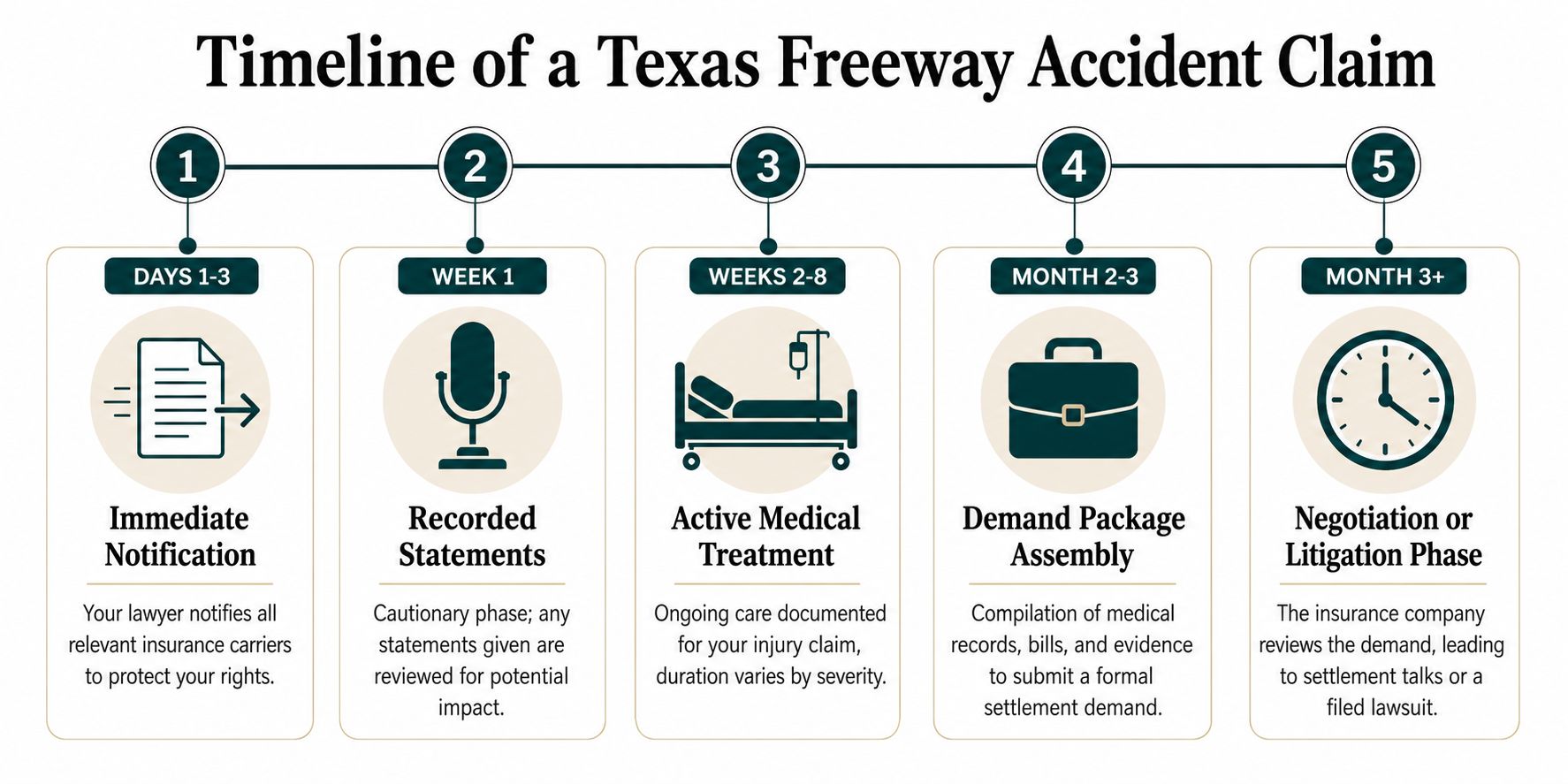
A Grand Parkway claim can begin with a short insurance call and become a detailed dispute over speed, visibility, hydroplaning, or a vehicle that left the roadway. An auto insurance claim asks an insurer to provide coverage or payment under a policy. Reporting the crash promptly puts the carrier on notice, but it does not require you to accept its account or settle the case.
In the first days, an adjuster may request a recorded statement, medical authorization, photographs, or a quick property-damage resolution. Provide accurate information, avoid guessing, and do not sign a broad release while your medical condition remains uncertain. A fast offer may cover visible vehicle damage while leaving treatment, lost income, and lasting limitations unresolved.
Treatment and claim preparation
Medical care may last weeks or months, depending on the injury. Keep each provider's name, appointment date, diagnosis, recommendation, and bill. Your lawyer may collect the crash report, TxDOT materials, photographs, witness information, medical records, wage proof, and insurance documents for a demand package once your condition is stable enough to evaluate, or doctors can reasonably project future care.
The package should connect the collision to the injury and the injury to the requested damages. It should answer practical questions: What happened on the freeway? Why is another person or entity responsible? What treatment was necessary? How did the injury affect work and daily activities? What future care remains possible?
Texas generally gives an injured person two years from the crash date to file a personal injury lawsuit. Minors, government defendants, and other circumstances can change the deadline, so obtain a legal review early instead of treating that period as permission to wait.
When negotiation stops working
Claims may stall over fault, medical causation, policy limits, future treatment, or the value of non-economic harm. Delays involving vehicle inspections, repeated statement requests, social-media monitoring, and early offers can add pressure before the diagnosis is final.
Filing suit does not guarantee a trial. It preserves the claim, creates formal evidence procedures, and demonstrates that the deadline is being addressed. For a practical overview of how long a personal injury case takes, review the expected stages and timing.
Settlement Versus Trial, A Real Decision
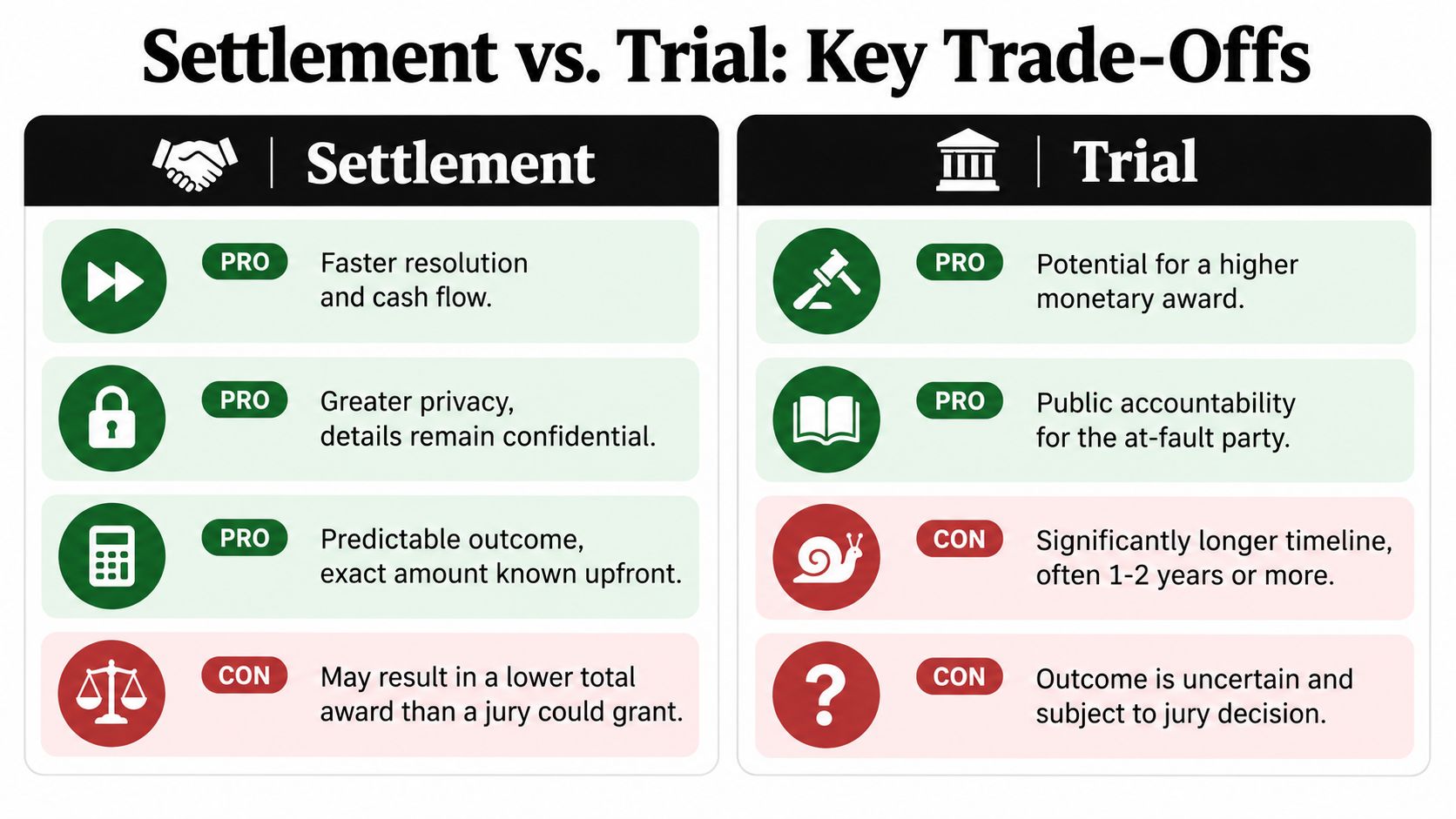
Settlement and trial serve different purposes. A settlement usually offers more control over timing, privacy, and the final number. Trial gives a judge or jury the power to decide disputed facts and damages, but the result is less predictable and requires greater preparation.
A settlement can provide earlier resolution and avoid the stress of testimony. It may also permit structured payment arrangements, subject to the agreement and applicable financial advice. The trade-off is that you give up the right to seek more from the settling parties, even if later evidence suggests the claim could have been worth more.
Trial may make sense when liability is contested, evidence is strong, injuries are substantial, or an insurer refuses a fair policy-limit tender. A verdict can include compensation for non-economic losses and, in an appropriate case involving especially serious conduct, punitive damages. It can also produce an unfavorable result, and comparative fault may reduce the award.
The middle ground is often mediation
Mediation gives both sides a structured opportunity to negotiate with a neutral third party. It doesn't guarantee agreement, but it can resolve a case while preserving more control than a verdict. Cases involving roadway design, multiple drivers, commercial operators, or disputed medical causation may require mediation after the evidence is developed.
County strategy matters too. A lawyer may consider venue, local procedures, available witnesses, expert costs, and the practical posture of courts in Harris, Fort Bend, Brazoria, Chambers, or Galveston County. The right decision depends on the evidence and your needs, not on a promise that every case should settle or every case should be tried.
For property damage and valuation issues, these insurance settlement negotiation tips can help you understand why vehicle value disputes may need separate attention from the injury claim.
Choosing the Right Grand Parkway Accident Lawyer
A free consultation should be practical, not performative. Bring the crash report number, scene and vehicle photographs, insurance declarations page, medical records, bills, wage information, and a list of every treating provider. If you don't have everything, don't wait to call. A lawyer can identify what remains missing and what may need immediate preservation.
Ask direct questions before signing:
- Who handles the file? Find out whether the attorney you meet will make key decisions or whether the matter will move to another team.
- What Highway 99 experience matters here? Ask about Grand Parkway cases involving wrong-way drivers, lane departures, hydroplaning, roadway exits, commercial vehicles, and multi-lane reconstruction.
- Where has the lawyer tried cases? Ask about experience in Harris, Fort Bend, Brazoria, Montgomery, Galveston, Liberty, or Chambers counties when those venues may matter.
- How are costs handled? Clarify whether the firm advances case expenses, how experts and records are paid, and what happens if the case doesn't recover money.
- Who manages property damage and liens? A strong injury claim can still become difficult if vehicle issues, medical balances, or reimbursement claims are ignored.
- How will communication work? Ask who updates you during treatment and how quickly you can expect answers about offers, deadlines, and major decisions.
Fees should be clear before representation begins
Many Texas injury firms use contingency-fee agreements, meaning the attorney's fee depends on a recovery rather than an upfront payment. The percentage, case-cost treatment, litigation expenses, and any reimbursement obligations should appear in a written fee agreement. Texas lawyers must provide clients with written fee terms, so read the agreement carefully and ask about anything you don't understand.
A general personal injury firm may handle a wide range of cases. A corridor-focused lawyer should also know how to investigate TxDOT records, preserve dashcam evidence, examine event data, analyze wrong-way impacts, and work with reconstruction experts when the roadway itself becomes part of the dispute. That knowledge can matter when a claim involves more than one careless driver.
A Houston car accident lawyer can help with a Grand Parkway collision, but the right fit depends on the facts, location, injuries, and parties involved. You may also need a Texas injury attorney for a truck crash, uninsured-motorist dispute, or fatal collision. The Law Office of Bryan Fagan, PLLC handles car, truck, wrongful death, insurance, and serious injury claims and offers free consultations with contingency-fee representation.
The Law Office of Bryan Fagan, PLLC can review your Grand Parkway crash, help preserve roadway and medical evidence, and explain your insurance and litigation options without charging for the initial consultation. Visit The Law Office of Bryan Fagan, PLLC to request a free case review and take the next step toward protecting your recovery.