A car crash can change your life in seconds, but you don't have to face recovery alone. Maybe you're sitting at home after a garbage truck struck your vehicle, bicycle, or loved one on a Houston street. Your body hurts, your work has been disrupted, and an insurance adjuster is already asking for information you're not sure how to provide.
Garbage-truck crashes can involve city departments, private waste companies, drivers, maintenance contractors, and multiple insurance policies. The right path depends on who owned the truck, how the collision happened, what evidence still exists, and which Texas deadlines apply. This guide explains those issues in plain English, including when a Houston garbage truck accident lawyer can help protect your claim.
How a Garbage Truck Crash Can Turn a Normal Day Upside Down
Before sunrise in Meyerland, a parent may be backing out of a driveway while the neighborhood is still quiet. A rear-loader turns onto the residential street, its hydraulic equipment groaning as the truck swings wide around a parked car. In a few seconds, the driver, the household vehicle, and nearby pedestrians may all be forced into the same narrow space.
The collision can leave more than a damaged bumper. A parent may need emergency care, a child may be frightened, and a family vehicle may require towing. The injured person might miss work while trying to schedule appointments, manage pain, and understand why one insurer says the City is responsible while another points to a private contractor.
A similar crash can happen in a tight Heights alley, an apartment parking lot, or near a busy neighborhood intersection. A truck backing toward a collection point may strike a cyclist. A worker riding on the rear platform may fall when the truck moves before the route is clear. A driver turning through a blind spot may hit a car that had the right of way.
The first priority is your health. The second is preserving the facts before they disappear.
This guide focuses on the practical questions that usually create the most stress:
- Who may be responsible: The City of Houston, a private hauler, a driver, a maintenance company, or more than one party.
- What deadlines apply: A municipal claim can involve a notice deadline as short as 90 days, while Texas generally gives injured people two years to file a personal injury lawsuit. The Texas Civil Practice and Remedies Code contains the general limitations rule.
- What evidence matters: Photos, witness information, route records, cameras, telematics, maintenance logs, and medical documentation.
- How insurance works: Your own policy, the truck operator's commercial coverage, and possible uninsured or underinsured motorist coverage may all matter.
You don't need to solve every legal issue from the kitchen table. You do need to act carefully while the evidence and deadlines remain available.
Key Legal Terms Every Houston Victim Should Understand
Legal letters can feel harder to read than they need to be. These definitions will help you understand conversations with insurers and attorneys.
Negligence and liability
Negligence usually means failing to use the care a reasonably careful person or company would use in similar circumstances. A driver who backs without checking the path, follows too closely, uses a phone, or ignores a malfunctioning warning system may have acted negligently.
Liability means legal responsibility for the harm. If a contracted Waste Management rear-loader strikes a parked car near Montrose, liability could involve the driver's conduct, the contractor's supervision, or a mechanical problem. The truck's presence alone doesn't prove fault. The evidence must connect a careless act or omission to the injury or damage.
Vicarious liability, sometimes called respondeat superior, is an employer-responsibility rule. If an employee causes a crash while performing job duties, the employer may also face responsibility for that employee's negligence. That analysis can differ when the driver is an independent subcontractor.
Comparative fault
Comparative fault means more than one person may share responsibility. Under Texas law, a claimant may recover only when their share of fault is 50% or less, and the recovery is reduced by that percentage. If the claimant's responsibility is greater than 50%, recovery is barred under the Texas rule described in this explanation of Texas comparative negligence.
For example, if a bicyclist was partly in a truck's blind area but the driver backed without using available safety procedures, an investigation may assign fault to both sides. The final result depends on the evidence, not an assumption that the larger vehicle is automatically responsible.
Other terms you may encounter
- Texas Tort Claims Act: The legal framework that allows certain claims against Texas governmental entities, subject to special procedures and limits. A City-operated garbage truck claim needs prompt attention because notice requirements can apply.
- Statute of limitations: The deadline for filing a lawsuit. Missing it can end your right to sue, even if your injury and liability evidence are strong.
- Common carrier: A business that transports members of the public or property for compensation. Waste collection vehicles are generally analyzed as commercial motor vehicles, but calling a garbage operator a common carrier doesn't automatically decide liability.
- Punitive damages: Additional damages that may be available in limited cases involving especially wrongful conduct. They require more than ordinary carelessness.
- Subrogation: An insurer's effort to recover money it paid from the party responsible for the loss. This can affect how medical or insurance payments are handled after settlement.
Why Garbage Trucks Create Unique Risks on Houston Streets
Garbage trucks combine heavy equipment, repeated stops, limited visibility, and difficult route geometry. They're built to collect and compact waste, not to maneuver like a passenger sedan. Houston's residential streets, alleys, apartment drives, and school-area traffic can leave little room for a large truck to correct an error.
The physics matter. The National Highway Traffic Safety Administration's federal stopping-distance material notes that emergency braking for a heavy truck can require up to 720 feet at 60 miles per hour in an unloaded condition. That doesn't excuse unsafe driving, but it helps explain why speed, following distance, sightlines, and early hazard recognition are central issues in a truck case.
The Texas Department of Transportation commercial motor vehicle crash records also show that commercial-vehicle crashes and injuries are tracked at the county level. Those records can provide context, but a claim still turns on the facts of the particular collision.
| Risk Factor | Why It Matters in Houston | Typical Crash Pattern |
|---|---|---|
| Blind spots | A tall cab and collection equipment can hide people, bicycles, or smaller cars from the driver. | Turning collision or pedestrian strike |
| Frequent stops | Trucks stop repeatedly near homes, apartments, and curbside collection points. | Rear-end crash or sudden lane change |
| Backing movement | Narrow drives and alleys can force a driver to reverse around parked vehicles and obstacles. | Backup strike involving a person, cyclist, or car |
| Turning sweep | The rear of the truck can travel differently from the front during a turn. | Sideswipe or left-turn collision |
| Hydraulic equipment | Lift arms, compactors, and exposed work areas create hazards for workers and nearby people. | Worker fall or equipment-related injury |
Why low-speed crashes still deserve serious attention
A truck doesn't need to be moving quickly to cause a severe injury. A person can be pinned, pulled beneath a vehicle, or struck while standing in a blind area. OSHA's Garbage Truck accident search reflects that garbage-truck incidents continue to receive federal safety attention.
The important questions include whether backup alarms and cameras worked, whether a spotter was needed, whether the driver followed route procedures, and whether maintenance problems affected visibility or braking. Those details often distinguish a careful operation from unsafe conduct.
Who Is on the Hook When a Garbage Truck Causes Harm
The truck's ownership is one of the first facts to identify. Houston may operate some sanitation vehicles, while private companies may perform collection under contracts with the City, apartment communities, homeowners' associations, or other property managers. The answer changes the notice process, available insurance, and potential defendants.
Three common responsibility paths
A City-operated truck may lead to a claim involving the City and the Texas Tort Claims Act. For example, if a Solid Waste Management truck runs a stop in Third Ward, investigators would examine the driver's conduct, the vehicle's condition, and any governmental notice requirements.
A private contractor may be responsible when its truck backs over a cyclist in Memorial. The contractor's commercial policy, route instructions, training records, and supervision may become important. If the driver was supplied through another company, that subcontractor may need to be investigated too.
An individual driver can also carry direct responsibility. Phone use, unsafe speed, failure to check mirrors, or ignoring a known blind spot may support a negligence claim. An employer may face negligent entrustment allegations if it assigned a vehicle to a driver it knew, or should have known, was unfit to operate it.
| Truck Operator | Legal Theory Typically Used | Notice Requirements | Insurance Coverage to Pursue |
|---|---|---|---|
| City-operated fleet | Negligent operation, governmental liability rules | Special municipal notice may apply, potentially as short as 90 days | Government claim process and available applicable coverage |
| Private waste contractor | Driver negligence, respondeat superior, negligent hiring or supervision | Prompt claim notice and ordinary legal deadlines generally matter | Commercial auto policy and contractor coverage |
| Subcontractor | Direct negligence and contract-related responsibility | Identify the contracting chain quickly | Subcontractor and primary contractor policies |
| Maintenance provider | Negligent repair or failure to identify a safety defect | Preserve service records and inspection history | Applicable business liability or vehicle coverage |
| Vehicle or equipment maker | Product defect theory when supported by evidence | Preserve the truck and defective component | Manufacturer coverage, subject to the facts |
A lawyer must verify the operator rather than rely on the truck's colors or logo. The vehicle may be leased, operated under a contract, or maintained by a separate business. Route assignments, vehicle identification numbers, municipal contracts, dispatch records, and insurance information can help identify every potentially liable party.
The goal isn't to name everyone indiscriminately. It's to identify each party whose conduct or legal relationship contributed to the injury.
A Houston garbage truck accident lawyer may also coordinate the case with a Houston commercial vehicle accident lawyer when the collision involves broader commercial-vehicle issues. Early investigation matters because one defendant may have limited coverage while another has additional insurance or contractual responsibility.
Evidence to Gather in the First Hours After the Crash
Your first decisions can preserve facts that may later become difficult to obtain. If anyone is hurt, call 911 and request medical help. If the scene is safe and no one needs immediate care, move out of traffic when possible, as the Texas Department of Insurance advises in its post-wreck safety guidance.
Start with the scene
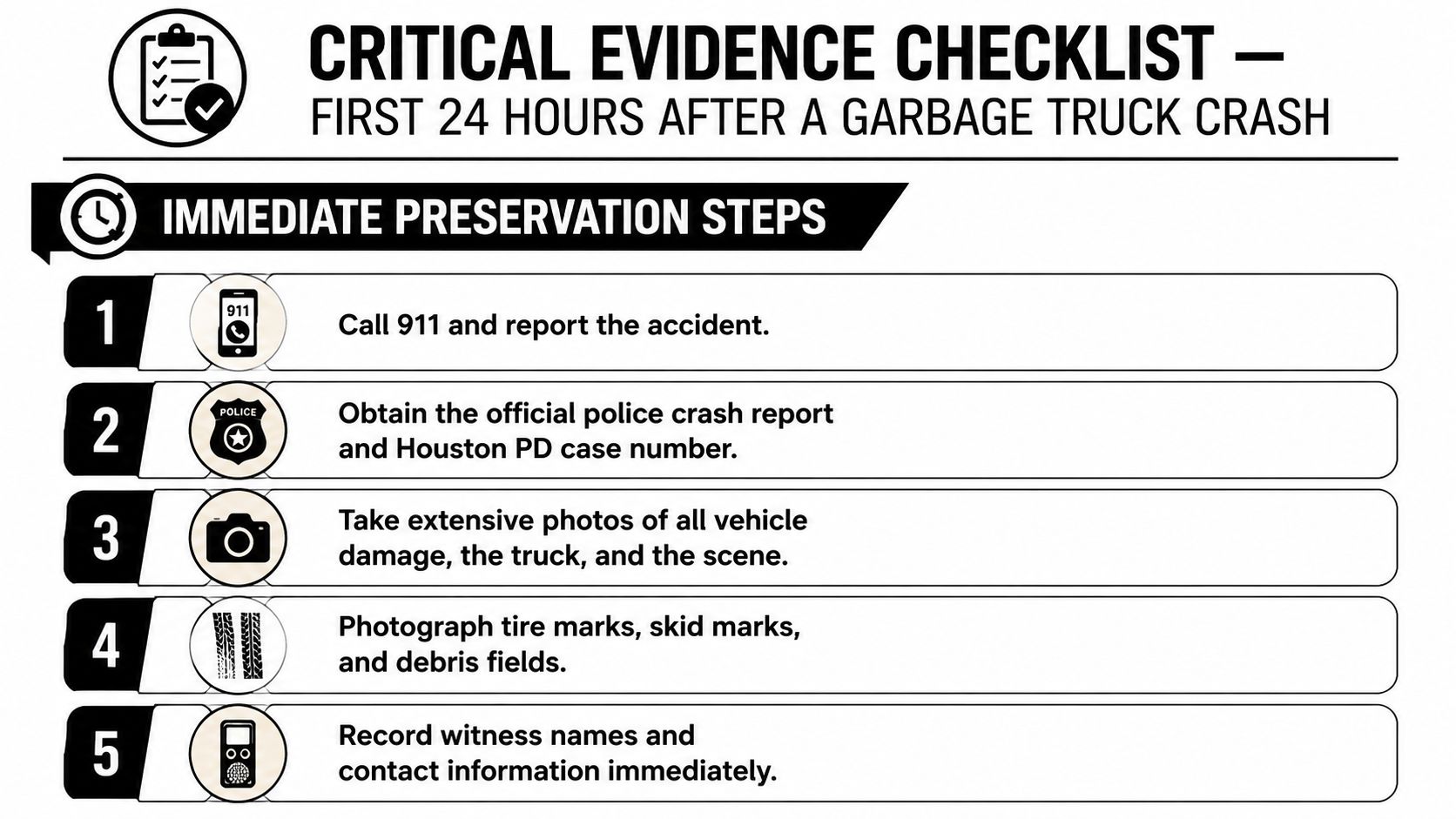
Ask for the police crash report and record the Houston Police Department case number if officers respond. Take photographs of the vehicles, truck markings, damage, debris, tire marks, road position, traffic signs, lighting, and surrounding buildings. Photograph the truck from different angles, including areas where mirrors, cameras, or equipment may have limited visibility.
The guide to obtaining Houston police records can help you locate the official report. Don't rely only on the report, however. Police reports may not contain every witness statement, camera recording, or mechanical detail.
Preserve information before it disappears
- Record witnesses: Get names, phone numbers, and a short description of what each person saw.
- Identify the truck: Photograph unit numbers, license information, company names, and route markings.
- Look for cameras: Nearby businesses, homes, apartment offices, Houston TranStar traffic cameras, and METRO bus cameras may have useful footage.
- Document medical care: Keep discharge papers, prescriptions, referrals, bills, and treatment instructions.
- Track work losses: Save employer records, missed-shift information, and proof of reduced income.
- Keep damaged property: Don't repair or discard a bicycle, helmet, clothing, or vehicle parts before they're documented.
An attorney can send a preservation, or spoliation, letter to the City, contractor, and other parties. That request can target telematics, GPS route data, onboard cameras, driver qualification files, maintenance records, dispatch communications, and training materials. These records may be overwritten or discarded under ordinary company practices, so early action can change what investigators are able to review.
For practical information about protecting an auto insurance claim, avoid giving a recorded statement or signing a broad release until you understand what you're accepting.
Texas Deadlines and Insurance Steps That Shape Your Claim
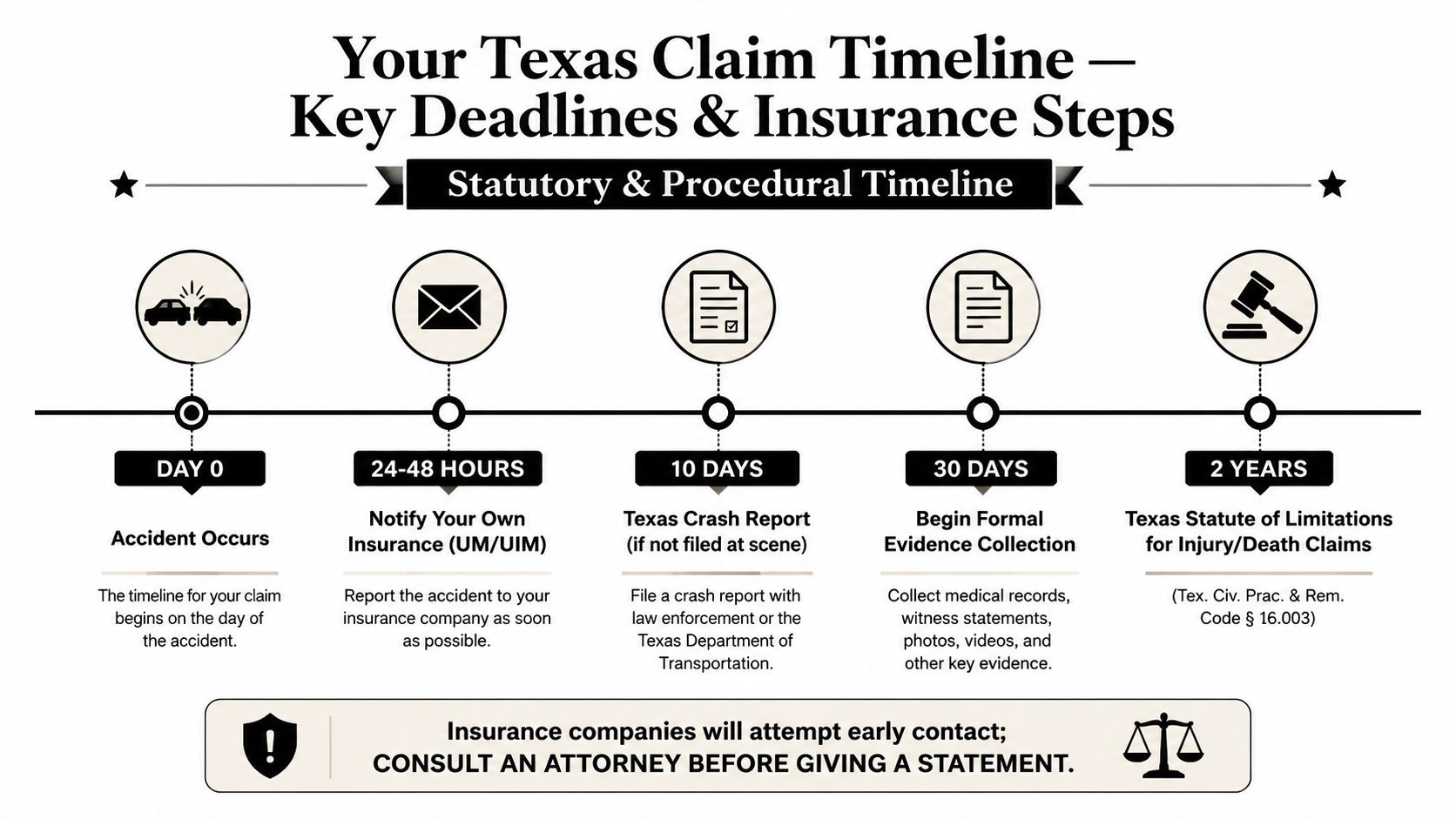
A garbage-truck claim can involve several clocks at once. The most urgent may not be the general lawsuit deadline. If a City vehicle is involved, the Texas Tort Claims Act may require notice within 90 days, depending on the applicable law and circumstances. Waiting for the police investigation or finishing medical treatment can put a municipal claim at risk.
Texas generally allows two years from the date a personal injury cause of action accrues to file a lawsuit under Chapter 16. The same general two-year period applies to many wrongful-death claims, but the details can depend on the cause of action and the people bringing it. A deadline is not a reason to rush medical decisions. It is a reason to obtain legal guidance promptly.
A practical claims timeline
At the scene: Seek care, call police when appropriate, exchange information, photograph the truck and scene, and obtain witness details.
As soon as possible: Notify your own insurer and ask about applicable personal injury protection or uninsured and underinsured motorist coverage. Report the crash to the commercial carrier only with care, because the carrier's adjuster represents its financial interests.
During the early investigation: Confirm whether the truck was City-operated, privately contracted, leased, or maintained by another company. Request records and preserve evidence before video, GPS, telematics, or dispatch information becomes unavailable.
Before any municipal deadline: Provide the required notice through the appropriate process. A general phone call to an adjuster may not satisfy a formal notice requirement.
Before the lawsuit deadline: File suit if necessary. Negotiations with an insurer don't automatically extend the statute of limitations.
Subrogation adds another layer. Your health insurer or another coverage provider may seek repayment from a settlement for amounts it paid. That doesn't mean you lose the right to compensation, but it means the final accounting must be handled carefully.
A lawyer letter of representation can direct communications through counsel and help organize the claim. It doesn't erase deadlines, and it doesn't guarantee a settlement.
How a Houston Garbage Truck Accident Lawyer Builds Your Case
A strong case begins before the first demand letter. Counsel can notify the City, contractor, insurer, and maintenance provider to preserve records that may otherwise disappear. That may include dashcam files, telematics, GPS route history, onboard camera footage, inspection records, driver qualification materials, and maintenance logs.
The investigation then tests competing explanations. Was the truck moving before a spotter cleared the area? Did a camera or backup alarm work? Did the route require a particular turn or stop? Was the driver using a phone, rushing, or operating with a known equipment problem?
From records to proof
A lawyer may seek the 911 call, police report, traffic-camera material, dispatch records, and available METRO or TxDOT footage. The legal team can also review City of Houston Solid Waste Management records or private contractor files to determine who controlled the vehicle and route.
An accident reconstructionist may analyze vehicle positions, turning paths, sightlines, braking, and timing. A medical expert may connect the injuries to the collision and explain future treatment or limitations. Those opinions should support the records, not replace them.
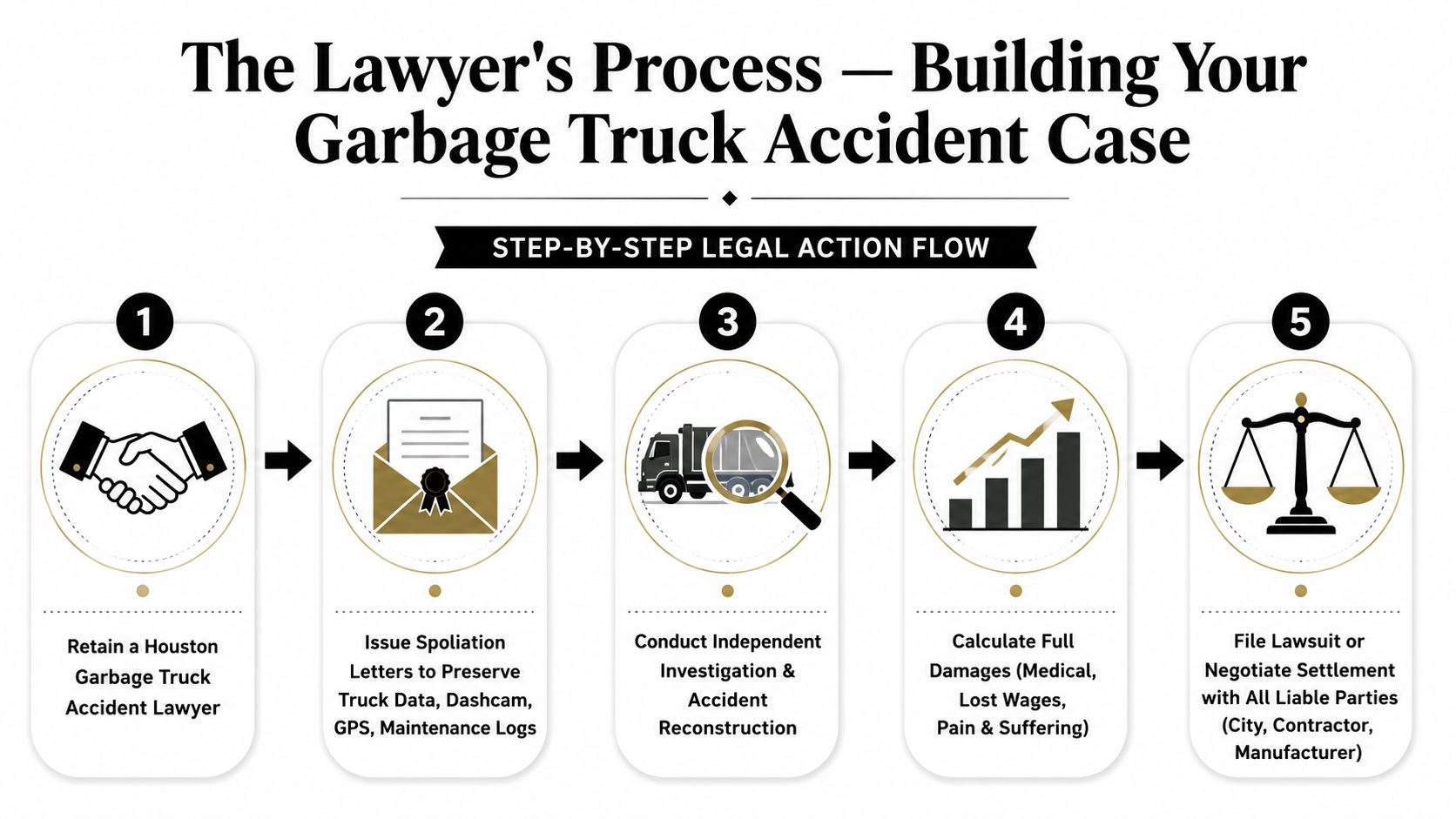
The demand package should connect liability to damages. Damages may include medical expenses, lost income, pain, impairment, and future care when the evidence supports those losses. Texas Chapter 41 addresses damages and proof standards, so a claim should be documented rather than overstated through unsupported demands.
Trying to handle the matter alone can create avoidable problems. A recorded statement may contain an incomplete description of the crash. A broad medical release may give an insurer access to unrelated history. A missed City notice deadline may end a municipal claim before the facts are fully investigated.
The Law Office of Bryan Fagan, PLLC handles Texas personal injury matters through negotiation and courtroom advocacy, with free consultations and contingency-fee representation described by the firm. A trial-ready approach can also give settlement discussions more structure, whether the opposing adjuster works for a city-related claim or a commercial carrier.
Common Questions and the Next Step Toward Recovery
How long does a garbage-truck case take?
There isn't one honest answer. A case may resolve after the parties understand fault, medical treatment, coverage, and documented losses. A more complicated claim may take longer because it involves a public entity, several insurers, disputed injuries, or expert review.
Do I have to pay a lawyer upfront?
Ask the firm about its fee agreement before representation begins. The Law Office of Bryan Fagan, PLLC states that it offers free consultations and contingency-fee representation, meaning clients don't pay unless the firm wins the case under the agreement.
Can a child passenger recover?
A minor may have a claim for injuries caused by another party's negligence. A parent or legal representative generally handles the claim process, but the child's medical needs, future care, and legal deadlines require careful review.
What if the driver fled?
A hit-and-run doesn't automatically eliminate your options. Police and counsel may work to identify the truck through cameras, witnesses, route records, vehicle markings, or insurance information. Your own uninsured or underinsured motorist coverage may also matter, depending on the policy and facts.
What if the driver was an independent subcontractor?
The label isn't decisive. Investigators should examine who hired the driver, controlled the route, owned or leased the truck, paid the driver, trained the person, and maintained the vehicle. Those facts can identify additional sources of responsibility and insurance.
What if I was partly at fault?
Texas comparative fault can reduce recovery based on your share of responsibility, and recovery is barred when your responsibility is greater than 50%, as discussed earlier. A bicyclist near a backing truck or a person stepping from a parked car shouldn't assume they're automatically at fault. The question is how each person acted and whether the truck operator followed reasonable safety practices.
What happens after a death?
A fatal crash may support a wrongful-death claim when another party's negligence caused the death. Texas generally uses a two-year limitations period for many wrongful-death claims, so families should seek advice early. While legal questions are pending, families may also find practical information about state-level death care after catastrophe helpful when arranging services and handling immediate decisions.
You may also be considering a Houston car accident lawyer if the garbage truck collision involved a passenger vehicle. The same basic concerns remain, but commercial-vehicle records, municipal notice rules, and contractor relationships can make the investigation more involved.
A free consultation can help you understand who may be responsible, which deadline applies, what evidence should be preserved, and whether an insurance claim or lawsuit is appropriate. You don't have to decide everything today, but you shouldn't let uncertainty stop you from protecting your rights.
The Law Office of Bryan Fagan, PLLC can review your Houston garbage-truck crash, investigate City or private-contractor responsibility, preserve truck and route evidence, and explain your insurance options during a free consultation. Visit The Law Office of Bryan Fagan, PLLC to discuss your injuries, deadlines, and path toward recovery.