A car crash can change your life in seconds, but you don't have to face recovery alone. If a dump truck hits your vehicle on a crowded Houston freeway, the aftermath can feel impossible to manage. You may be dealing with pain, missed work, medical bills, vehicle damage, and insurance representatives who want answers before you understand what happened.
A Houston dump truck accident lawyer can help protect the evidence, identify every responsible party, and explain your rights under Texas law. This guide gives you practical steps to take after a collision, explains how liability works, and shows why acting quickly matters.
Life After a Dump Truck Crash in Houston
You're driving near downtown Houston on I-45 during rush hour. Traffic compresses without warning. A dump truck shifts into the next lane, gravel sprays across the pavement, and its horn cuts through the traffic noise. Then comes the impact, the sound of breaking glass, and the frightening realization that your body may be seriously injured.
After a heavy-truck collision, people often focus first on getting out of the vehicle and finding medical care. The financial consequences arrive quickly afterward. You may miss work, face treatment costs, need help with daily tasks, and receive calls from an insurer asking for a recorded statement or a quick settlement.
Houston and Harris County carry a significant share of Texas commercial-vehicle crash activity. In 2024, Harris County recorded 6,313 commercial motor vehicle-involved crashes, compared with 39,393 statewide, meaning the county accounted for about 16% of the Texas total, according to Houston truck accident statistics. The same county data recorded 41 fatal crashes and 41 fatalities, a reminder that dump truck cases can involve catastrophic injuries and wrongful death, not only property damage.

The first problem is often confusion
You might not know whether the driver was working for a private carrier, a construction contractor, or a public agency. You might not know who loaded the truck, whether the brakes were maintained, or whether the truck's electronic records still exist. Those details can determine who owes compensation and which deadlines apply.
A lawyer's role isn't only to argue with an insurance company. Counsel can take over communications, preserve technical evidence, investigate the crash, and organize your medical and financial losses while you concentrate on healing. Recovery includes physical treatment, financial stability, and emotional support after a traumatic event.
Practical rule: Don't assume the first insurance offer reflects the full value of your injuries. Understand the evidence and your future needs before signing anything.
Why Dump Truck Accidents Are Different
Dump truck crashes create risks that ordinary car collisions often don't. The truck's weight, raised cargo bed, shifting load, and operating environment can affect both the mechanics of the crash and the legal investigation.
FMCSA's Large Truck Crash Causation Study found that among large-truck crashes involving injury or fatal outcomes, 23.1% were fatal, 28.7% caused incapacitating injury, and 48.2% caused non-incapacitating injury. The study estimated that about 141,000 large trucks were involved in fatal or injury crashes during the study period.
Dump trucks also carry unusual cargo hazards. Gravel, hot asphalt, soil, or construction debris can spill into traffic. A vehicle may collide with the truck, then be struck by another driver trying to avoid the debris. That creates questions about cargo loading, securement, the driver's conduct, and whether a contractor or loader shares responsibility.
Physics can explain the severity
Dump trucks often have a higher center of gravity than passenger vehicles. A loaded bed can shift the truck's balance during a turn, sudden lane change, hard braking, or uneven roadway movement. Rollover, override, and underride risks can cause severe trauma even when the collision doesn't appear dramatic in a short video.
A reconstruction professional may examine the truck's mass, whether it was loaded or empty, lane positions, braking distance, sight lines, impact angles, and the pattern of spilled material. Those facts can challenge an insurer's attempt to describe a serious crash as minor.
Commercial-truck cases also involve operating rules and driver records. A lawyer may need to evaluate driver training, maintenance, dispatch instructions, hours-of-service compliance, and the carrier's safety practices. Guidance about federal driving limits can be found in this resource on the new 14-hour rule for truck drivers.

Public and private trucks follow different paths
A private carrier usually involves ordinary insurance and negligence claims. A city, county, or state dump truck may involve the Texas Tort Claims Act, governmental immunity, special notice rules, and statutory limits on recovery. Notice can be required in as little as 180 days, and some local entities require notice within 60 to 90 days, according to guidance on government truck accident claims. Injury recovery against government entities is often capped at $250,000 per person and $500,000 per incident.
A Houston Truck Accident Lawyer may investigate commercial truck collisions in Houston, but the correct strategy still depends on the truck's ownership, operation, cargo, and available records.
Critical Steps to Protect Your Claim Immediately
The first hours after a dump truck crash can affect the strength of your claim. Follow this order as closely as your medical condition allows.
Start with your health
Get medical care immediately. Go to an emergency department or follow the treatment instructions given by medical professionals. Tell providers about every symptom, including soreness, headaches, dizziness, numbness, anxiety, or difficulty sleeping. Heavy impacts can produce injuries that become clearer over time, and medical records connect your symptoms to the collision.
Follow treatment instructions. Keep appointments, take medication as prescribed, and tell your providers when treatment isn't helping. Gaps in care give insurers an argument that your injuries aren't serious or weren't caused by the crash.
Preserve what you can see
Photograph the scene and vehicles. If you're physically able, capture vehicle damage, skid marks, spilled cargo, lane markings, debris, traffic controls, road conditions, and the truck's company markings and DOT number. Don't put yourself in danger to take photographs.
Record identifying information. Save the truck company's name, driver information, insurance details, and the responding agency's information. Ask for the crash report number. Identify witnesses and preserve their contact information before they leave.
The Texas Department of Insurance advises drivers to move out of the roadway when no one is injured, call police when there's an injury or hit-and-run, exchange insurance and license information, photograph the scene, speak with witnesses, report the crash to the insurer, and keep medical records and bills. You can review the state's steps after a Texas wreck.
Protect digital evidence
- Request preservation of truck data. A lawyer should send a spoliation letter to the carrier, owner, contractor, and other relevant parties. The demand should cover electronic control module data, event data recorder information, GPS history, electronic logging device records, dash-camera footage, dispatch messages, maintenance records, and driver qualification files.
FMCSA materials require driver log records to be retained for six months, while electronic data recorder information may be overwritten after roughly 30 to 45 days of continued driving if it isn't preserved, as explained in Houston truck crash evidence preservation guidance.
- Limit insurance conversations. Report the crash as required by your policy, but don't guess about fault, minimize your injuries, or provide a recorded statement before you understand your rights. You can say that you're still receiving medical care and will respond through counsel.
A Houston Car Accident Lawyer may represent car accident victims in Houston and Harris County. For a dump truck collision, counsel should also investigate commercial records, cargo, maintenance, and ownership.
Identifying Every Liable Party in Your Crash
The driver may be responsible, but the driver is rarely the only possibility. Liability means legal responsibility for causing harm. To establish it, your claim generally must connect a person or organization's careless conduct to the crash and your injuries.
A carrier may be responsible for its employee's conduct under respondeat superior. It may also face direct allegations involving negligent hiring, training, supervision, scheduling, or maintenance. Texas truck-law materials recognize that possible defendants can include carriers, brokers, shippers, cargo loaders, and defective-part manufacturers, depending on the facts, as discussed in Texas truck accident liability guidance.
The investigation should follow the evidence
A cargo-loading company may share responsibility if it loaded the bed improperly, exceeded safe limits, or created an unstable distribution of weight. A manufacturer may be involved if a brake component, tire, hydraulic system, or other part failed because of a defect. A general contractor may face questions when its work-zone layout, instructions, or traffic controls contributed to the collision.
Road conditions matter, too. If a public entity failed to address a dangerous roadway condition or created an unsafe work zone, government-claim rules may apply. Those claims require careful attention to notice and immunity issues, so waiting can be especially damaging.
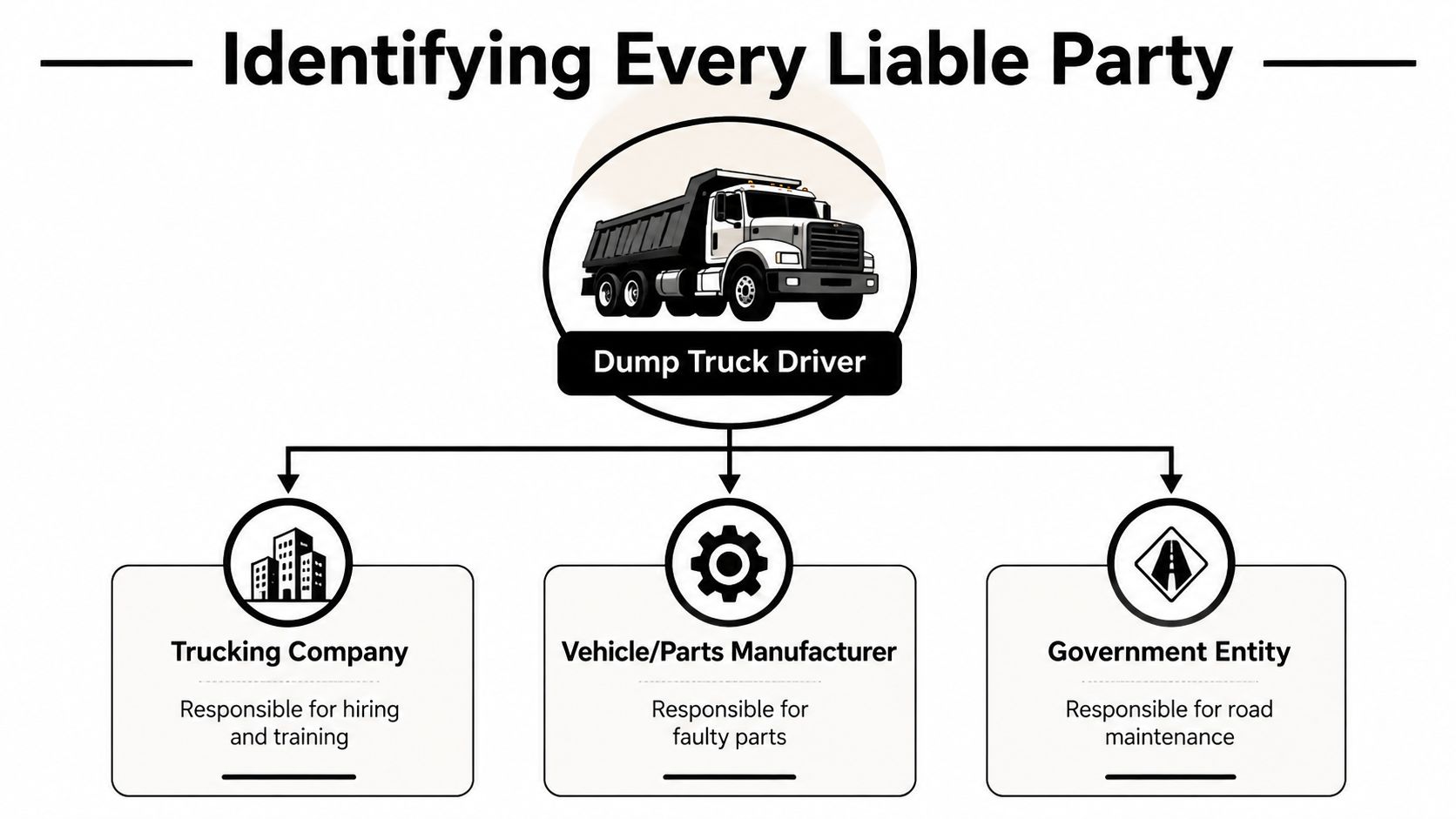
Consider a Houston driver struck when a dump truck loses gravel during a lane change. The driver may have failed to secure the load, the carrier may have ignored maintenance problems, and a contractor may have controlled the loading process. A thorough investigation tests each possibility instead of accepting a quick conclusion from a police report.
Employer liability can also depend on causation. Recent Texas Supreme Court guidance shows that employer liability may narrow when the employee's conduct wasn't a proximate cause of the injury. That makes early reconstruction, vehicle inspection, and record collection important.
The same principle applies in a fatal crash. Families may pursue wrongful death compensation based on the evidence, but the correct defendants and deadlines must be identified promptly. Additional information about commercial-vehicle claims is available through Houston commercial vehicle accident information.
Texas Laws That Determine Your Compensation
Texas law uses several rules that shape whether you can recover and how damages are evaluated. Damages means the money recovery sought for losses such as medical expenses, lost income, pain, physical impairment, and related harm.
Chapter 33 of the Texas Civil Practice and Remedies Code applies proportionate responsibility, often called comparative fault. Fault can be divided among the people or entities involved. If a claimant is found more than 50% responsible, the claimant can't recover damages under the rule described in Texas Civil Practice and Remedies Code Chapter 33.
That rule matters in a multi-vehicle crash. An insurer may argue that you were speeding, changed lanes unsafely, or failed to avoid spilled cargo. You need evidence that addresses those allegations, including photographs, witness accounts, vehicle data, traffic-camera footage, medical records, and reconstruction findings.
Chapter 41 and the meaning of damages
Chapter 41 governs damages and provides the legal framework attorneys use when discussing economic and non-economic losses, as explained in Texas Civil Practice and Remedies Code Chapter 41. Economic losses can include treatment expenses and lost income. Non-economic losses can include pain, emotional distress, physical impairment, and loss of enjoyment of life.
Punitive damages are a separate issue. They aren't automatic after a serious crash, and you shouldn't assume that a severe injury alone establishes entitlement. The evidence must support the legal requirements, which may involve especially wrongful conduct.
The filing deadline
A statute of limitations is the legal deadline for filing a lawsuit. Texas personal injury claims are generally subject to a two-year deadline after the cause of action accrues, according to Texas statute of limitations guidance. Government claims can involve much shorter notice periods, so do not treat the ordinary deadline as a safe planning tool if a public truck or roadway may be involved.
| Texas Law / Statute | What It Means for Your Case | Impact on Compensation |
|---|---|---|
| Chapter 33 | Fault may be allocated among parties | A finding that you're more than 50% responsible can bar recovery |
| Chapter 41 | Governs categories and rules for damages | Medical costs, lost income, pain, and related harms must be supported by evidence |
| Texas Tort Claims Act | Applies to qualifying government-entity claims | Notice rules, immunity issues, and statutory limits may affect recovery |
| Two-year limitations rule | Sets the general deadline for filing a personal injury lawsuit | Missing the deadline can prevent a court from hearing the claim |
How We Fight for Your Maximum Recovery
Insurance companies begin evaluating exposure quickly after a commercial crash. Your legal team should move just as quickly, not because every claim must go to trial, but because evidence and negotiating power can disappear before the case is fully understood.
The Law Office of Bryan Fagan, PLLC investigates the truck's ownership, carrier relationships, driver records, maintenance history, cargo handling, and available insurance. Counsel can send preservation demands, communicate with adjusters, arrange vehicle inspections, and coordinate crash reconstruction before skid marks, debris patterns, and roadway conditions change.
Digital evidence deserves special attention. EDR and ECM information, GPS records, dash-camera footage, dispatch communications, electronic logs, and maintenance files can help establish speed, braking, throttle use, fatigue concerns, or mechanical problems. The preservation timing described earlier makes this work urgent.
Building the full value of your claim
A serious claim requires more than adding medical bills. The case should account for continuing treatment, rehabilitation, lost income, reduced earning ability, pain, physical limitations, and the effect of the injury on family life. In a fatal collision, the family's wrongful death claim requires its own careful evaluation of eligible losses and responsible parties.
Vehicle damage can also require organized documentation. If your truck or commercial vehicle is declared a total loss, a resource on how to document truck value may help you understand the records that support a valuation dispute.
Your attorney should also assess settlement discussions carefully. A settlement can resolve a claim without trial, but you shouldn't accept an offer until you understand your medical outlook, available coverage, comparative-fault risks, and whether all responsible parties have been investigated. Background on evaluating trucking accident settlements can help you prepare questions for counsel.
The firm offers a free consultation and contingency-fee representation, so you can discuss the crash without paying upfront legal fees. The goal is straightforward: protect your rights, build the evidence, and pursue the compensation Texas law allows.
The Law Office of Bryan Fagan, PLLC can investigate your Houston dump truck crash, protect time-sensitive black-box evidence, and handle insurance communications while you focus on treatment. Contact The Law Office of Bryan Fagan, PLLC for a free consultation about your injuries, losses, and legal options.