
A car crash can change your life in seconds, but you don't have to face recovery alone. If a Houston wreck leaves you unable to work, the financial pressure can arrive almost as quickly as the pain. Rent, groceries, car payments, and family expenses continue while your paycheck shrinks or disappears.
A Houston car accident lost wages claim can help address income you missed because of crash-related injuries. Texas law also allows injured people to pursue other economic damages, coverage through their own insurance in some situations, and compensation for lasting limits on their ability to earn. The key is acting promptly, following medical restrictions, and building the claim with reliable records.
What a Lost Wages Claim Means After a Houston Car Crash
A warehouse driver is rear-ended on I-45 near Downtown Houston. His doctor says he can't lift anything, so he misses three weeks of shifts. He sits at home reviewing unpaid bills while each payday passes without the income his family depends on.
That missed income is the heart of a lost wages claim. In plain English, it means seeking payment for money you would have earned if the crash hadn't injured you. Texas treats lost wages as economic damages, meaning they represent a measurable financial loss. They're separate from medical bills and from noneconomic damages such as pain and suffering. Guidance on documenting Texas wage loss includes pay stubs, employer verification, medical restrictions, tax records, and invoices for self-employed work. Texas lost-wages guidance explains these proof requirements in practical terms.

What the claim can include
Your claim may address:
- Past lost wages: Pay you already missed because you couldn't work, attended treatment, or couldn't perform your normal duties.
- Future lost wages: Income you're reasonably expected to lose because the injury permanently limits your work.
- Reduced earning capacity: The difference between what you could earn before the crash and what your restrictions allow you to earn afterward.
- Variable compensation: Overtime, shift differentials, commissions, bonuses, tips, or paid leave used during recovery when records support the loss.
The same Houston crash can involve more than one payment path. You may pursue the at-fault driver's liability insurance, your own Personal Injury Protection coverage, or uninsured and underinsured motorist benefits, depending on the policies involved.
Practical rule: A small missed paycheck is still a financial loss. Don't dismiss it because you're paid hourly, work irregular shifts, or missed only part of a pay period.
Texas recorded 4,150 traffic fatalities and 251,977 injuries in 2024, including 18,218 serious injuries, according to Texas Department of Transportation crash records. Those figures show why wage loss is a recurring part of Texas injury claims, not an unusual edge case.
Who Can Recover Lost Earnings After a Texas Crash
Texas doesn't limit lost-income recovery to traditional W-2 employees. The core question is whether the crash caused an injury, the injury kept you from working or reduced your output, and your records establish what you lost.
Hourly and salaried employees
Hourly workers should collect pay stubs, timecards, work schedules, and an employer letter stating the dates and hours missed. This matters in Houston industries such as warehousing, retail, hospitality, construction, and healthcare support, where overtime and shift premiums may make a normal paycheck different from the base hourly rate.
Salaried employees may use payroll records and an employer statement confirming missed days, reduced duties, delayed bonuses, or lost commissions. A promotion isn't automatically a wage-loss item, but documented performance compensation or a scheduled bonus can matter when the evidence shows the crash affected it.
Gig workers and contractors
Uber, Lyft, DoorDash, and Amazon Flex drivers may not have ordinary pay stubs. Save app earnings histories, weekly summaries, bank deposits, tax forms, route records, and work calendars. The same approach applies to independent contractors who rely on invoices, 1099 forms, contracts, profit-and-loss records, and prior earnings history.
For rideshare liability and insurance issues, Houston Uber and Lyft Accident Lawyer materials address how coverage can work after a Houston rideshare crash.
Caregivers and surviving families
A family member who misses work to care for an injured loved one should keep employer records, dates missed, and proof of the care required. The claim may depend on the case's facts and the damages being pursued.
When a crash causes a death, surviving relatives may pursue wrongful death compensation, including losses tied to the income and support the family depended on. Employment classification, immigration status, and cash tips don't automatically erase a claim. Documentation still matters, so preserve every record that can show the work and income that were lost.
How Past and Future Lost Wages Are Calculated
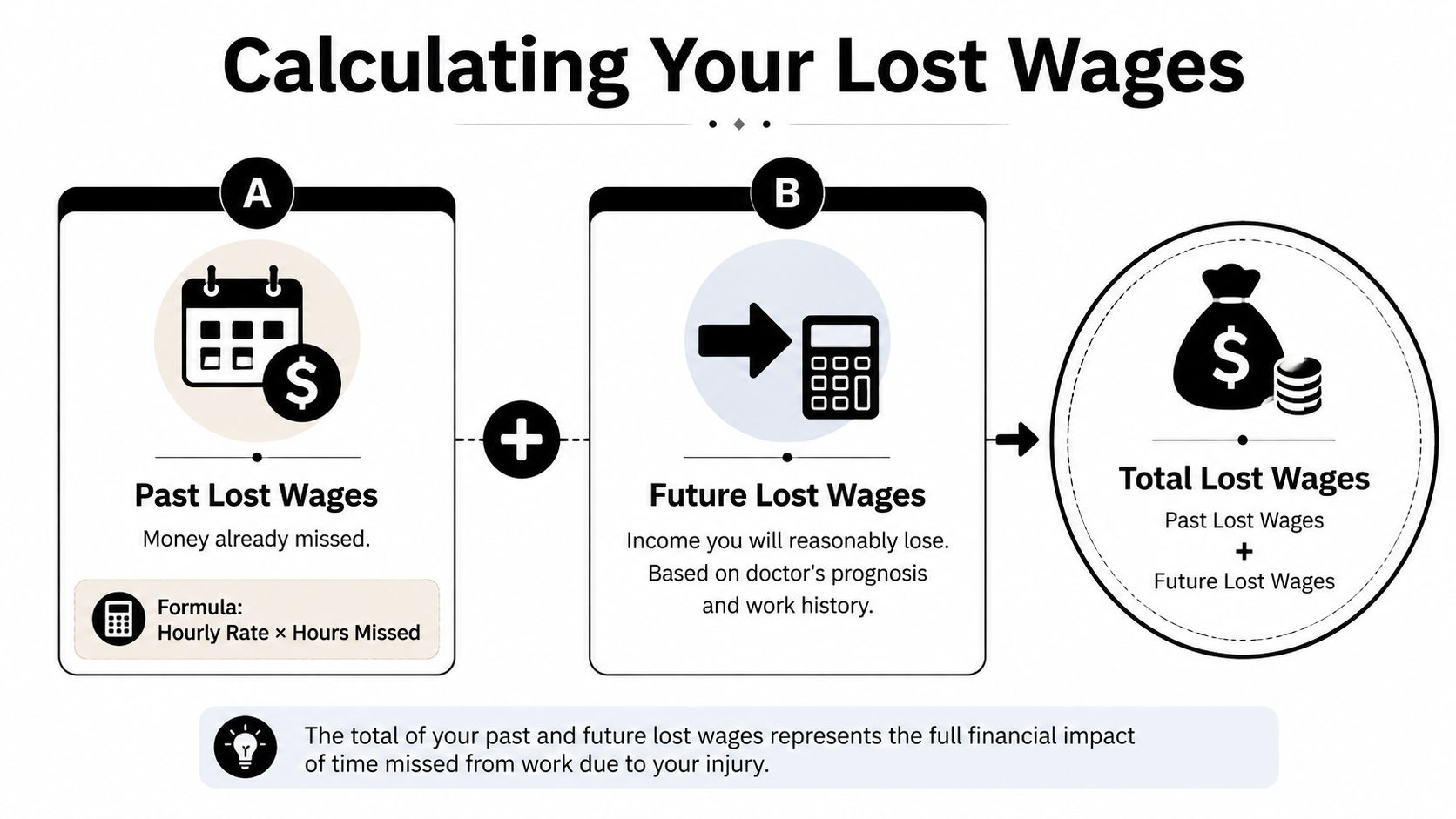
Past and future losses require different proof. Past lost wages are tied to income you already missed. Future lost wages or reduced earning capacity concern income you're reasonably expected to lose because the injury continues to limit your work.
For a straightforward hourly claim, start with:
Hourly rate × hours missed = base past wage loss
A salaried employee may start with:
Daily rate × workdays missed = base past wage loss
That's only the starting point. A complete calculation can include overtime that was regularly scheduled, night or hazard shift differentials, commissions tied to completed deals, performance bonuses, and PTO used because the crash forced you away from work. Texas guidance specifically identifies these components as possible parts of a properly supported wage-loss claim. Detailed Texas wage-loss guidance discusses overtime, bonuses, tips, self-employment income, and paid leave.
A representative Houston example
Suppose a logistics worker earns $24 per hour. Before the crash, the worker regularly accepted overtime and worked a night shift with a higher differential. A doctor takes the worker off normal duties for six weeks, followed by three months of light duty with reduced output.
The calculation should identify:
- Regular hours completely missed during the six-week absence.
- Overtime shifts the worker likely would have worked, supported by prior schedules and payroll records.
- Night-shift differentials that would have applied.
- PTO or vacation used during the recovery period.
- The difference between normal production and light-duty earnings during the restricted period.
- Any bonus or commission affected by the inability to perform the job.
You shouldn't guess at future losses. A treating physician can explain permanent restrictions. A vocational professional can address what work remains available. An economist may calculate the financial effect over time. The right evidence depends on the injury, job, work history, and expected recovery.
The Texas damages calculation resource can help you organize the broader categories that may accompany wage loss. In a fatal crash, a Houston Wrongful Death Lawyer can address compensation issues for families who lost a loved one because of negligence.
Here's a short video that provides another visual explanation of accident damages:
Key Texas Laws and Deadlines That Shape Your Claim
Texas law treats lost wages as part of the injury claim, not as a separate dispute. Your ability to recover depends on proving the crash, showing the other driver's responsibility, meeting filing deadlines, and documenting the income you missed. Overtime, shift differentials, commissions, and PTO can matter, but each item still needs support.
Chapter 33 and the 51% bar
Texas follows modified comparative fault under Civil Practice and Remedies Code Chapter 33. Comparative fault assigns each party a percentage of responsibility for the crash. Your award is reduced by your share of fault. If a court finds you more than half responsible, the 51% bar prevents recovery. The rule appears in Texas Civil Practice and Remedies Code Section 33.001.
That rule reaches lost wages, medical expenses, and other damages. An insurer may challenge your driving, traffic decisions, or conduct after the collision instead of focusing only on payroll records. Preserve evidence that addresses both fault and income.
The two-year filing deadline
Texas generally gives an injured person two years from the date the cause of action accrues to file a personal injury lawsuit under Section 16.003. Waiting past that deadline can bar the lawsuit even if your doctor keeps you off work or your restrictions continue. Review the Texas statute-of-limitations overview promptly, because exceptions and claim-specific deadlines can affect the analysis.
Chapter 41 and exemplary damages
Chapter 41 governs exemplary damages, also called punitive damages. Section 41.008 generally limits them to the greater of two times economic damages plus up to $750,000 in noneconomic damages, or $200,000, subject to the statute's requirements and exceptions. The governing cap language appears in Texas Civil Practice and Remedies Code Section 41.008.
Plain-English glossary
- Liability: Legal responsibility for causing the crash and resulting harm.
- Comparative fault: Assigning each side a share of responsibility.
- Damages: Compensation for missed income, medical bills, and other crash-related harm.
- Statute of limitations: The deadline for filing a lawsuit.
Where the Money Comes From in a Texas Claim
After a Houston crash, your wage-loss payment may come from more than one policy. The right order is to identify available coverage, submit each claim correctly, and track every payment so the same loss is not counted twice.
The three common paths
The at-fault driver's liability policy is the main third-party source. Lost wages belong in the broader injury demand with medical expenses and other damages. The insurer may negotiate a settlement, or the dispute may proceed toward a verdict.
Your own Personal Injury Protection coverage can provide income replacement before the liability claim resolves. Texas PIP commonly pays up to 80% of lost wages, subject to the policy limits, after you provide satisfactory proof. That money can help cover immediate bills, but it does not replace the full wage claim against the responsible driver.
Uninsured or underinsured motorist coverage may apply when the responsible driver has no insurance or lacks enough coverage. UM/UIM can matter when the other driver's policy cannot cover your missed income, overtime, PTO value, and other crash-related injuries.

PIP is often the first practical source of cash flow while a liability or UM/UIM claim develops. Keep the payment records, wage calculations, and policy information together. You generally cannot recover the same wage loss twice.
For guidance on protecting your claim during insurer communications, read Dealing With Insurers After a Houston Accident. You can also review Houston car accident settlement amounts without treating another claimant's result as a prediction of yours.
Common Insurance Defenses and How to Beat Them
An adjuster may sound reasonable while narrowing your claim. Don't treat a request for more information as proof that your wage loss isn't legitimate. Treat it as a signal to strengthen the record before you discuss settlement.
Causation disputes
The insurer may argue that a prior injury, not the crash, caused your missed work. Your response should connect the restriction to the collision through consistent medical records, prompt treatment, and a doctor's explanation of what changed after the wreck.
Documentation gaps
Missing pay stubs don't end the inquiry. Use W-2s, tax returns, employer letters, schedules, timesheets, payroll histories, and bank records. For self-employed workers, invoices and business records can show the income stream more clearly than a traditional paycheck.
Variable income arguments
An insurer may say commissions, bonuses, overtime, or tips are too uncertain. Respond with prior payroll records, commission ledgers, scheduled shifts, tax history, employer verification, and evidence that the income was regularly earned or specifically expected.
Comparative-fault blame
The adjuster may shift attention from your injuries to your alleged role in the crash. Preserve the police report, photographs, witness information, vehicle data, and relevant communications. If fault remains disputed, accident reconstruction evidence may help explain how the collision occurred.
Don't sign away a wage claim just because the insurer offers quick money. A release can affect losses that haven't been calculated yet, including reduced earning capacity.
Sample Evidence and a Houston Wage-Loss Calculation
Consider a logistics worker earning $24 per hour plus a $2 night-shift differential. The worker misses four weeks entirely, then works eight weeks at 60% capacity and uses 32 hours of PTO during recovery.
The calculation depends on documented schedules, overtime, shift premiums, employer records, and medical restrictions. It is not a universal result.
| Income Component | Calculation | Amount |
|---|---|---|
| Base pay during four missed weeks | $24 × documented missed hours | Verify from schedules |
| Night-shift differential | $2 × documented night hours missed | Verify from schedules |
| Reduced-capacity period | Expected pay minus actual light-duty pay during eight weeks | Verify from payroll |
| PTO used | $24 × 32 hours, plus supported differential | Verify from payroll |
| Lost overtime | Prior overtime pattern compared with expected shifts | Verify from records |
| Past wage-loss total | Add supported components | Case-specific |
PTO belongs in the calculation when you used it because of the injury. Overtime, commissions, tips, and shift premiums also require proof of a consistent pattern or specifically scheduled work. Payroll records should show what you would have earned and what you received.
Evidence checklist
- Pay stubs: Show regular pay, overtime, differentials, commissions, and deductions.
- W-2s or 1099s: Establish employment income and contractor earnings.
- Employer letter: Confirm missed dates, restrictions, reduced duties, and PTO use.
- Doctor's work note: Connect the injury to time away or limited capacity.
- Tax returns: Help establish self-employed or variable income.
- Gig-app history: Show earnings and work activity for delivery or rideshare drivers.
A doctor's restriction should match the employer's records. That connection helps address an insurer's argument that missed work resulted from something other than the crash.
Future wage loss needs separate proof when a permanent restriction is expected. Build it from the medical prognosis, work history, vocational evidence, and financial analysis. Do not add a speculative figure.
Your Next Steps and How a Houston Lawyer Can Help
Your wage claim is strongest when your medical file, employment records, and insurance notices tell the same story. Take these steps:
- See a doctor and follow every work restriction.
- Notify your employer in writing about missed work and modified duties.
- Request PIP promptly and submit satisfactory wage proof.
- Preserve pay stubs, schedules, tax records, PTO records, and app earnings.
- Keep a calendar of missed shifts, appointments, and reduced-duty days.
- Avoid giving a recorded statement to the at-fault insurer before receiving legal advice.
- Speak with a Texas injury attorney before signing a settlement or release.
The Law Office of Bryan Fagan, PLLC offers free consultations and contingency-fee representation for Houston and Texas clients. The firm handles rear-end, T-bone, head-on, multi-vehicle, rideshare, trucking, and uninsured-motorist cases, and pursues compensation for medical bills, lost wages, and long-term recovery.
You don't have to sort through the records, insurance tactics, and legal deadlines by yourself.
Contact The Law Office of Bryan Fagan, PLLC for a free consultation about your Houston car accident lost wages claim, including PIP, liability, and underinsured-motorist options. The firm can review your wage records, explain your rights, and help you move forward without facing the insurance company alone.