A car crash can change your life in seconds, but you don't have to face recovery alone.
If you were rear-ended on I-45, hit in an intersection in Houston, or hurt by a driver who was texting, you may be dealing with pain, car repairs, calls from adjusters, and a question nobody teaches in school. Which Harris County court hears my injury case?
That question matters more than people think. Many crash victims search for courthouse addresses and court numbers, but the answer usually starts with three things. How much is the case worth, whether Harris County is the right county, and which court gets the case after filing. If you understand those steps, the system gets much less intimidating.
You may also be worried that choosing the wrong court could ruin your case. That fear is understandable. The good news is that Texas has a real structure for injury cases. There are rules for where a lawsuit belongs, rules for which level of court can hear it, and local rules for how Harris County assigns the case once it is filed.
Practical rule: The “right” court usually is not picked by accident type alone. It depends on venue, the amount in controversy, and local assignment.
If you've been searching for “Harris County civil district court which one hears my injury case,” you're really asking a bigger question. You want to know where your rights fit in the Texas court system, and what to do next so you don't lose time.
A Houston car accident lawyer or Texas injury attorney can help sort that out, but it also helps to know the basics yourself. When you understand the court structure, you're in a better position to protect your claim, respond to insurance pressure, and make informed choices for your family.
A Car Crash Can Change Your Life in Seconds But You Do Not Have to Face Recovery Alone
On the day of a crash, people aren't thinking about civil district courts. They're thinking about neck pain, an ambulance bill, missing work, and whether the insurance company is about to blame them.
Take a common Houston example. A driver gets rear-ended on I-45 during traffic. At first, it seems simple. Then the pain gets worse, treatment starts, the other driver's insurer asks for a statement, and the injured person starts hearing legal terms like “petition,” “venue,” and “district court.” That's when confusion sets in.
Why this court question feels so overwhelming
Part of the stress comes from how court information is usually presented. You find lists of courts, buildings, and filing offices, but not a plain-English answer to the question you have. You don't need a tour of downtown Houston. You need to know where your injury case likely belongs.
The answer is often more predictable than it seems. Texas courts divide civil cases by court level. Harris County has multiple civil district courts. And when a qualifying injury lawsuit is filed there, the case is generally assigned to one court rather than hand-picked by the injured person.
- Your first concern may be medical care. That makes sense. Your health comes first.
- Your second concern is often the insurance claim. An auto insurance claim may begin before you even know whether a lawsuit will be needed.
- Your third concern is usually legal process. That includes where to file, how deadlines work, and how to avoid mistakes.
A clear path through the confusion
You don't have to memorize the Texas court system to protect your rights. You just need a working map.
That map starts with understanding the different court levels in Texas, then narrowing down whether your case belongs in a county court at law or a civil district court, then confirming whether Harris County is the proper county, and finally looking up which court received your case after filing.
Getting the court right is part of protecting the claim. It helps avoid delay, transfer fights, and unnecessary stress.
If your injuries are serious, your losses are substantial, or more than one person or business may be responsible, the case often becomes more than a basic insurance matter. That's when court choice starts to matter in a very real way.
How Texas Civil Courts Fit Together for Injury Cases
After a crash, the court system can sound like a second language. You may hear terms like justice court, county court at law, and district court, then wonder which one applies to your injury claim and why.
A simple way to sort it out is to picture a set of shelves. Each shelf holds a different group of civil cases based on legal limits set by Texas law.

At the lower end, justice courts handle smaller civil disputes. Above them, county courts at law hear many everyday civil cases within their allowed range. District courts sit higher in the trial court system and can hear the broad range of civil lawsuits that Texas law places there.
For injury cases, that court structure matters because your claim does not go to a court based only on the label "car accident." The key questions are more specific. How much is being claimed? Does the law allow the case in that court? Is Harris County the right county to file in?
Harris County adds one more layer that often confuses people. It has several civil district courts, and those courts handle many kinds of lawsuits, not just injury cases. The Harris County District Clerk civil court information page explains that these courts hear matters such as personal injury, damages, malpractice, breach of contract, and multi-district litigation.
That means there is no single "Harris County injury court" waiting for every crash case.
A serious wreck case may belong in district court. A smaller injury claim may fit in a county court at law. If Harris County is the proper county and the lawsuit is filed in the right court level, the specific civil district court is usually assigned through the county's filing system rather than chosen by the injured person.
For a reader trying to understand how personal injury cases proceed locally, Filing an Injury Claim in Harris County Courts offers a factual overview of that county process.
The point to keep in mind is simple. Court choice in Harris County usually turns on legal fit first, then assignment second. Once you understand that rule, the system feels a lot less random.
County Courts at Law or Civil District Court and Why Amount Matters
After a wreck, one of the first questions is often, “Will my case go to county court or district court?” The answer usually starts with one practical issue. How much money is being claimed for your injuries and losses.
Lawyers call that the amount in controversy. It means the value of the claim being put before the court. In a crash case, that can include medical bills, lost pay, pain and suffering, future care, and other damages allowed by law.
Here is the basic Harris County rule in plain English. Smaller injury cases may fit in a County Court at Law. Higher-value cases usually belong in Civil District Court. The line matters because each court level has its own power to hear certain civil cases.
A simple way to picture it is a weight limit on a bridge. If the claim falls within the county court limit, that court may be the right fit. If the claim is above that limit, the case usually needs the broader authority of district court.
| Court Level | General Fit for Injury Cases |
|---|---|
| County Court at Law | Claims that fall within the county court's amount limits |
| Civil District Court | Larger claims, serious injury cases, wrongful death cases, and other claims that exceed the county court limit |
What does that mean for you?
If your crash led to an ER visit, some follow-up care, and a short time off work, the case may fit in a county court at law. If the wreck caused surgery, a long recovery, permanent limits, or a death, the claimed damages can rise fast. Those cases are often filed in civil district court.
The takeaway many first-time filers miss is that court choice usually turns more on the size of the claim than on the type of vehicle involved. A car crash is not automatically a district court case. A truck crash is not automatically a county court case. The money being sought, and sometimes the complexity of the facts, usually drives the decision.
Complexity can matter too. A case with several defendants, disputed medical issues, or large future-loss claims may be a stronger fit for district court even apart from the label attached to the wreck.
If you're trying to match a collision claim to the local court system, Houston Car Accident Lawyer provides factual information about representation for car accident victims in Houston and Harris County.
Here is a real-world example. A Houston driver gets hit by someone speeding through an intersection. The injured person needs surgery, misses months of work, and may need future treatment. In that situation, the value of the claim may push the case into civil district court.
That still does not mean you choose a specific district judge for your injury case. It means you first file in the correct court level. After that, Harris County's assignment system decides which particular court gets the case.
Venue Rules That Decide If Harris County Is the Right County
A lot of injured people ask the wrong question first. They ask, “Which Harris County civil district court will hear my case?” The better first question is simpler. Does your case belong in Harris County at all?
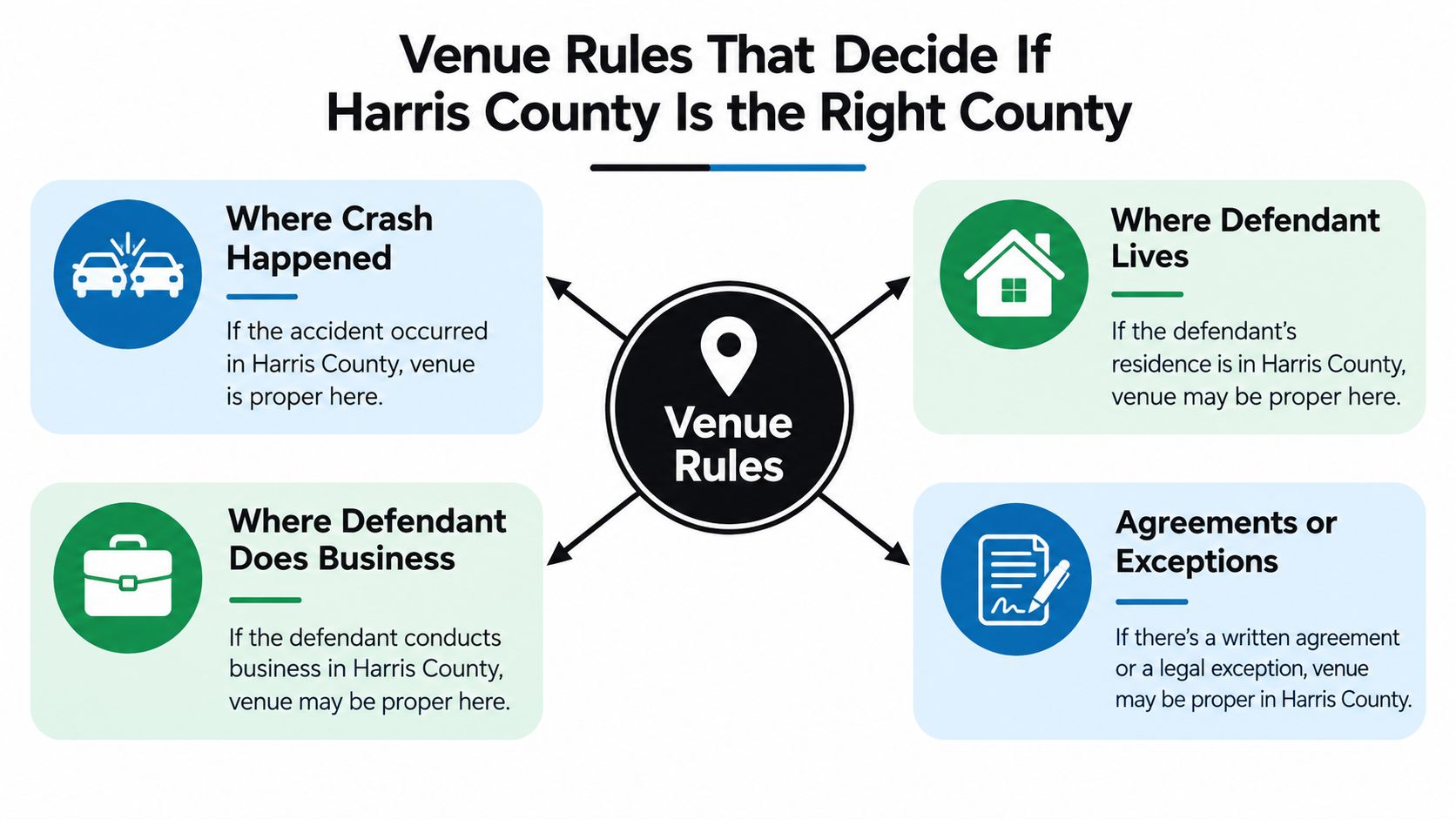
Texas uses venue rules to answer that. Venue means the proper county for the lawsuit, not the specific courtroom or judge. The main rule in Texas usually points to one of a few places: where all or a substantial part of the events happened, where the defendant lived when the case arose, or, in some situations, where the plaintiff lived, as stated in the Texas venue statute.

Here is a simple way to sort it out. Court level answers “county court or district court?” Venue answers “Harris County or some other county?” Those are two different gates, and your case has to fit through both.
Say you were rear-ended on the Gulf Freeway in Houston. Harris County is often a proper venue because the crash happened there. If the wreck happened in Fort Bend County, Harris County might still work if the at-fault driver lived in Harris County when the claim arose. If neither the crash facts nor the people involved tie the case to Harris County, filing there can lead to a transfer fight.
That matters because a wrong-county filing can cost time, add expense, and slow down your recovery. The court does not become proper just because the injuries are serious or because treatment happened in Houston afterward.
For local context about where serious crashes recur across the area, Houston's Most Dangerous Intersections and Roads discusses places where severe collisions often happen in Houston and Harris County.
A helpful way to picture the decision is as a two-part screen:
- First, pick the right county under Texas venue law.
- Then, file in the right court level based largely on the amount in controversy.
Only after those steps does Harris County assign a specific court.
That is the point many crash victims miss. You do not start by picking a courthouse address or a judge. You start by asking whether Texas law gives you the right to file in Harris County.
How Harris County Assigns Your Case and How to Look Up the Court
You may picture a courthouse clerk asking what kind of crash you had and then sending your case to a matching judge. Harris County does not work that way. After your lawsuit is filed in the correct county and at the correct court level, the county assigns a specific court through its normal case-assignment system.
That point helps clear up a common worry. In many injury cases, you do not get to pick Civil District Court No. 11, 55, 61, 80, 113, 125, 133, 151, 152, 157, 164, 165, 189, 190, 215, 234, 269, 270, 280, 281, 295, 333, or 334 based on preference. The case is assigned after filing, and it usually stays with that court unless a later transfer happens for a legal reason.
A simple way to understand it is this. First, Texas law decides whether Harris County is a proper county. Next, the amount in controversy helps determine the right level of court. Only then does Harris County place the case with a particular judge.
What “random assignment” means in real life
If two people are hurt in similar Houston wrecks, their cases may land in different civil district courts even though the injuries look alike on paper. That does not mean one case is stronger or weaker. It only means the county assigned them to different dockets.
For you, the practical answer to “which court hears my injury case?” is usually found in one place. Your cause number and case record will show the assigned court.
Finding your court without getting lost
If your lawyer has filed suit, or you already have filing papers, use the paperwork like a map.
Start with the cause number listed on the petition or citation. Then search the Harris County District Clerk's online records and look for the court listed with that case. Check that the case appears in the correct civil category, and keep an eye out for later updates such as settings, notices, or a transfer order.
For a step-by-step explanation of what happens after filing, including early deadlines and discovery, see this Harris County injury lawsuit process guide.
Why this matters after filing
Knowing the court gives you a clearer picture of what comes next. You can track deadlines, hearings, and notices. You can also make sure the defense has answered and that your case is moving instead of sitting still while you recover.
Some people confuse court assignment with the value of the case. They are different issues. A randomly assigned court does not decide who was at fault, how badly you were hurt, or what your claim may be worth.
If you want a broader general resource on how civil cases often progress toward resolution, Mediation & Negotiation Services (M&N) court insights offers additional reading.
People can also get tripped up by one more question. State court assignment is not the same as deciding whether a case stays in state court for its full life, and smaller civil disputes may fall within county court limits instead of district court. If you are also dealing with insurance pressure while these court questions are being sorted out, Dealing With Insurers After a Houston Accident explains practical ways to protect your claim.
Important: Court assignment tells you where your case will be heard. It does not decide fault or guarantee any result.
Texas Laws That Shape Your Injury Case Before You File
Court choice matters, but the law behind your claim matters just as much. Before any judge decides anything, Texas negligence rules shape what your case is worth, whether you can recover, and how long you have to file.

Liability and comparative fault
Liability means legal responsibility for the crash.
If another driver caused the wreck by speeding, texting, failing to yield, or following too closely, that driver may be liable. But Texas does not always treat fault as all-or-nothing.
Texas follows a modified comparative fault system under Chapter 33. Recovery is barred if the claimant's percentage of responsibility is greater than 50 percent, and damages are reduced by the claimant's share of responsibility under the Texas Chapter 33 discussion.
Comparative fault means each person's share of blame is assigned before money is paid.
A simple example helps. A Houston driver rear-ended on I-45 may still face an argument from the insurer that the driver changed lanes unsafely or braked suddenly. If the injured person is found 30 percent responsible, damages can be reduced by that share. If the injured person is found 51 percent responsible, recovery is barred under Chapter 33.
Damages and exemplary damages
As discussed earlier, damages are money awarded for harm.
Texas law also recognizes exemplary damages, sometimes called punitive damages. Chapter 41 governs those damages and treats them differently from ordinary compensation. Exemplary damages are meant to punish especially bad conduct such as fraud, malice, or gross negligence, as shown in Texas Civil Practice and Remedies Code Chapter 41.
This comes up in serious injury and wrongful death compensation questions. Families often ask whether reckless conduct such as drunk driving or extreme speeding can justify more than ordinary compensation. Chapter 41 is where that issue is evaluated.
The filing deadline you can't ignore
Statute of limitations means the legal deadline to file suit.
For Texas personal injury claims, the general deadline is two years after the day the cause of action accrues, and wrongful death claims generally follow the same two-year period from the date of death under Texas Civil Practice and Remedies Code Section 16.003. For a plain-English discussion of that deadline, see Texas statutes of limitations for injury claims.
That deadline can arrive while treatment is still ongoing.
- Get medical care early. Your health and your records both matter.
- Preserve evidence. Photos, witnesses, and crash details can become important if fault is disputed.
- Be careful with adjusters. An insurer may push for a quick statement before the full injury picture is clear.
- Don't wait for “perfect timing.” Waiting too long can end the claim before fault and damages are ever decided.
Waiting for treatment to finish before talking to a lawyer can create real deadline problems. A claim can expire even when the injury is still affecting daily life.
In the recommendation stage, some people speak with the insurer first, some gather records on their own, and some consult counsel early. The Law Office of Bryan Fagan, PLLC is one option for Texas injury representation and court filing guidance in vehicle collision cases.
Your Next Steps to Protect Your Rights and Get Help
If you're hurt and trying to answer “Harris County civil district court which one hears my injury case,” the path is usually simpler than it first appears. First, confirm the right county under Texas venue rules. Next, identify the right court level based on the amount in controversy and the nature of the case. Then, once the case is filed in Harris County, check the assigned court tied to the cause number.
A short checklist you can use today
- See a doctor and follow up. Medical records often become part of proving injury and damages.
- Document the crash. Save photos, names of witnesses, repair information, and any insurance letters.
- Be cautious with recorded statements. Insurance companies may look for ways to shift blame or minimize the claim.
- Keep an eye on fault arguments. Comparative fault can reduce or bar recovery depending on the facts.
- Talk with a lawyer early. That can help with court choice, filing timing, and preserving evidence.
Families pursuing fatal crash claims face many of the same court and deadline questions. So do people hit by distracted drivers, uninsured drivers, or commercial vehicles. The legal labels may differ, but the first goal is the same. Protect the claim before procedural mistakes make things harder.
If you're comparing legal help, this guide on how to find a good car accident lawyer in Texas may help you ask the right questions. It also helps to explore related topics involving car wrecks, truck crashes, insurance disputes, and wrongful death claims so you can see how your situation fits the bigger picture.
You don't need to solve every legal detail while you're in pain and trying to get your life back together. You just need to take the next right step.
If you're unsure whether your case belongs in a Harris County civil district court, The Law Office of Bryan Fagan, PLLC can help you sort out venue, court level, filing deadlines, and the next steps after a serious crash. Visit The Law Office of Bryan Fagan, PLLC to request a free consultation and get clear guidance on protecting your rights while you focus on recovery.