A car crash can change your life in seconds, but you don't have to face recovery alone. You may have been driving through a sudden Houston downpour when your tires lost contact with the road, your vehicle slid into standing water, or another driver entered a flooded underpass despite warning signs. Now you're dealing with injuries, a damaged vehicle, rising bills, and an insurance adjuster asking what happened before you've had time to process it.
Weather may have contributed to the crash, but it doesn't automatically erase legal responsibility. A Houston flooding car accident lawyer can examine the driver's conduct, roadway conditions, closure records, vehicle damage, and available insurance. The steps below explain how liability, evidence, coverage, deadlines, and recovery fit together.
When Houston Floodwater Meets a Crash
A driver on I-45 sees rain turn the lanes into a sheet of water. Traffic slows, but the vehicle ahead stops near a flooded section. The driver behind follows too closely, brakes hard, and hydroplanes into the rear of the stopped car. Sirens arrive while water moves across the roadway. Witnesses point in different directions. One person says the road was merely wet. Another remembers a closure sign near the entrance ramp.
A different crash may happen on Memorial Drive when a motorist ignores a barricade at a flooded underpass and strikes a vehicle already stalled in the water. In both situations, the storm is part of the story, but it may not be the whole legal explanation.
Houston's flood risk creates serious danger for drivers and passengers. A federal roadway safety study reports that Texas leads the nation in flood fatalities, and that about 77% of Texas flood fatalities are motor-vehicle related, with 471 of 616 fatalities with known circumstances classified as motor-vehicle related. The study also reports a U.S. average of 9.42 confirmed flood deaths per year over a 50-year period, highlighting the severity of Texas flood danger for people traveling by car. The federal roadway safety study provides the underlying safety data.
Houston's most defining flood event remains Hurricane Harvey. National Weather Service reporting found that 60 of 67 river forecast points in Southeast Texas reached flood stage, while 46 of 67 reached major flood stage and 31 points set records. NOAA also reported 36 to 48 inches of rain across the Houston metro area, with 9 of 19 official river gauges in Harris County reaching all-time high flood stages. NOAA and the National Weather Service's Hurricane Harvey report documents those conditions.
The storm can explain why the roadway became dangerous. It doesn't automatically explain who caused your collision.
The legal question is often whether someone drove unreasonably, failed to obey a closure, created a dangerous drainage condition, or failed to warn motorists. Your recovery may involve a claim against another driver, an insurer, a governmental entity, a contractor, or more than one responsible party. Evidence disappears quickly in flood conditions, so preserving it should begin as soon as you're safe.
Texas Legal Terms You Need to Know First
A few Texas legal terms will help you understand what an insurer is really asking when it discusses fault, responsibility, or the value of your claim. Consider one running example: you're rear-ended on flooded I-45 during a thunderstorm, and you suffer neck and back pain afterward.
Liability and negligence
Liability means legal responsibility for the crash and resulting harm. If the driver behind you was traveling too fast for visibility, followed too closely, or failed to control the vehicle after encountering standing water, that conduct may support liability.
Negligence means failing to use the level of care a reasonably careful person would use in similar circumstances. A storm doesn't give every driver permission to ignore traffic, visibility, speed, stopping distance, or road-closure warnings. The key question is what the driver did after encountering the conditions.
The Houston Personal Injury Lawyer resource describes representation for injury victims across Houston and Harris County. It can serve as a general starting point for understanding the type of legal assistance available after a crash.
Comparative fault
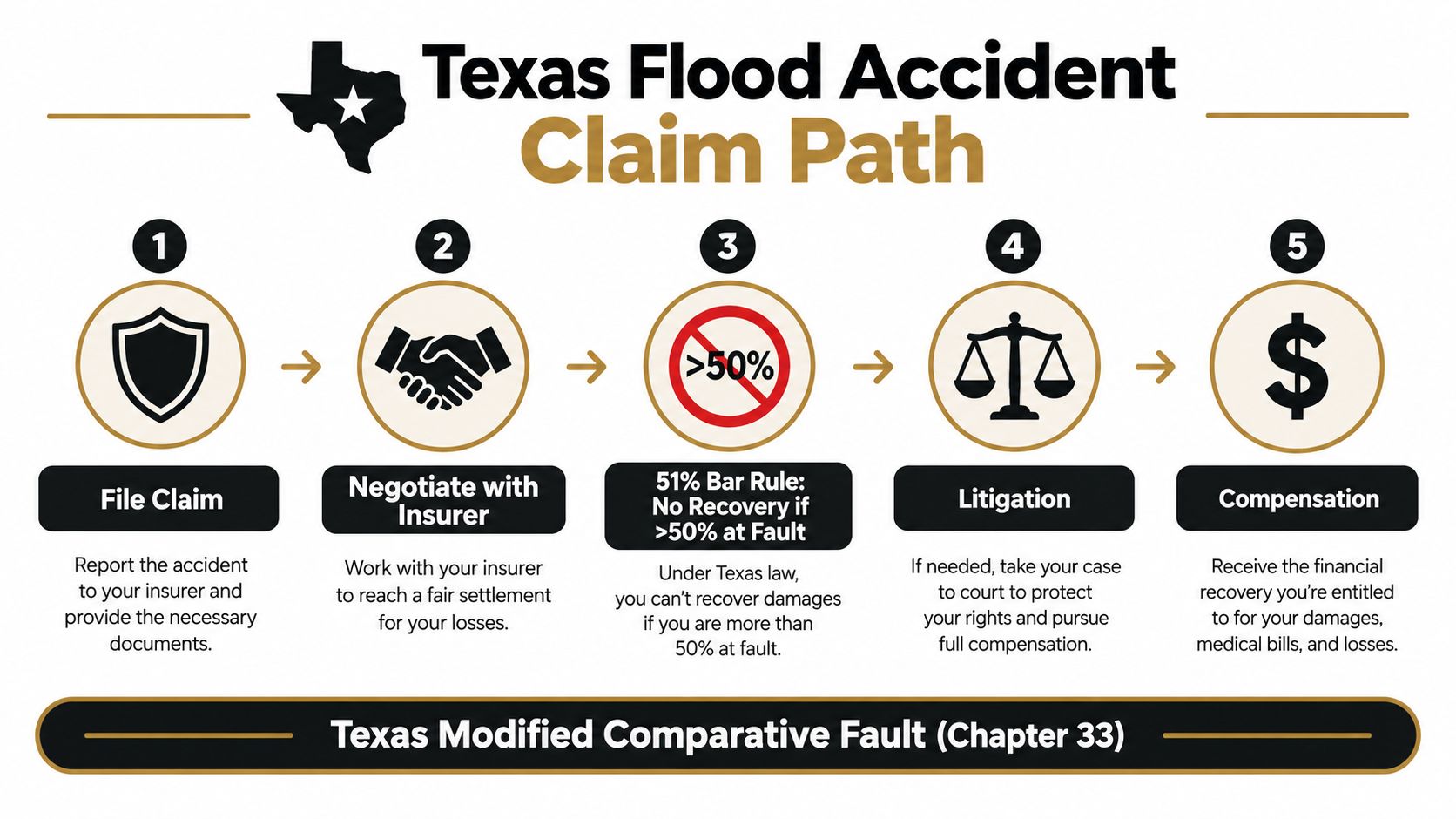
Comparative fault means the parties' shares of responsibility are evaluated separately. Texas Civil Practice and Remedies Code Chapter 33 uses a modified comparative-fault rule called proportionate responsibility. A claimant may not recover damages if their percentage of responsibility is greater than 50%, as stated in Texas Civil Practice and Remedies Code Chapter 33.
In the I-45 example, the insurer might argue you stopped abruptly or entered a dangerous lane. The other driver may still bear responsibility, but an insurer could use any alleged share of fault to reduce the amount it offers. You shouldn't accept that conclusion without examining the evidence.
Damages
Damages are the losses you seek to recover. They can include medical bills, future medical care, lost wages, vehicle damage, reduced vehicle value, pain, physical limitations, and other harm connected to the crash. Texas Civil Practice and Remedies Code Chapter 41 governs damages in actions where a claimant seeks damages and defines exemplary damages, which are intended as a penalty or punishment rather than ordinary compensation. Chapter 41 of the Texas Civil Practice and Remedies Code contains those provisions.
Statute of limitations
A statute of limitations is the legal deadline for filing a lawsuit. Texas generally gives you two years for a personal injury claim, and wrongful-death claims also generally must be filed within two years of the date of death. Missing the deadline usually ends the claim, even when the facts appear strong. Texas car accident law guidance on filing deadlines explains this general rule.
Insurers know these terms well. You should, too. Understanding them helps you avoid treating an early settlement offer as the final value of your injuries.
Who Can Be Liable in a Flooding Car Accident
Flood crashes often involve more than a simple driver-versus-driver dispute. Liability depends on the specific cause of the collision and the evidence available before water, traffic, towing, and repairs erase important details.
Another driver
A motorist may be liable for tailgating in heavy rain, driving too fast for visibility, ignoring high-water warnings, entering a closed roadway, or failing to maintain control. A rear-end collision on I-45 may look straightforward, but standing water can make the sequence harder to reconstruct.
Investigators may review dashcam footage, event data recorder information, photographs, witness accounts, police reports, and vehicle damage. TranStar closure records can help establish whether a warning or closure was active when the driver entered the area. The Houston TranStar road-closure system is especially relevant when high water, barricades, and active roadway incidents are part of the dispute.
A governmental entity
The City of Houston, Harris County, or TxDOT may become relevant when a known drainage problem, missing barricade, dangerous signal condition, or other roadway issue contributed to the crash. Claims against governmental entities involve special rules, including notice requirements under the Texas Tort Claims Act. Those rules can make early legal review particularly important.
Public-works records, drainage maintenance files, 311 complaints, signal records, inspection documents, and closure logs may help show what the responsible entity knew and what it did or failed to do.
Property owners and contractors
A private property owner may face scrutiny if landscaping, grading, or construction directed unusual water onto the roadway. A construction contractor may also be involved if temporary drainage was not maintained as required under applicable TxDOT permits.
These cases require a close review of site conditions, plans, permits, maintenance records, photographs, and witness testimony. A roadway hazard can involve several contributing causes, so investigators shouldn't stop after identifying the first negligent driver.
| Potentially Liable Party in a Houston Flooding Car Accident | Common Scenarios | Key Evidence |
|---|---|---|
| Other driver | Speeding for conditions, tailgating, ignoring high-water warnings, or entering a closure | Dashcam footage, event data, witness accounts, vehicle damage, closure records |
| City, county, or TxDOT | Drainage failure, missing barricade, unsafe signal timing, or roadway maintenance issue | Public-works records, 311 complaints, inspection files, signal records |
| Private property owner | Landscaping, grading, or site conditions send water onto the roadway | Property records, photographs, drainage information, witness statements |
| Construction contractor | Temporary drainage is not maintained during roadway work | Contracts, permits, work plans, inspection records, site photographs |
Early investigation by a Houston car accident attorney matters because witnesses leave, surveillance footage may be overwritten, vehicles get repaired, and flood conditions change. If a government entity may be involved, delay can create additional problems before the full claim is even evaluated.
What to Do Right After a Flooding Crash in Houston
Your first responsibility is survival, not evidence. If water is rising, move to higher ground when you can do so safely. Don't re-enter rising water to retrieve property, and don't remain inside a vehicle that is becoming unsafe.
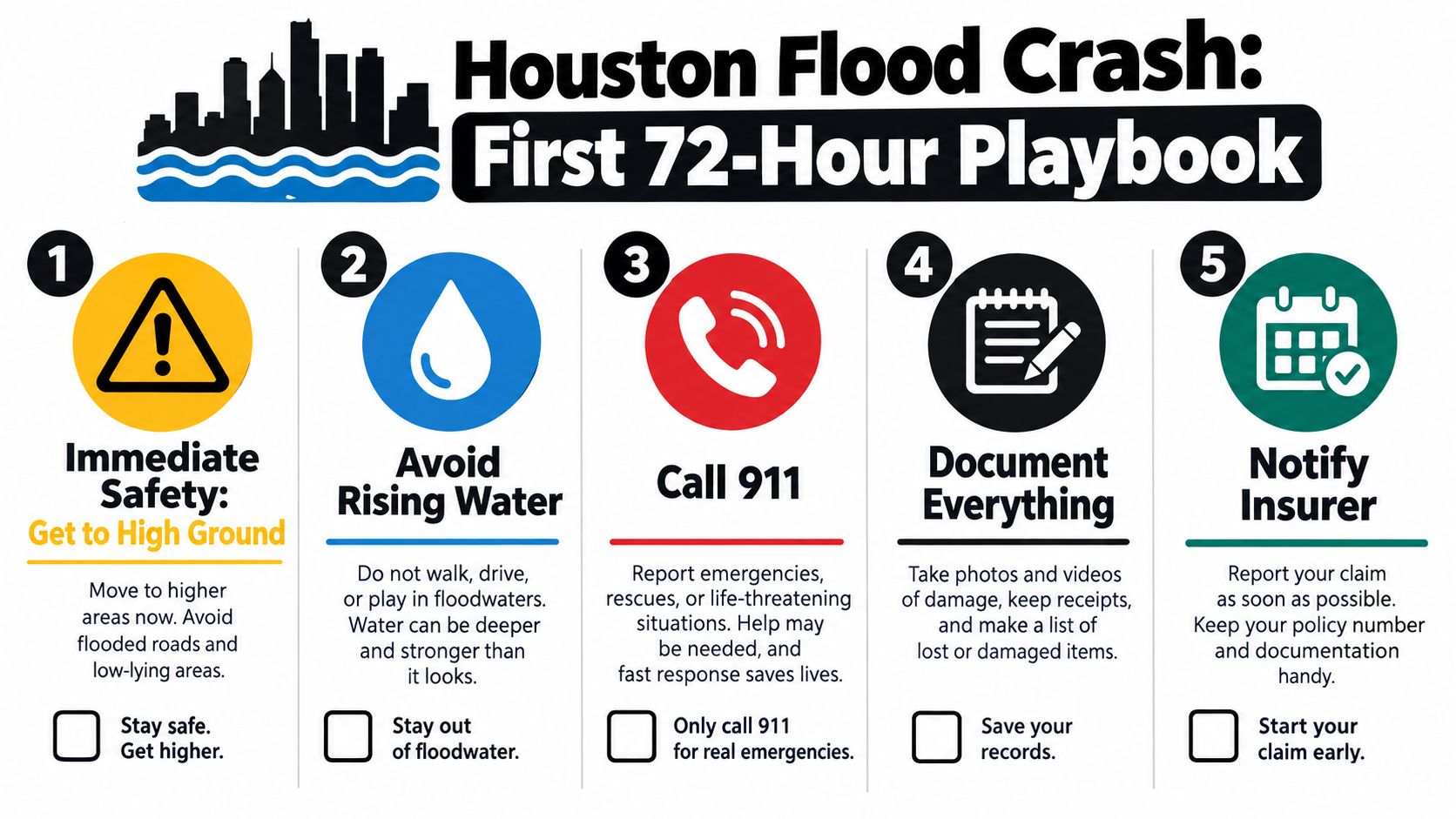
Once you're out of immediate danger, use this first-72-hours playbook.
Call 911: Request emergency assistance and make sure the crash is documented by the appropriate Harris County or municipal police agency. Tell the dispatcher if anyone is injured, trapped, or exposed to moving water.
Record the roadway: From a safe location, photograph standing water, moving water, tire marks, receding water lines, barricades, closure signs, downed signals, and nearby landmarks. If it's safe, show water depth against a ruler, curb, or other fixed reference.
Collect contact information: Exchange names, phone numbers, insurance details, license information, and vehicle descriptions with every involved motorist. Ask witnesses for their contact information before traffic, water, or emergency activity separates everyone.
Request video quickly: Nearby businesses, traffic cameras, 18-wheeler dashcams, and residential security systems may have captured the crash or the roadway condition. Ask the owner to preserve the footage before routine recording overwrites it.
Get medical care: Adrenaline can hide pain. A medical evaluation creates a health record and helps identify injuries that may not be obvious at the scene.
Notify your insurer carefully: Report the loss, but don't guess about fault, minimize your symptoms, or speculate about what the water caused. You can provide basic facts without giving a recorded statement before you understand the claim.
Preserve the vehicle: Don't authorize repairs, destroy parts, or send the vehicle to salvage before it has been photographed and inspected. Save tow receipts, repair estimates, weather screenshots, medical records, and every insurer communication.
For a broader collision checklist, review what to do after a car accident. A Houston flooding car accident lawyer can then organize the scene evidence into a claim file rather than relying on memories after the water recedes.
How Insurance Actually Works in a Flood Crash
Houston flood crashes can trigger several coverage questions at once. The answer depends on whether you need payment for vehicle damage, medical treatment, or losses caused by another driver.
Collision coverage generally addresses damage from striking another vehicle or object. A separate type of auto coverage generally addresses flood damage, including a submerged engine or water intrusion, subject to the policy's terms and exclusions. Check the declarations page and ask the insurer to identify the exact coverage before authorizing repairs.
Your medical coverage may operate separately. Personal Injury Protection, or PIP, can help cover medical expenses and related losses under the policy terms. MedPay may cover medical bills without first deciding fault. Texas has specific PIP rules, including a written rejection requirement for a policyholder who declines it.
Uninsured and underinsured motorist coverage, often called UM/UIM, may apply when the responsible driver has no insurance, leaves the scene, or carries too little liability coverage. A rain-related, multi-vehicle collision can produce competing claims against limited policies, so document each vehicle's involvement and report the loss promptly.
| Coverage | What It Pays |
|---|---|
| Collision | Vehicle damage from impact with another vehicle or object |
| Flood and water damage coverage | Covered flood or water damage to the vehicle |
| PIP | Covered medical and related losses under the policy |
| MedPay | Covered medical bills, generally without deciding fault first |
| UM/UIM | Covered losses caused by an uninsured or underinsured driver |
Report the loss promptly, keep estimates, and photograph damage before repairs. Do not assume a vehicle is safe because it starts after water exposure. Standing water can damage systems that fail later, and Houston roadway conditions may change quickly. Preserve TranStar closure information and other records showing whether flooding or a closure affected the route.
For practical guidance on how to avoid pitfalls in your storm claim, use that separate storm-claim resource while keeping auto collision and injury issues distinct.
An adjuster may request a recorded statement or broad medical authorization. Review how underinsured motorist coverage works before agreeing, and consider counsel's advice about what information the claim requires.
Filing a Claim and Recovering Compensation
Filing an insurance claim is only the beginning. The insurer may investigate the crash, question the roadway conditions, dispute the extent of your injuries, or argue that you contributed to the collision.
Texas follows modified comparative fault under Chapter 33. If a claimant's responsibility is greater than 50%, recovery is barred. If the claimant's responsibility is not greater than that threshold, the award can still be reduced according to the assigned share of fault. A carrier may use alleged fault to discount an offer, so the evidence must address both the other party's conduct and your own actions.
Build the damages record
Damages can include:
- Medical treatment: Emergency care, follow-up appointments, therapy, medication, and reasonable future care.
- Income loss: Missed work, reduced earning ability, and documented employment effects.
- Vehicle losses: Repair costs, covered total-loss issues, and diminished value where supported.
- Human harm: Pain, physical limitations, emotional distress, and the effect on daily life.
- Punitive-type damages: Chapter 41 addresses exemplary damages for conduct that warrants punishment rather than ordinary compensation.
Keep records in one place. Save bills, treatment notes, wage information, photographs, prescriptions, repair documents, and communications with every insurer. A demand should explain the evidence, not merely state that you were hurt. You can also review personal injury demand letters for a better understanding of how a claim may be presented.
Watch the filing deadline
Texas generally applies a two-year statute of limitations to personal injury claims. A wrongful-death claim also generally must be brought within two years from the date of death. Late-discovered symptoms can complicate a case, but you shouldn't assume a later diagnosis automatically extends the deadline. Get legal advice early.
When a loved one dies in a flood-related crash, surviving family members may have claims for wrongful death compensation, including losses tied to financial support, services, and the family relationship. The specific claim depends on the facts and the applicable Texas statutes.
A contingency-fee arrangement may allow a Houston flooding car accident lawyer to investigate, communicate with insurers, negotiate, and prepare the case without requiring attorney fees upfront. The written agreement should explain fees, case expenses, and what happens if there is no recovery.
Why Call a Houston Flooding Car Accident Lawyer Now
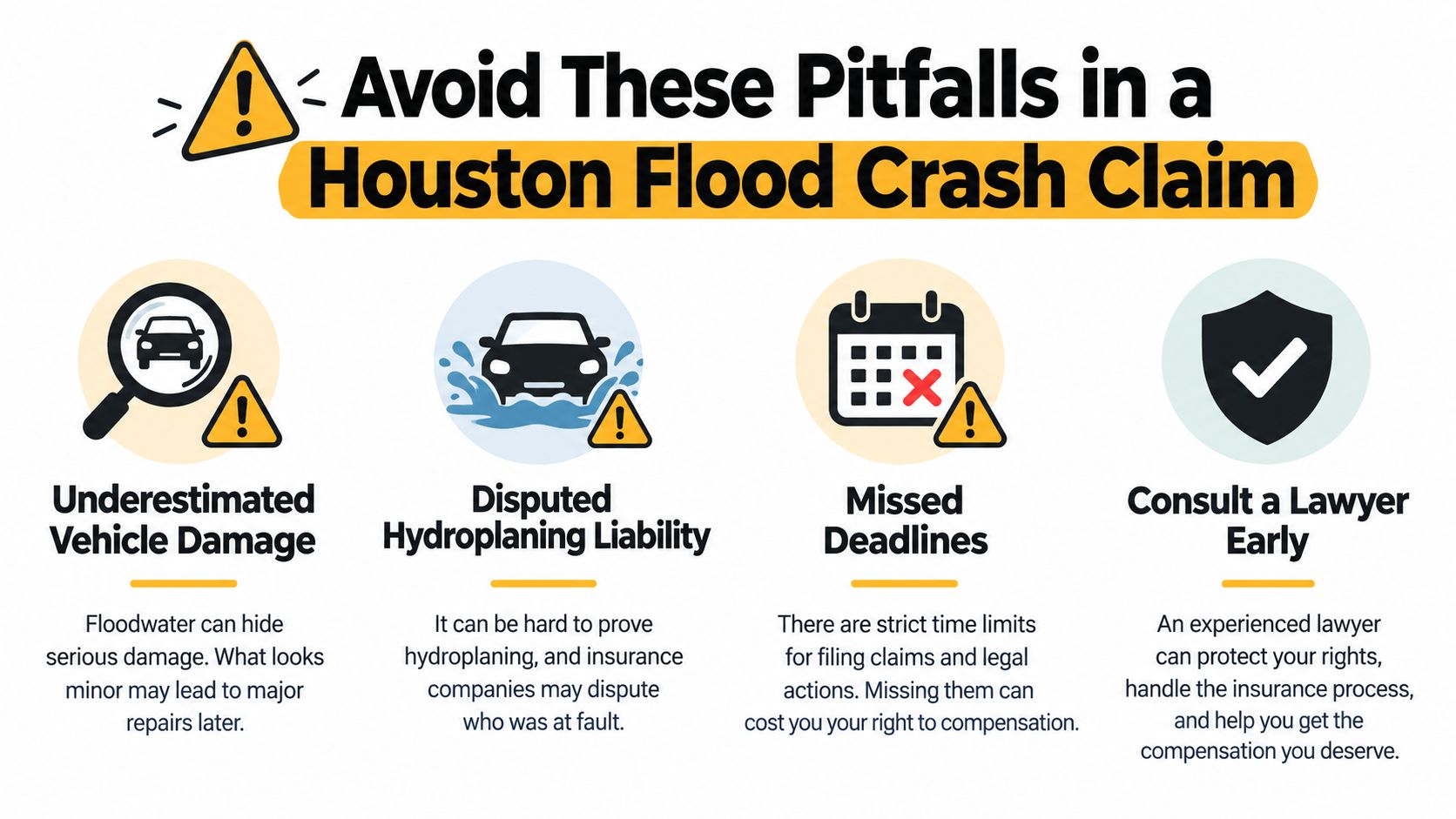
Handling a flood crash alone creates avoidable risks. Vehicle damage may be underestimated because water affects systems that don't fail immediately. An insurer may blame you for hydroplaning without examining tread marks, speed, visibility, closure warnings, or the conduct of other drivers. A claim involving the City of Houston, Harris County, TxDOT, a property owner, or a contractor may also involve rules that a standard auto claim doesn't address.
A local attorney can help preserve the evidence that matters. That may include roadway photographs, TranStar records, police reports, surveillance video, vehicle inspections, weather information, public-works documents, witness interviews, and accident-reconstruction analysis. When the dispute involves water movement or drainage, a qualified attorney may also evaluate whether engineering or meteorological testimony is needed.
What legal help changes
A lawyer can:
- Separate causes: Determine whether the crash resulted from driver conduct, hydroplaning, a closure violation, a roadway defect, drainage, or several causes together.
- Identify insurance: Review liability, collision, PIP, MedPay, and UM/UIM coverage.
- Protect communications: Handle adjuster contact and reduce the chance that an incomplete statement becomes the insurer's main evidence.
- Value the claim: Account for medical treatment, wage loss, vehicle damage, pain, and continuing effects.
- Prepare for litigation: Preserve claims against private parties and address governmental procedures when necessary.
The Law Office of Bryan Fagan, PLLC represents Texas accident victims through contingency-fee arrangements, meaning clients don't pay attorney fees unless the firm secures a recovery under the agreement. The firm also offers a free consultation, allowing you to discuss the crash, injuries, evidence, and available legal options.
The firm's work includes car, truck, uninsured and underinsured motorist, and wrongful-death matters. You should preserve evidence and seek medical care even if an insurer has already contacted you. Don't wait until the filing deadline is close to learn that a witness, video, or government notice is difficult to obtain.
The Law Office of Bryan Fagan, PLLC offers a free consultation and contingency-fee representation for Houston flood-crash victims who need help with liability, an auto insurance claim, injuries, or wrongful death compensation. Visit The Law Office of Bryan Fagan, PLLC to discuss what happened, protect important evidence, and learn your next legal step.