A car crash can change your life in seconds, but you don't have to face recovery alone. If a METRORail train struck your vehicle, knocked you down near a crossing, or threw you across a train during emergency braking, you may be dealing with serious injuries while trying to understand who pays and what deadline applies.
A METRORail claim isn't an ordinary auto insurance claim. Houston METRO is a governmental transit authority, and special notice rules, immunity protections, evidence requirements, and comparative-fault rules can determine whether you recover anything. The safest move is to preserve evidence and speak with a Houston metro rail accident lawyer before you give detailed statements to METRO or its insurer.
Why a Houston Metro Rail Accident Is Legally Different
You might be a passenger jolted into a pole at a downtown platform. You might be a driver T-boned at a signalized crossing. You might be a pedestrian who had the walk signal and still suffered life-changing injuries. Each situation requires a different investigation, but all involve more than ordinary driver negligence.
Houston METRORail has faced a long-running collision problem. Local reporting noted that the system averaged six crashes per month in 2004, and a widely cited account placed the 100th accident on August 10, 2005. The same reporting described that frequency as far above the national light-rail norm. Later safety work focused heavily on driver conduct at crossings. A 2019 METRO safety award submission stated that more than 65% of crashes between light-rail vehicles and cars involved illegal left turns or drivers running red lights. Houston reporting on METRORail's collision history
That history doesn't decide your case. It does show why investigators must examine the roadway, signals, operator conduct, and crossing design instead of assuming the train caused the crash.
Government claims follow different rules
Liability means legal responsibility for causing an injury. In a typical car wreck, you may deal mostly with the at-fault driver's insurer. A METRORail case can involve the Texas Tort Claims Act, METRO's governmental status, city traffic controls, contractors, and other public agencies.
Government records often become central evidence, including:
- Operation records: Dispatch communications, operator qualification files, training materials, and event-recorder data may show what happened before impact.
- Safety records: Maintenance tickets, inspection reports, signal-cycle logs, and complaints can help establish notice of a dangerous condition.
- Crossing evidence: Sight distance, warning-device timing, lane markings, lighting, and pedestrian controls may explain why a collision occurred.
A person injured because of an unsafe platform condition may also need premises-liability analysis. For that kind of property-condition injury, Houston Slip and Fall / Premises Liability Lawyer describes representation for injuries caused by unsafe property conditions in Houston.
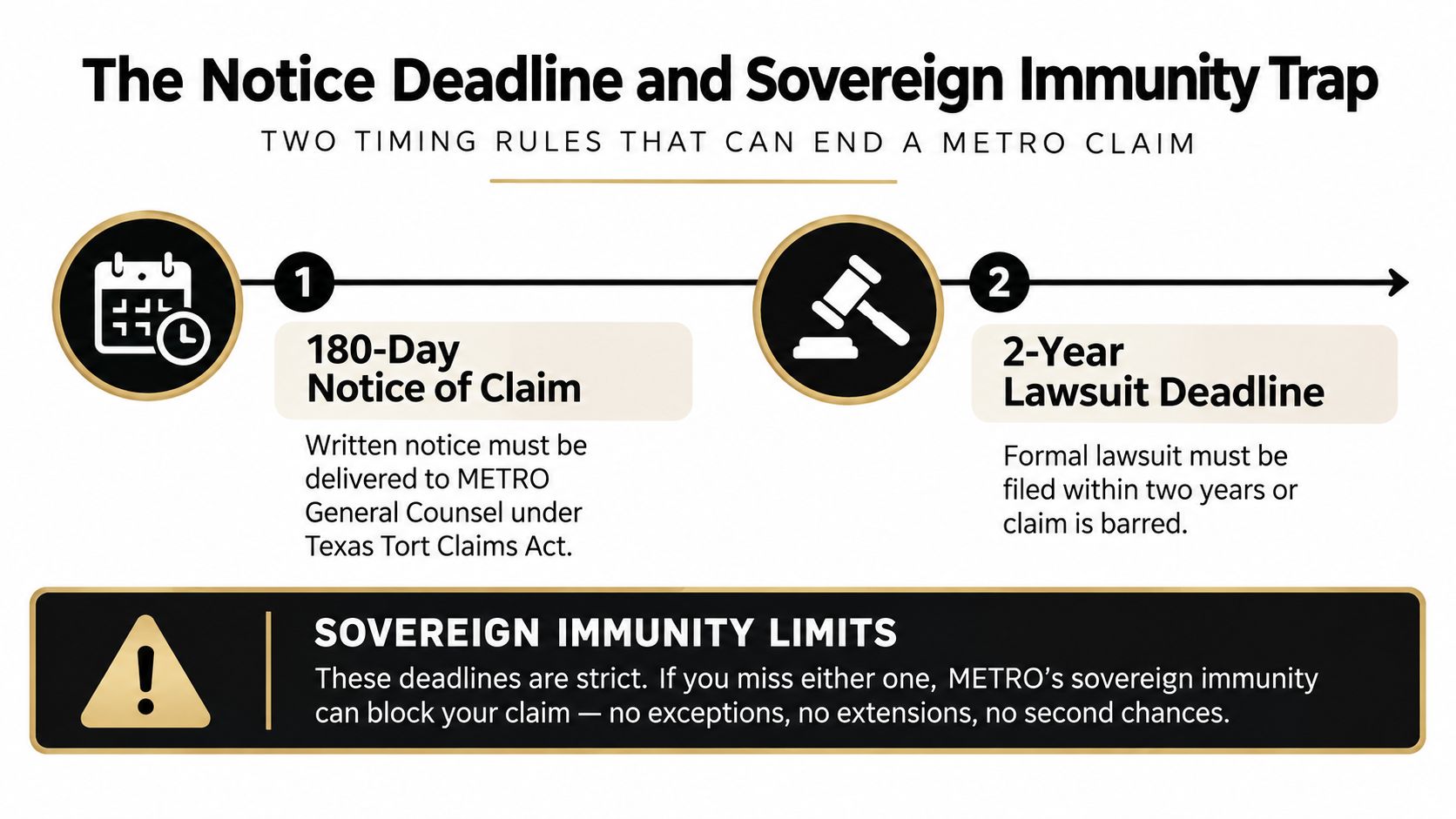
The most important difference is timing. A public-transit claim can require written notice to METRO within 180 days, even though Texas generally provides a longer limitations period for many personal-injury lawsuits. Missing that notice requirement can end a claim before the evidence is fully developed.
Who Can Be Held Liable for a METRORail Crash
Liability depends on how the crash happened. A train striking a car at a crossing raises different issues from a passenger falling during an emergency stop. The investigation should identify each person, agency, or company whose conduct contributed to the injury, rather than accepting the first incident report as the final answer.
Potential defendants and the evidence against them often include:
| Defendant | Common Liability Theory | Typical Evidence |
|---|---|---|
| METRO | Negligent train operation, maintenance, employee conduct, or safety-system implementation | Video, dispatch logs, operator records, maintenance files, event-recorder data |
| Another driver | Illegal turn, failure to obey a signal, distraction, or unsafe entry onto the crossing | Traffic video, vehicle damage, witness accounts, signal records |
| City of Houston | Poorly coordinated traffic signals or dangerous roadway conditions | Signal timing, engineering records, prior complaints, photographs |
| Track or signal contractor | Defective repair, construction activity, or maintenance work | Contracts, work orders, inspection records, photographs |
| Vehicle manufacturer | Brake or other mechanical defect in an unusual case | Vehicle inspection, component testing, recall and maintenance records |
The crash location and sequence matter. Vehicle impacts have occurred near corridors such as Harrisburg, Scott, and Fulton. Passenger and platform incidents near the Downtown Transit Center require a different examination of train handling, platform conditions, warnings, and crowd movement.
Comparative fault can reduce or defeat recovery. Texas uses proportionate responsibility under Chapter 33. A claimant assigned greater than 50% responsibility cannot recover damages under the statute. Texas Civil Practice and Remedies Code Chapter 33
METRO or an insurer may argue that a pedestrian crossed too soon, a driver turned in front of the train, or a passenger failed to hold on. Test those allegations against signal timing, sight distance, warning-device performance, video, witness accounts, and the train's response. An incident report records an initial conclusion. It does not decide the case.
Practical rule: Do not accept the first fault percentage. A second review of the physical evidence may show that METRO, another driver, a contractor, or a public agency shared responsibility.
A government vehicle creates another complication. Houston Fire Department vehicles were involved in multiple METRORail collisions in 2026, and reporting indicated that TxDOT records assigned fault to the city vehicles in both July collisions. Passengers were taken to the hospital in those incidents. ABC13's report on the HFD and METRORail collisions
When METRO, a government vehicle, and a private party are involved, analyze immunity, notice requirements, damage limits, and proportionate responsibility together. A Houston Metro bus accident lawyer may address related public-transit issues, but a rail claim needs rail-specific evidence and a separate liability analysis.
The Notice Deadline and Sovereign Immunity Trap
A METRORail injury claim can fail before the full extent of the injury is known. Houston-area guidance identifies a 180-day notice of claim deadline for claims against METRO. The ordinary two-year Texas statute of limitations may also govern the lawsuit itself. The notice deadline comes first, so waiting for treatment to finish can eliminate the claim. Guidance on claims against public transit agencies
What the notice must do
A notice of claim should identify the injured person, the date and location of the crash, the basic circumstances, the injuries, and the compensation sought. It also must reach the proper METRO claims channel and General Counsel process. A police report, medical bill, or conversation with a station employee does not automatically satisfy that legal requirement.
Sovereign immunity protects a government entity from lawsuits unless Texas law waives that protection. Texas permits claims in limited situations, subject to strict conditions. Those conditions can determine whether the claim proceeds, which defendants remain available, and how much compensation a governmental defendant may pay.
The damages request matters too. Texas Civil Practice and Remedies Code Section 74.201 limits non-economic damages, including pain, mental anguish, and disfigurement, to $250,000 per person in the governmental-claim circumstances described. A cap does not measure the full harm. Damages include the financial and personal losses caused by the crash, while a statutory limit restricts the amount a particular governmental defendant may owe.
Filing an Injury Claim in Harris County Courts explains the local civil-court process. Do not rely on a generic calendar estimate for a METRO claim. Have counsel confirm the deadline, recipient, required contents, and delivery method immediately.
What to Do in the First 72 Hours After a METRO Rail Crash
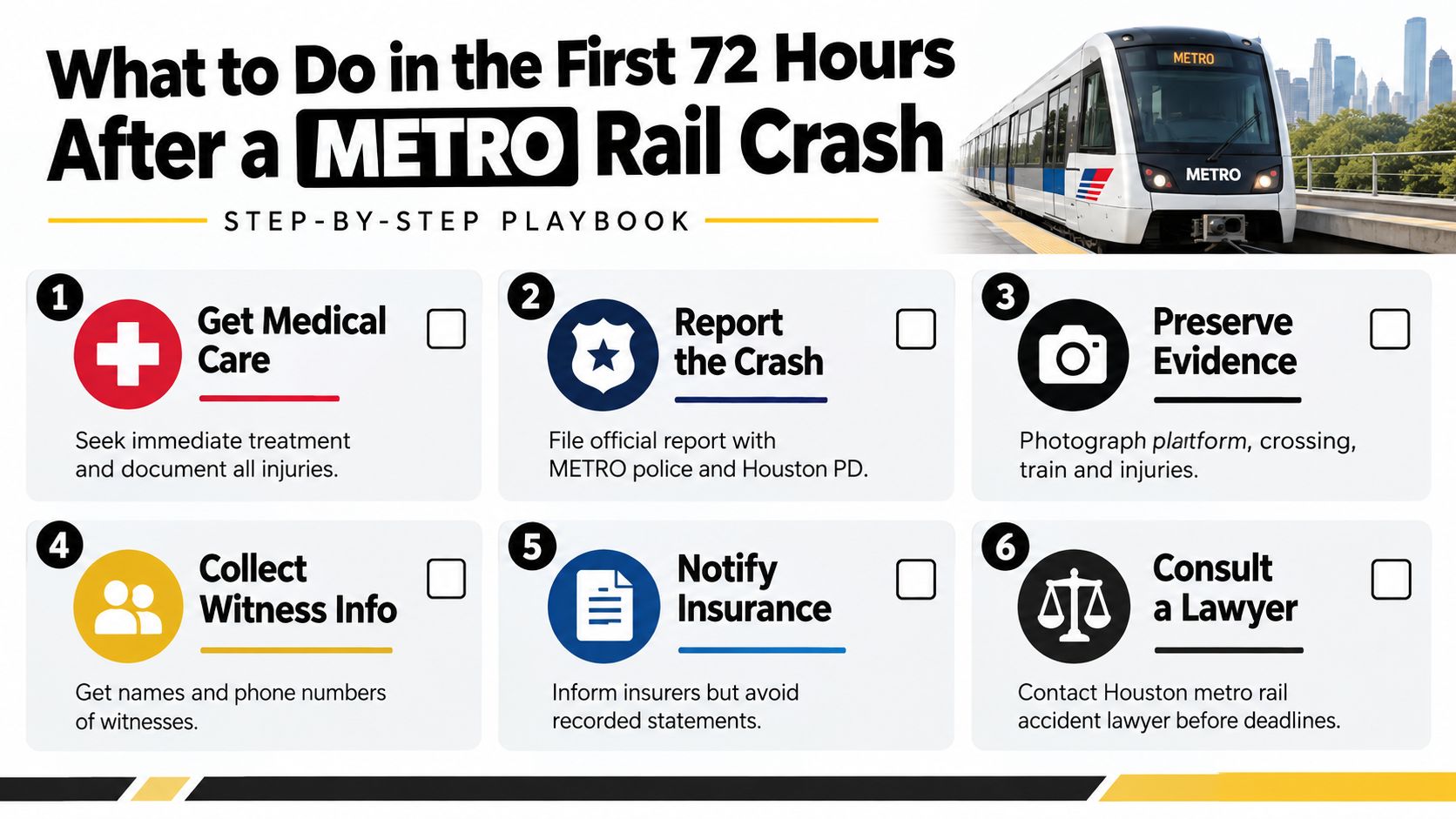
Your first priority is medical safety. Texas Department of Insurance recommends moving out of traffic when no one is hurt, calling police when someone is injured or a driver leaves, collecting insurance and license information, photographing the scene, speaking with witnesses, and notifying your insurer after you get home. Texas Department of Insurance guidance after a wreck
Start with medical care and official reports
Call 911 and accept evaluation by METRO emergency responders. Pain can be delayed, especially after a sudden stop or vehicle impact. Ask for the METRO Police incident number and the Houston Police Department report information when applicable.
If you're physically able, photograph the train, crossing arms, traffic signals, platform, vehicle positions, debris, and visible injuries. For a crossing collision, record the approach from the driver's viewpoint and the location of warning signs. Don't enter an unsafe track area to obtain photographs.
Riders should remain where responders direct them, identify witnesses, and preserve the METRO ticket, card record, or app information showing the trip. Drivers and pedestrians should preserve damaged clothing, helmets, phones, and other physical evidence. Don't repair or discard a vehicle before it can be inspected.
Protect the insurance and evidence trail
Notify your own auto insurer as required by your policy. You may have coverage that applies to your vehicle or injuries, but give only accurate facts and don't guess about speed, fault, or medical prognosis. Avoid a recorded statement for METRO's claims adjuster until you've received legal advice.
On the second day, contact counsel about a written preservation request for onboard video, platform footage, dispatch communications, operator logs, event-recorder data, signal records, and track-maintenance documents. A preservation request made later can be harder to enforce when video is overwritten or routine records are discarded.
Use the Houston accident report guide to understand the role of the official report, but remember that the report is only one piece of evidence. It may not contain the technical information needed to prove a crossing or operational defect.
How Damages and Comparative Fault Work in These Cases
A pedestrian enters a Main Street crossing with a walk signal and is struck by a METRORail train. The injuries include a broken leg, continuing back pain, lost income, and fear of returning to the crossing. The claim is not valued by adding the ambulance bill. It requires a careful review of financial losses, long-term effects, fault, and the limits that apply to a public-transit defendant.
Economic damages cover measurable financial losses, including past and future medical care, lost wages, reduced earning capacity, rehabilitation, transportation, and other documented costs. Non-economic damages address pain, mental anguish, disfigurement, and loss of enjoyment of life. Texas treats exemplary damages differently. Under Chapter 41, exemplary damages are punishment, not compensation, and the statute controls when they may be considered. Texas Civil Practice and Remedies Code Chapter 41
| Damage Category | What It Covers | Texas Cap or Rule |
|---|---|---|
| Medical and rehabilitation losses | Treatment, therapy, medication, and future care | Must be supported by medical and financial evidence |
| Lost income | Missed work and reduced ability to earn | Requires proof of past and future impact |
| Pain and mental anguish | Physical discomfort and emotional suffering | Governmental limits may apply to non-economic damages |
| Disfigurement and reduced enjoyment | Permanent changes and limits on daily life | Evaluated with the injury evidence and applicable caps |
| Exemplary damages | Punitive damages for qualifying misconduct | Chapter 41 governs availability and proof |
Shared fault can reduce or eliminate recovery. If a jury assigns part of the responsibility to the pedestrian, the award is reduced by that percentage. If the pedestrian is assigned responsibility greater than 50%, Chapter 33 bars recovery. Signal timing, witness accounts, visibility, crossing design, and the operator's response can determine whether the defense succeeds.
Fatal crashes require a separate family claim
Houston reporting has documented repeated deaths and injuries on the light-rail system. Those incidents show why a fatal collision requires more than a standard injury demand.
A fatal collision may support a wrongful-death claim under Texas law. Wrongful death compensation can address losses suffered by eligible family members, while an estate claim may address losses belonging to the deceased person. The family must evaluate the available recovery, responsible defendants, notice requirements, and governmental limits together.
Do not assume an insurance policy limit equals the amount legally recoverable. A private driver or contractor may carry applicable coverage, while METRO remains subject to governmental restrictions and statutory caps. A lawyer should identify every responsible party, separate each defendant's coverage, and account for shared fault before valuing the claim.
How a Houston Metro Rail Accident Lawyer Builds Your Case
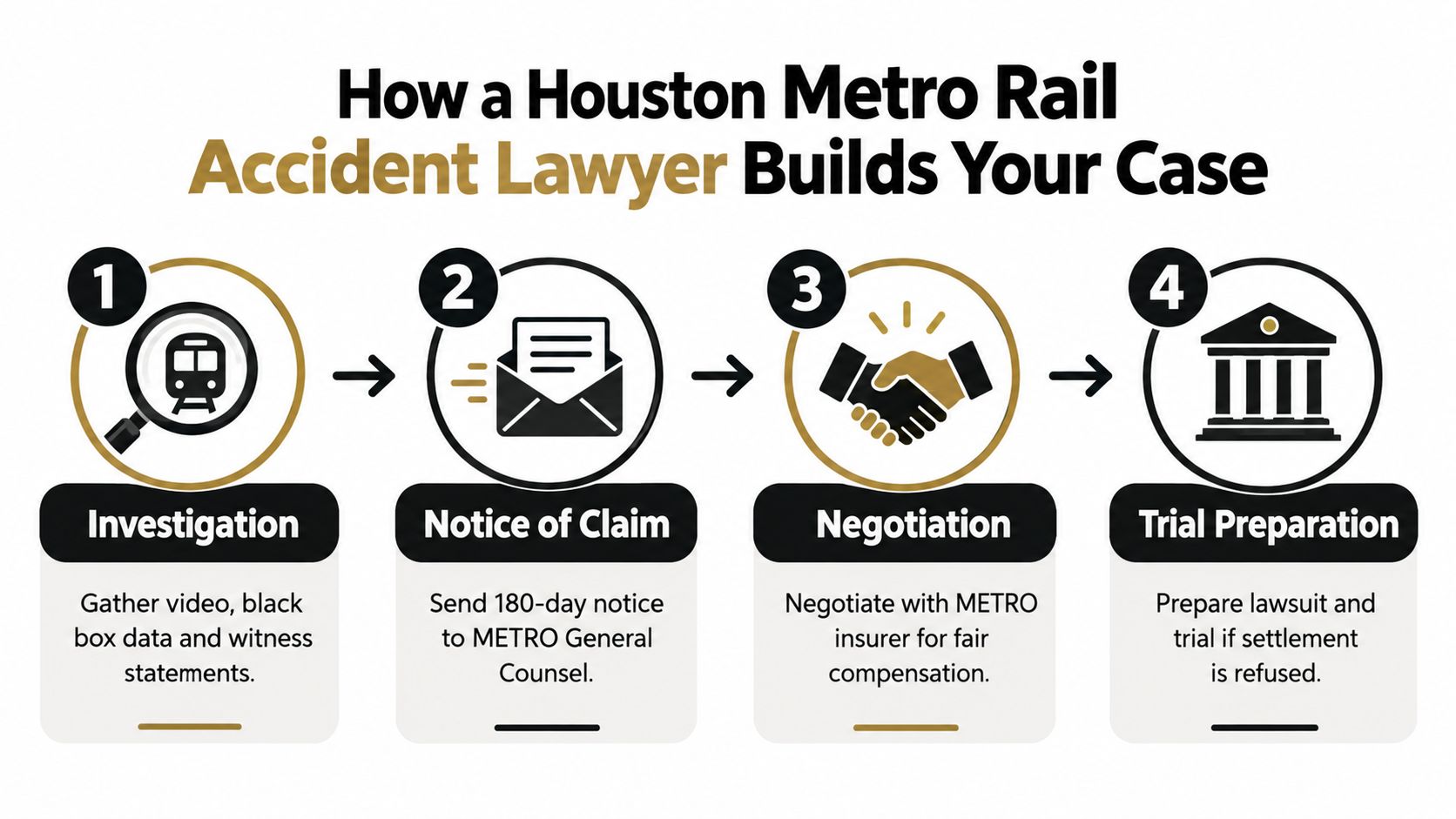
A strong case starts with preservation, not a demand letter. A Houston metro rail accident lawyer should identify what can disappear, send the required notice, and build the liability theory around evidence rather than assumptions.
The early evidence sweep
The investigation may include the METRO Police report, onboard and platform video, nearby business footage, dispatch communications, operator qualification files, and train event-recorder data. For a grade crossing, the review should include signal-cycle records, warning-device maintenance, inspection documents, track work, sight distance, lane markings, and prior incident information.
Witnesses should be contacted while their memories remain clear. A witness may remember whether the crossing gate was down, whether the signal changed, whether the operator sounded a warning, or whether traffic blocked the crossing. Those details can directly affect comparative fault.
Notice, negotiation, and trial preparation
The notice of claim must be prepared and delivered within the applicable 180-day period. It should accurately describe the incident, injuries, circumstances, and demand without overstating facts that later evidence may contradict. Filing notice isn't the same as filing a lawsuit, and it doesn't replace the separate limitations deadline.
After notice, the claim package should organize medical records, billing, wage documentation, physician opinions, future-care evidence, and, when appropriate, life-care planning or economic-loss analysis. METRO or its claims representatives may dispute operator conduct, crossing conditions, causation, or the extent of damages. A clear package answers those disputes with records.
Legal teams often use structured administrative support to manage medical files, witness materials, and deadline tracking. If you're evaluating those systems for a law practice, this resource on virtual legal assistants companies offers background on available support models. Support staff don't replace legal judgment, but organized case administration helps prevent critical documents from being missed.
If negotiation fails, the lawyer should be ready to file suit, conduct discovery, retain accident-reconstruction and transit-safety experts, and prepare for mediation or trial. Trial readiness affects settlement negotiations because a government defendant can see whether the claimant's evidence is organized and whether counsel is prepared to challenge comparative fault and immunity arguments.
Why Choose The Law Office of Bryan Fagan for Your METRO Claim
A METRORail claim needs a Texas injury attorney who understands both injury damages and governmental defendants. The Law Office of Bryan Fagan, PLLC handles Texas personal-injury matters involving vehicle collisions, pedestrian injuries, transit incidents, and wrongful death. Its work includes the practical concerns that matter after a rail crash, such as medical documentation, insurance communications, evidence preservation, and deadline control.
You won't benefit from a lawyer who treats the event as a routine auto insurance claim. The legal team should identify whether METRO, a private driver, the City of Houston, a contractor, or another government vehicle contributed to the crash. That analysis can affect the notice process, comparative responsibility, damages, and available coverage.
The firm offers a free initial consultation and uses contingency-fee representation, meaning clients don't pay attorney fees unless the firm recovers compensation. Ask directly about how the fee agreement works, what expenses may arise, and how the firm will handle the METRO notice deadline. Clear answers matter when you're already facing medical bills and lost income.
A steady plan for injured families
The firm can coordinate with treating providers, accident-reconstruction professionals, and life-care planners when the injuries require long-term analysis. That may include organizing records for a traumatic brain injury, spinal injury, fracture, permanent disability, or fatal crash. The purpose is to document the full effect of the injury while applying the limits and rules that govern claims against public entities.
The firm serves clients throughout Texas and communicates in English and Spanish. It can also help with related claims, including a Houston car accident lawyer matter involving a negligent driver, an uninsured or underinsured motorist dispute, or a family's wrongful-death case. Those cases may involve different rules, so the legal theory should match the event.
You deserve a calm explanation of what happens next, not a promise of a particular result. The right attorney should tell you which evidence matters, which deadline comes first, how insurers may respond, and whether litigation is necessary.
The Law Office of Bryan Fagan, PLLC offers a free consultation and contingency-fee representation for people injured in METRORail collisions, crossing crashes, and related Texas injury claims. Visit The Law Office of Bryan Fagan, PLLC promptly so the team can review your evidence, protect the METRO notice deadline, and explain your recovery options.