A car crash can change your life in seconds, but you don't have to face recovery alone. You may be sitting at home after an accident on SH-288, replaying the impact while worrying about medical bills, missed work, vehicle damage, and an insurance adjuster asking for your recorded statement. Those concerns are real, but the right steps can protect your health, evidence, and legal rights.
Highway 288 is not just another Houston street. It's a high-speed urban freeway where lane changes, construction, heavy traffic, commercial vehicles, sudden closures, and limited reaction time can make fault difficult to prove. A Houston car accident lawyer can help preserve corridor-specific evidence, obtain the CR-3 crash report, evaluate insurance coverage, and build a claim based on what happened rather than the first version an insurer accepts.
What an Accident on Highway 288 Really Feels Like
You're merging onto SH-288 near the South Loop when traffic compresses. A vehicle behind you strikes your rear bumper before you can clear the lane. The airbags may not deploy, but the impact still jolts your neck and back. Horns sound. Cars pass close to the shoulder. Someone is asking whether you're hurt while you're trying to remember where your phone landed.
That kind of sensory overload affects judgment. Adrenaline can hide pain, and shock can make it difficult to explain the crash in a clear order. You might apologize even though you didn't cause the collision, agree that everyone is “fine,” or leave before anyone documents the roadway. Those statements can later be taken out of context.
The financial fear starts quickly
After the scene clears, the questions become more personal. How will you pay for treatment? Can you work tomorrow? Who will repair your car? What should you say when the other driver's insurance company calls?
An insurer's early questions may sound routine, but your answers can affect how the company evaluates liability and injury causation. Liability means legal responsibility for causing harm. In a highway crash, proving liability usually requires more than showing that one vehicle hit another. Investigators may need to determine lane position, speed, visibility, roadway conditions, vehicle movement, and whether another impact caused the collision.
Texas transportation data shows why distracted driving matters in Houston injury cases. In 2025, Texas recorded 86,384 distracted-driving crashes, causing 299 deaths and more than 2,437 serious injuries, according to TxDOT's distracted-driving safety data. Earlier statewide reporting also found distracted driving accounted for nearly one in five Texas crashes, making it a foundational risk factor on Houston corridors such as SH-288.
Your first goal isn't to win an argument at the roadside. It's to stay safe, obtain medical care, and preserve facts before they disappear.
The guidance below is designed for the decisions you face after the collision, before an insurer turns a serious freeway injury into a “routine” claim.
First Steps After a Crash on SH-288
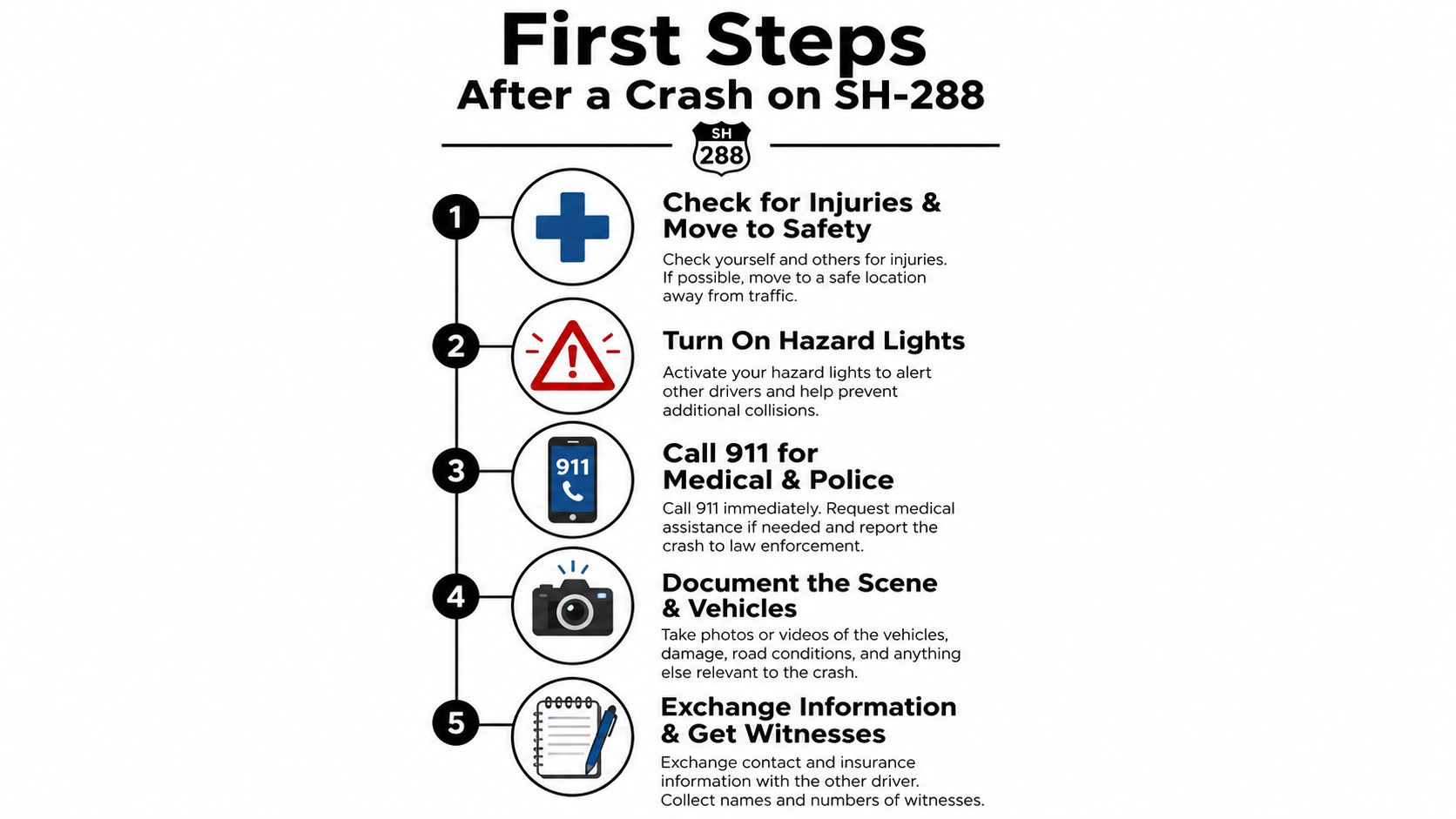
Safety comes first. If you can move without worsening an injury, get out of active traffic and onto the shoulder. Turn on your hazard lights, use emergency equipment if you have it, and stay away from moving lanes. If your vehicle is in a dangerous position, tell the 911 operator exactly where you are and follow emergency instructions.
Follow the first-hour sequence
- Check for injuries: Look at yourself and passengers, but don't move someone with a serious injury unless remaining in place creates an immediate danger.
- Call 911: Request medical help and law enforcement. Explain that the collision occurred on SH-288 and provide the nearest exit, cross street, interchange, or visible landmark.
- Give a factual account: Tell the officer what you observed. Avoid guessing about speed, distance, or fault, and don't say you're uninjured if you're uncertain.
- Exchange information: Obtain names, phone numbers, driver's license details, vehicle information, and insurance details from the other drivers when it's safe.
- Document the scene: Photograph vehicle positions, damage, debris, skid marks, lane markings, barriers, construction equipment, lighting, weather, and roadway defects. Ask witnesses for contact information before they leave.
Request the CR-3 crash report from the investigating agency, such as the Houston Police Department or Harris County Sheriff's Office, when available. The report may not decide the case, but it can identify involved parties, observed conditions, citations, and the officer's initial account.
For a broader checklist, review what to do after a car accident. You can also consult Dealing With Insurers After a Houston Accident for information about protecting your claim from Houston-area insurance tactics.
Don't argue with the other driver, post accusations, or sign anything at the scene. Share only the information needed for identification and insurance. Your scene photographs and witness contacts may later help establish the sequence of impacts, especially in a multi-vehicle collision where each driver blames someone else.
The Next 72 Hours That Quietly Shape Your Claim
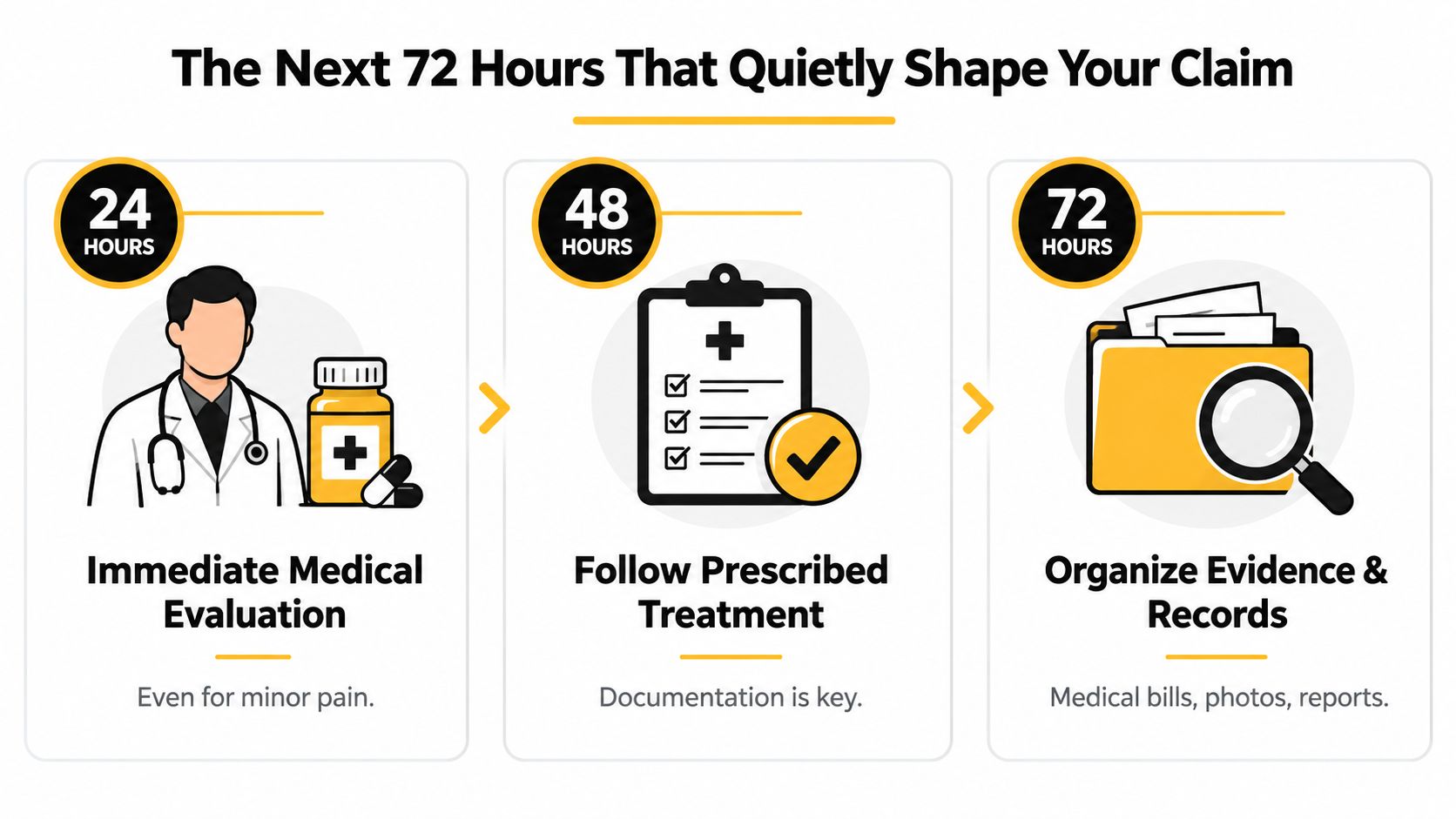
The first three days can influence how an insurer views your injuries. Seek a medical evaluation even if pain feels minor. Neck strain, back injuries, concussion symptoms, and other conditions may become clearer after the immediate shock fades, but waiting gives an adjuster an opening to argue that the crash didn't cause your condition.
Follow the treatment plan your healthcare provider gives you. Keep appointment records, prescriptions, bills, work notes, referrals, and instructions. A short daily journal can help you record pain, sleep problems, mobility limits, medication effects, and tasks you can't perform.
Handle insurance contact carefully
Notify your own insurer as your policy requires, but don't provide a recorded statement to the opposing carrier before you understand your rights. You can confirm basic facts, such as the date, location, vehicles, and injuries you know about. You don't need to speculate about fault or promise that you'll sign a medical release.
If the at-fault driver's insurer calls, write down the adjuster's name, company, claim number, and callback information. Don't accept a quick settlement before doctors understand your prognosis. A signed release may end your ability to seek more compensation for treatment that hasn't happened yet.
Preserve electronic evidence immediately:
- Dashcam footage: Save the original file and backups. Don't edit or overwrite it.
- Traffic evidence: Identify possible TranStar camera locations and request relevant records through appropriate channels.
- Emergency records: Preserve 911 information and dispatch details.
- Vehicle evidence: Photograph damage before repairs, and ask that damaged parts and onboard data be preserved.
- Witness evidence: Record names, phone numbers, and what each person saw, without coaching anyone.
Avoid posting photographs, opinions, accusations, or recovery updates on social media. Even an innocent statement can be presented as evidence that your injuries are less serious than you reported. For help obtaining law-enforcement records, see how to obtain police records. A Houston Personal Injury Lawyer may also assist injury victims across Houston and Harris County.
Who Is Liable in a Texas Highway Crash
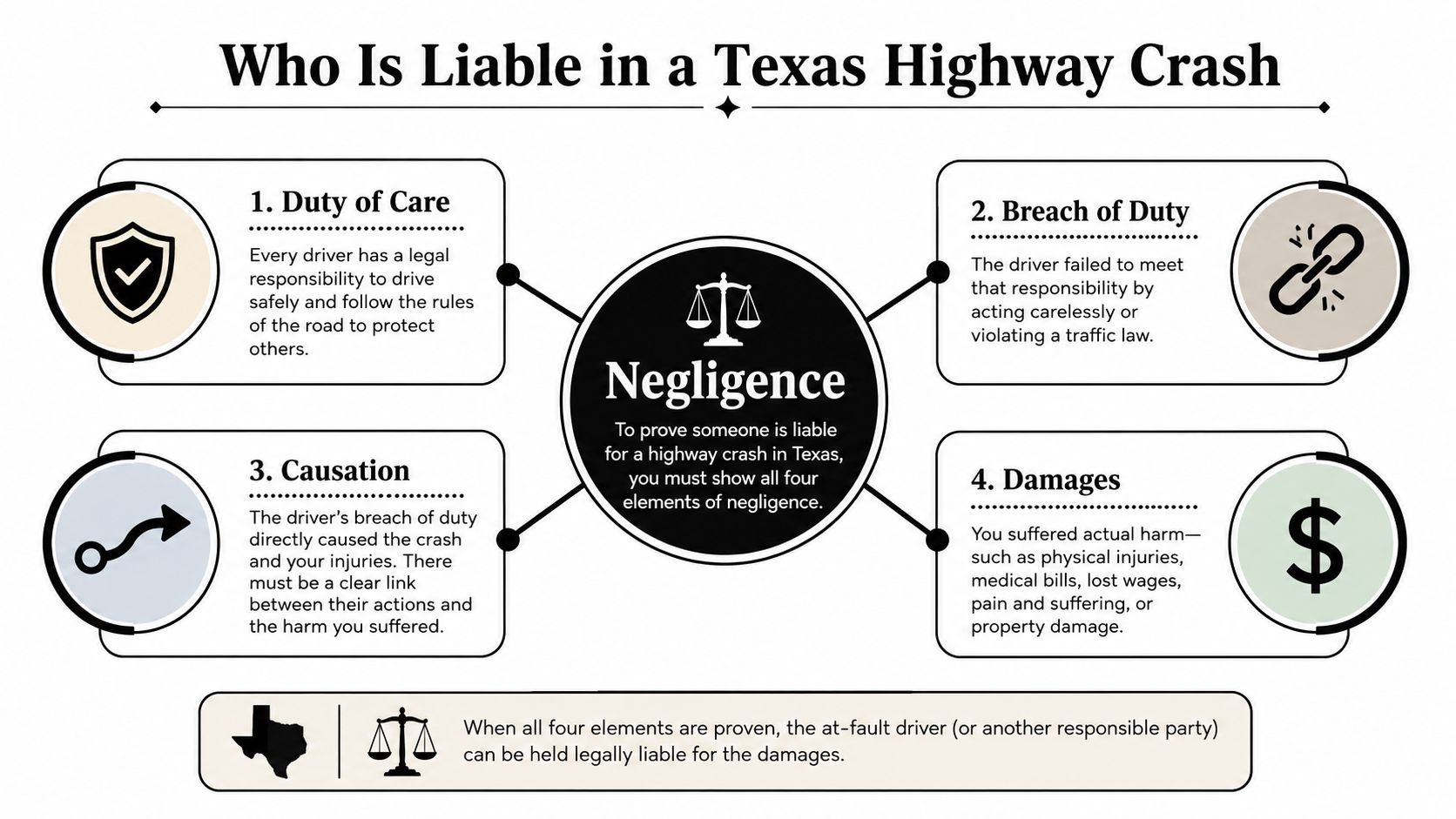
The driver who caused the collision may be responsible, but the answer depends on evidence. Negligence means failing to use the care a reasonably careful person would use in the same situation. A personal injury claim generally requires proof that the other party owed you a duty, breached that duty, caused the crash or injury, and left you with damages.
Damages are the losses the law may compensate. They can include medical expenses, lost income, vehicle-related losses, physical pain, and other harm supported by evidence.
Highway 288 creates complicated fault questions
A sudden lane change near the US-59 or Beltway 8 interchanges may involve disputed visibility, signaling, speed, and vehicle position. A rear-end crash in a construction zone may require review of lane shifts, barriers, warnings, and traffic control. In a pileup, the first impact may not be the only event that caused your injuries.
Commercial truck cases add another layer. The driver, motor carrier, vehicle owner, maintenance provider, cargo loader, or another party may have relevant responsibility. Federal motor-carrier rules, company policies, driver records, maintenance files, and electronic control module data can help show what occurred. A lawyer may send a preservation letter, sometimes called a spoliation letter, instructing a company to retain evidence that could otherwise be lost or overwritten.
Texas follows modified comparative fault under Chapter 33 of the Texas Civil Practice and Remedies Code. Comparative fault means responsibility can be divided among the people involved. If you're assigned 50% or less responsibility, you may recover, but the award is reduced by your percentage of fault. If your responsibility is greater than 50%, Chapter 33 bars recovery, as explained in this Texas comparative-fault discussion.
A CR-3 report is important, but it isn't the whole case.
For a 288 claim, counsel may compare the CR-3 report with dashcam footage, witness accounts, vehicle damage, roadway photographs, TranStar incident information, and available vehicle data. Texas's strategic safety plan found that 63.2% of distracted-driving fatal and suspected serious-injury crashes from 2017 through 2021 occurred in urban areas, with 12,417 such crashes statewide, 2,034 deaths, and 12,890 additional suspected serious injuries, according to the Texas Strategic Highway Safety Plan. That urban concentration matters because Houston freeway evidence often involves multiple drivers, dense traffic, and competing explanations.
Damages, Deadlines, and Uninsured Drivers
A strong claim accounts for more than the first hospital bill. It connects the crash to past and future medical care, missed work, reduced earning capacity, physical pain, mental anguish, scarring, and loss of enjoyment of life. Economic damages are financial losses that can be documented with bills, wage records, and invoices. Noneconomic damages compensate harms that don't come with a receipt.
Texas Chapter 41 generally doesn't cap ordinary economic damages in a standard car-accident injury claim. It does limit exemplary damages, which are punitive damages intended for especially serious wrongdoing, to the greater of $200,000, or two times economic damages plus noneconomic damages up to $750,000, under the framework summarized in this Texas damages-cap explanation. Exemplary damages aren't automatic, and most claims focus on proving actual losses.
| Damage Category | What It Covers | Key Evidence |
|---|---|---|
| Medical expenses | Emergency care, treatment, medication, rehabilitation, and reasonably supported future care | Medical records, bills, treatment plans |
| Lost income | Pay missed during recovery and supported future earning losses | Payroll records, employer statements, tax documents |
| Reduced earning capacity | The effect of lasting limitations on your ability to work | Medical restrictions, vocational evidence, employment history |
| Physical pain and mental anguish | Ongoing discomfort, emotional distress, fear, and disruption | Treatment notes, personal journal, testimony |
| Scarring and loss of enjoyment | Visible injuries and activities you can no longer enjoy normally | Photographs, witness accounts, medical opinions |
The deadline applies even while treatment continues
The general Texas personal-injury statute of limitations is the legal deadline for filing a lawsuit. In a typical car-crash injury case, it is two years from the date the claim accrues, usually the crash date, as described in this Texas limitations overview. Waiting can also allow video, vehicle data, and witness memories to disappear.
Uninsured and underinsured motorist coverage may provide another source of recovery when the at-fault driver lacks enough insurance. The Texas Department of Insurance explains that uninsured-motorist coverage is designed to help with medical bills and car repairs, although deductibles and coverage disputes may still arise. Review Texas uninsured motorist coverage promptly, because policy notice requirements matter.
Settlement analysis should consider proven losses, future care, fault allocation, and available coverage. A fatal crash may also support a wrongful-death claim, where the family may seek wrongful death compensation for losses recognized by Texas law.
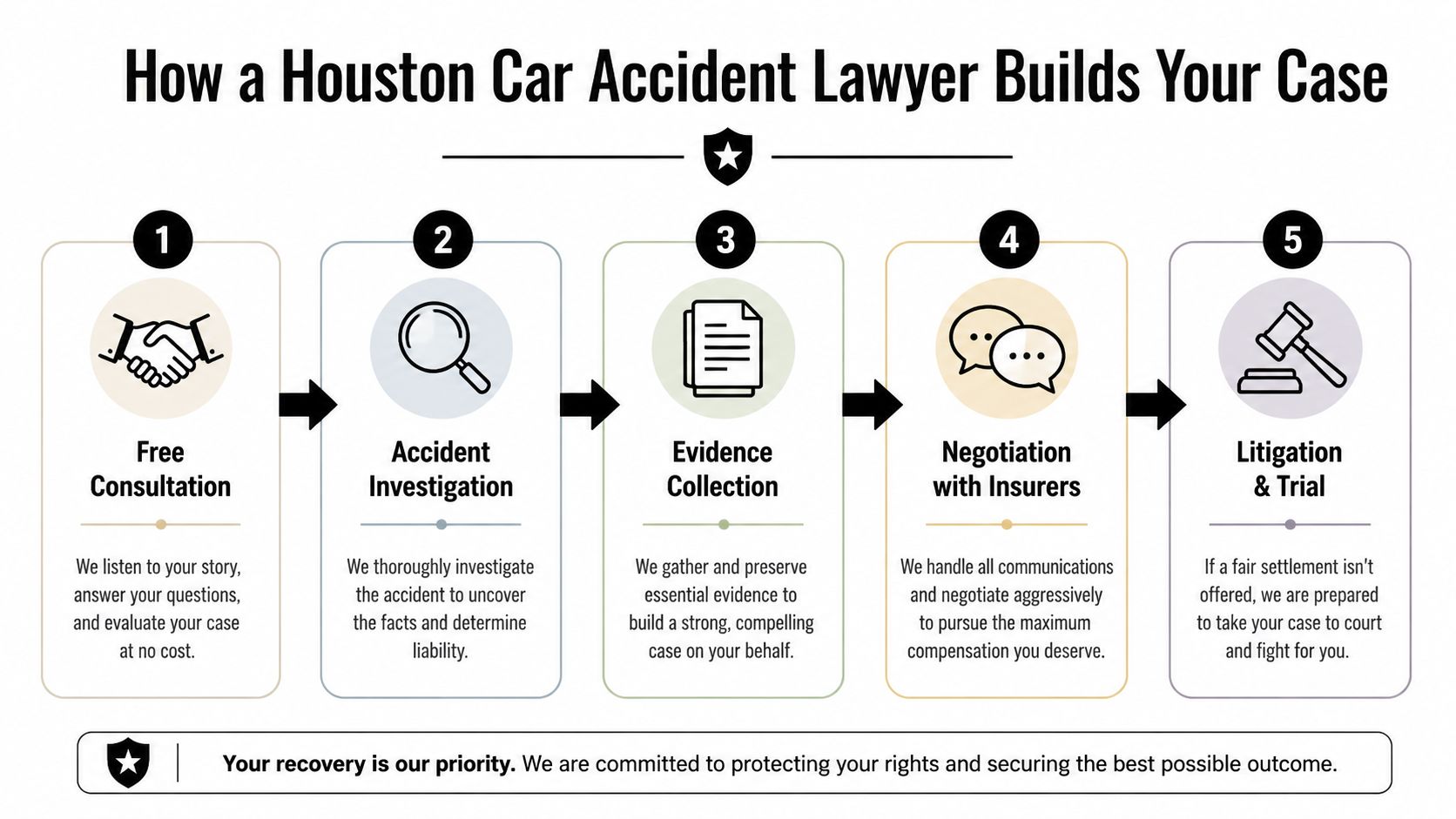
How a Houston Car Accident Lawyer Builds Your Case
A lawyer changes the process by investigating before evidence disappears. Houston TranStar's incident statistics show SH-288 Southbound at Airport Boulevard recorded 783 incidents in 2025, according to Houston TranStar incident statistics. That corridor activity supports urgency when seeking dashcam footage, witness accounts, and available traffic records.
Houston's broader crash volume also makes organized intake essential. TxDOT's 2024 city crash report lists Houston at 124,210 total crashes, 41,410 injury crashes, and 3,053 fatal crashes, as shown in the 2024 TxDOT Houston crash report. A lawyer's job is to separate your case from that volume by building a specific proof record.
Investigation comes before negotiation
A case may begin with obtaining the CR-3 report, locating witnesses, preserving vehicle photographs, requesting available TranStar information, and identifying nearby business or roadway cameras. In a truck collision, counsel may send preservation letters to the carrier and other custodians for electronic data, driver records, maintenance records, and cargo information.
The attorney then organizes damages. That may include reviewing medical records, calculating wage loss, identifying future treatment needs, and consulting vocational or medical professionals when the injury affects your ability to work. The purpose isn't to inflate a claim. It's to prevent an insurer from evaluating a serious freeway injury using only the first bill and the first photograph.
An insurer may make an early offer before your condition is clear. Your lawyer can explain what the offer covers, what it excludes, and whether accepting it would require a release. If negotiations fail, the case may proceed in the county connected to the crash, including Harris, Brazoria, or Fort Bend County, depending on the location and parties involved.
A free consultation is a confidential conversation about liability, damages, coverage, and deadlines. You can bring the crash report, photographs, insurance information, medical records, bills, wage documents, and a written account of what you remember. The Law Office of Bryan Fagan, PLLC offers free consultations and contingency-fee representation, with no attorney's fee unless the firm recovers money for your case.
The legal process may involve investigation, insurance negotiations, filing suit, discovery, mediation, and trial preparation. This video provides additional context about how a car accident case may develop.
Your Next Step and How to Reach The Law Office of Bryan Fagan
You don't need to solve the entire case today. You do need to protect the information and deadlines that matter.
- Write down your memory: Record where you were, which lane you occupied, what traffic was doing, what you saw before impact, and what happened afterward.
- Photograph your injuries and vehicle: Take clear photographs over time, and preserve the original images.
- Gather records: Locate the police report number, driver information, insurance details, medical records, and claim correspondence.
- Stop posting: Don't discuss fault, injuries, treatment, or settlement online.
- Schedule follow-up care: If pain or other symptoms appeared after the collision, contact a medical provider and explain when they began.
When you call The Law Office of Bryan Fagan, PLLC, you'll discuss the crash with a Houston accident lawyer during a free, no-obligation case review. The intake team can gather the location, vehicles, injuries, insurance information, and current treatment status, then discuss the two-year personal-injury filing deadline and any facts that could create a shorter notice requirement.
The next investigative steps may include retrieving the CR-3 report, requesting TranStar data, preserving dashcam and surveillance footage, interviewing witnesses, and sending evidence-preservation letters when a truck or commercial vehicle is involved. The firm can also explain its contingency-fee arrangement before you decide whether to move forward, including how case expenses are handled.
The firm's Houston office is at 3355 West Alabama, Suite 1220, Houston, Texas 77098, and the listed phone number is (713) 491-4792. If your family lost someone, ask about a wrongful-death case. If the other driver had no insurance or too little coverage, ask for a policy review. If your injuries affect work or future care, bring those concerns to the consultation.
You're a person recovering from a frightening event, not just a claim number. Take one careful step today, preserve what you know, get the care you need, and speak with counsel before signing away rights.
The Law Office of Bryan Fagan, PLLC offers free consultations and contingency-fee representation for victims injured in Highway 288 car, truck, uninsured-driver, and fatal crashes. Visit The Law Office of Bryan Fagan, PLLC to request a confidential case review and discuss your evidence, insurance coverage, damages, and Texas filing deadline.