A car crash can change your life in seconds, but you don't have to face recovery alone. If you're sitting on the shoulder of I-45 with a damaged motorcycle, or your family is waiting beside a hospital bed after a Houston collision, the next decisions matter. Your health comes first, but evidence, insurance coverage, and Texas deadlines can determine whether you recover the compensation needed for medical care, lost income, and long-term support.
Houston presents a serious environment for riders. City crash data report 671 motorcycle crashes in the most recent reporting year, including 36 fatal crashes, 130 serious injuries, and 185 minor injuries. The same data indicate that motorcycles make up under 2% of vehicles but are involved in 14% of fatal crashes in Houston, a disproportionate risk that makes careful liability and damages proof essential (Houston motorcycle crash analysis).
First Steps After a Houston Motorcycle Crash
You may be confused, hurt, and watching traffic rush past while your motorcycle lies several feet away. Start with safety, not an argument about fault.
Protect yourself and create an official record
If you can move without worsening an injury, get away from moving traffic. Turn on hazard lights if available, and ask someone to help warn approaching drivers. Call 911 and request a response from the Houston Police Department or the Harris County Sheriff's Office. An official crash report helps document the location, involved vehicles, injuries, and initial accounts.
Check your body before trying to lift or inspect the bike. Adrenaline can hide head, neck, back, and internal injuries. Don't remove a helmet or move someone with a suspected spinal injury unless there's an immediate danger.
Exchange basic information with the other driver:
- Contact information: Get the driver's name, phone number, license plate, insurance information, and the registered owner's details if different.
- Vehicle details: Record the make, model, color, and visible damage.
- Witnesses: Ask each witness for a name and phone number before traffic or emergency activity separates you.
Before the motorcycle is towed, photograph the scene if you can do so safely. Capture lane positions, skid marks, helmet damage, the other vehicle's plate and damage point, traffic signals, roadway defects, debris, and street sightlines.
Practical rule: Say only what you know. Don't apologize, speculate about speed, or accept the other driver's explanation as fact.
Houston claims can involve uninsured riders, hit-and-run drivers on feeder roads, and commercial vehicles operating near the 610 construction corridors. Those facts can create separate coverage and evidence problems. A guide on what to do after a car accident can also help family members organize the immediate response.
Seek medical care the same day, even if your pain seems manageable. Tell the provider every symptom, including dizziness, numbness, headache, confusion, and road rash. Keep the clothing, helmet, and damaged gear rather than replacing them.
Preserving Evidence That Protects Your Claim
A Houston motorcycle claim is often won or lost through evidence that disappears unless someone acts quickly. Pavement conditions change, vehicles get repaired, cameras overwrite footage, and witnesses forget details. You or a trusted family member should begin preserving proof while the event is still fresh.
Photograph the physical evidence
Take wide photographs that show the entire roadway and close images of the details that explain impact. Focus on:
- Helmet and gear: Photograph scratches, cracks, missing pieces, and embedded debris.
- Motorcycle damage: Capture crush points, bent controls, broken lights, and damage underneath visible panels.
- Roadway evidence: Photograph pavement gouges, skid marks, oil, loose gravel, debris fields, lane markings, and sight obstructions.
- Other vehicle damage: Capture the plate, bumper or side-panel damage, broken lights, and the point of contact.
- Video locations: Note businesses, residences, intersections, and vehicles that may have exterior cameras.
A damaged helmet can directly answer an insurer's attempt to portray you as reckless. It may also help show the force and direction of impact. Don't throw it away, clean it aggressively, or replace it before counsel or an appropriate expert has inspected it.

Capture witnesses and electronic records
Return to nearby businesses promptly, or ask a friend to do it. Request that owners preserve relevant footage, even if they won't release it immediately. Get written witness statements when possible, along with phone numbers and a description of what each person saw.
Preserve the police crash report, body-camera references, dash-cam files, helmet-camera or GoPro footage, and vehicle Event Data Recorder information. A request for records through the Houston Police Department Records Division can be part of that process. This guide to obtaining police records explains the practical records-request process.
A Houston Motorcycle Accident Lawyer may represent motorcyclists injured in Houston crashes. Whether you hire counsel immediately or ask a family member to help first, use this checklist:
- Preserve the motorcycle, helmet, boots, gloves, and riding clothing.
- Photograph the scene and every vehicle before repairs or towing changes the evidence.
- Record every witness and camera location.
- Request preservation of traffic, business, dash-cam, and vehicle data.
- Keep the crash report number and all medical paperwork together.
Medical Care and Building Your Damages Record
Consider a 34-year-old Houston commuter T-boned at Hillcroft and Bellaire. The rider feels shaken but believes the pain is tolerable. By evening, a headache and shoulder stiffness appear. Waiting several days can give an insurance adjuster an argument that the crash didn't cause the condition.
Go to an emergency room the same day when symptoms exist, and describe the collision accurately. The medical record should connect the event to your symptoms without exaggeration. Follow the treatment plan, attend follow-up appointments, and report changes rather than trying to push through pain without care.
Build a consistent medical chain
A strong record may include:
- Emergency care: Initial complaints, examination findings, diagnoses, prescriptions, and discharge instructions.
- Follow-up care: Primary-care visits that track whether symptoms improve, persist, or worsen.
- Specialist referrals: Orthopedic, neurological, or other evaluations when the injury requires focused care.
- Testing: Imaging and other diagnostic work that documents objective injury.
- Rehabilitation: Prescribed physical therapy, occupational therapy, or other treatment.
- Pain management: Notes showing continuing symptoms, functional limits, and treatment response.
Each step serves a purpose. Imaging can support an objective injury diagnosis. Consistent appointments help show that pain continued. A gap in treatment lets an adjuster argue that you recovered or that another event caused the symptoms. Receipts for medication, travel, equipment, and other out-of-pocket costs anchor the economic-loss portion of your claim.
Houston riders should also watch for delayed traumatic brain injury symptoms, road-rash infections, and insurance disputes over medically necessary MRI testing. Tell your provider about confusion, memory problems, sleep changes, headaches, balance issues, and mood changes. Medical records are not a formality. They are the foundation of the damages case.
Pain and suffering, physical impairment, disfigurement, lost wages, reduced earning capacity, property damage, and future care all require clear support. Keep a daily symptom journal, but write facts rather than legal conclusions. Record pain, sleep, missed work, household tasks you can't perform, and activities you've stopped.
Texas Comparative Fault and Who Pays
Liability means legal responsibility for causing the crash and resulting harm. In a motorcycle case, you generally must connect another person's careless conduct to the collision and your injuries. That may involve a driver who turned left across your path, changed lanes without checking, followed too closely, or looked at a phone instead of the roadway.
Texas uses modified comparative responsibility under Chapter 33 of the Texas Civil Practice and Remedies Code. A jury can assign a percentage of responsibility to each party. If your responsibility is greater than 50%, you can't recover damages. If your share is 50% or less, your recovery is reduced by that percentage (Texas Civil Practice and Remedies Code Chapter 33).

Here's how the rule can work in real Houston disputes:
- Left-turn collision: A rider enters an intersection on a yellow light while a driver turns left across the rider's path. The jury may examine visibility, speed, timing, turn signals, and each person's lookout.
- Lane-change collision: A rider is slightly over the speed limit when a texting driver moves into the lane. The rider's conduct may receive some responsibility, but it doesn't automatically erase the driver's conduct.
- Recovery reduction: If a jury values damages at $200,000 and assigns you 20% responsibility, the recovery is reduced by $40,000. The figures illustrate the rule, not a prediction of case value.
Police-report wording, independent witnesses, helmet and gear evidence, video, and accident reconstruction can move the responsibility analysis. The Houston Car Accident Lawyer practice represents car accident victims in Houston and Harris County, including cases where multiple vehicles dispute fault.
Adjusters often raise comparative fault before they've reviewed all evidence. Don't give a recorded statement before getting legal advice. A careless answer about speed, lane position, or helmet use can become the insurer's opening argument.
Dealing With Insurance Companies and Coverage Gaps
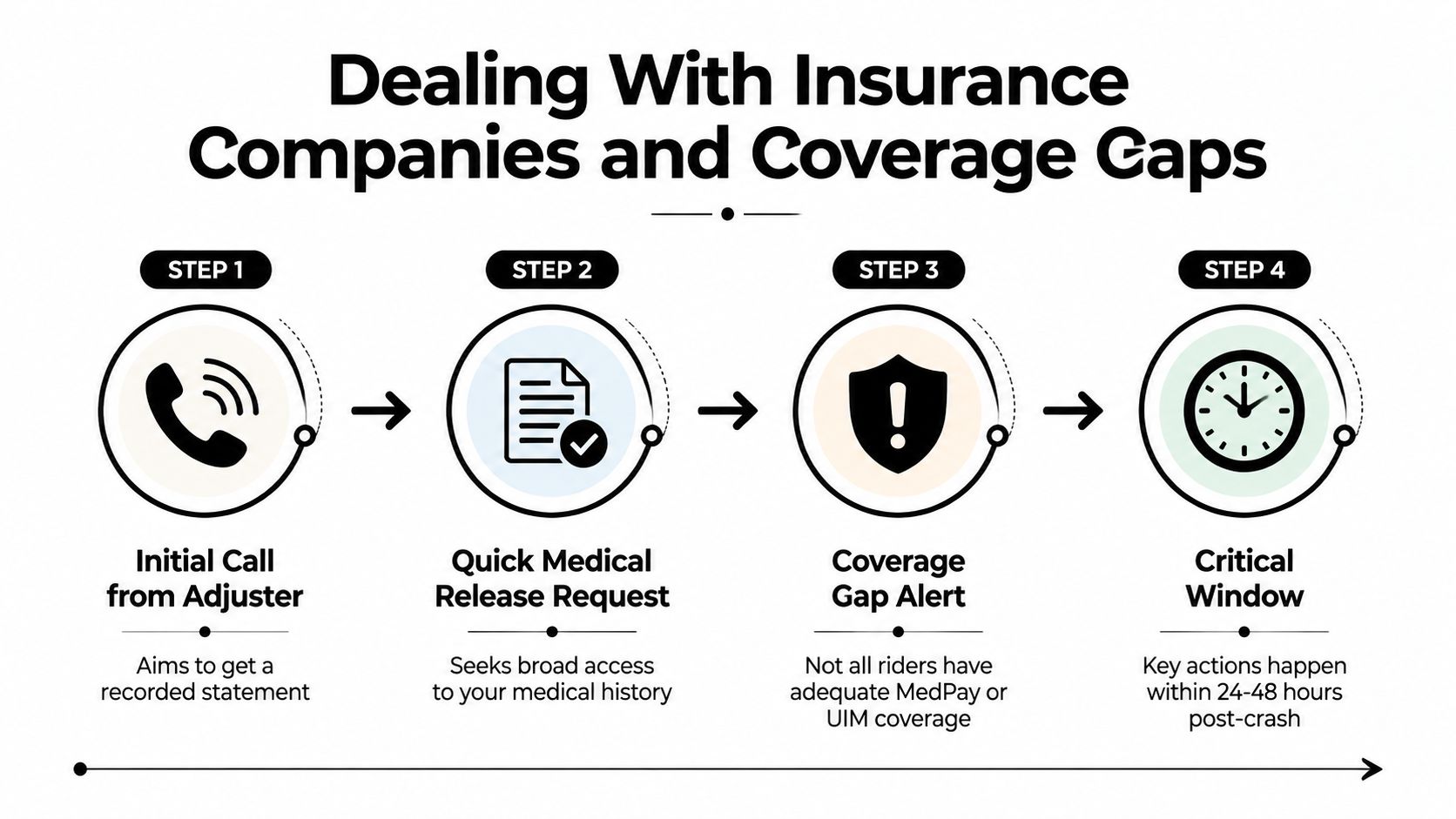
Within a day or two, an adjuster may call with a friendly tone and simple questions. The purpose may be to secure a recorded statement, obtain a broad medical authorization, or push a quick settlement before the full injury picture develops.
You don't have to treat the adjuster as an enemy. You do need to remember that the adjuster works for an insurer protecting its financial position. Your job is to protect your health, preserve proof, and avoid statements that can be taken out of context.
Don't give away control of the claim
Use this rule after a serious crash:
- Recorded statements: Don't agree to one before speaking with counsel.
- Medical releases: Don't sign a broad authorization that gives an insurer unrestricted access to your medical history.
- Early offers: Don't settle before doctors can evaluate future treatment, permanent impairment, and lost earning capacity.
- Written communications: Save letters, emails, text messages, claim numbers, and voicemail files.
A release can end claims you haven't yet understood. It may also prevent you from pursuing future medical expenses or additional coverage. An insurer's first offer often arrives when rent, medical bills, and lost wages create pressure. That timing doesn't make the offer fair.
Texas liability coverage can be inadequate for a catastrophic motorcycle injury. Serious harm may involve surgery, rehabilitation, permanent limitations, and an inability to return to the same work. The coverage problem becomes sharper when the at-fault vehicle is part of a rideshare fleet, a commercial operation, or a vehicle that leaves the scene.
Investigate every available policy
Ask counsel to review the at-fault driver's policy and your own household policies. Uninsured and underinsured motorist coverage, commonly called UM/UIM, may apply when the responsible driver has no insurance or not enough insurance. Depending on the policies and facts, counsel may analyze whether coverage can be combined across applicable policies.
Medical payments coverage, or MedPay, can help with qualifying medical expenses under the policy terms. If you carried personal injury protection, or PIP, that coverage also belongs on the claim checklist. Don't assume the at-fault driver's policy is the only source of recovery.
If the crash involved a leased vehicle, property damage and valuation questions can create separate disputes. A practical SnapClaim leased car guide can help explain leased-vehicle total-loss issues while your injury counsel focuses on liability and bodily-injury coverage.
Insurance claims should follow an organized sequence. Report the crash as required by the policy, provide basic identifying information, and keep copies of everything. Then gather medical bills, records, wage documentation, property-damage estimates, and proof of out-of-pocket expenses. The Texas underinsured motorist coverage resource can help you understand why first-party coverage deserves attention.
Track the filing deadline
A statute of limitations is the legal deadline for filing a lawsuit. Texas Civil Practice and Remedies Code Section 16.003 gives most personal injury claims a two-year filing deadline, generally measured from the date the injury claim accrues. A wrongful-death claim also requires careful deadline analysis, and the filing clock shouldn't be confused with the date you hire a lawyer (Texas personal injury limitations discussion).
Suppose a rider is hit at the I-45 and Beltway 8 interchange and waits 18 months to act. The case may then face rushed investigation, incomplete medical documentation, and compressed negotiations. Don't leave essential work for the final weeks.
Potential deadline issues can involve the minority disability rule for riders under 18, mental-incapacity tolling, government-claim notice requirements, and the discovery rule for injuries that surface later, including traumatic brain injury symptoms. A claim involving a city vehicle or METRO bus may require 30-day government-claim notice, so get legal advice immediately. These exceptions are fact-specific, and insurers may use a missed deadline to seek dismissal.
What a Houston Motorcycle Accident Lawyer Does for You
A capable lawyer should turn a confusing crash into a controlled investigation. That starts with obtaining the Houston Police Department crash report, reviewing 911 audio, requesting Houston TranStar traffic-camera footage, and identifying every person or business holding relevant evidence.
Counsel should send preservation or spoliation letters to the driver, vehicle owner, employer, insurer, and other evidence holders when appropriate. Those letters can address vehicle electronic data, commercial black-box downloads, dash-camera files, maintenance records, and company policies. The lawyer should also inspect the motorcycle, helmet, gear, roadway, lighting, traffic controls, and sightlines.
Measure the full effect of the injury
Damages means the losses the law may compensate. Economic damages can include medical expenses, rehabilitation, lost wages, reduced earning capacity, and property damage. Non-economic damages can address pain, emotional distress, physical impairment, disfigurement, and loss of enjoyment of life.
The lawyer should build those categories from records, not guesswork. That may require medical experts, life-care planning, vocational analysis, accident reconstruction, and testimony from people who understand how your injuries changed daily activities. A family's claim after a fatal crash may involve wrongful death compensation, including losses recognized under Texas law.
The firm should communicate with insurers, challenge comparative-fault arguments, negotiate when a fair resolution is possible, and file suit in Harris County when settlement talks fail. Chapter 41 sets a high bar for exemplary, or punitive, damages. Clear and convincing evidence must show fraud, malice, or gross negligence, and ordinary negligence alone isn't enough (Texas exemplary-damages statute).
Ask direct questions before hiring counsel
Texas injury attorneys commonly use contingency agreements in personal injury cases, meaning the fee is ordinarily a percentage of a recovery rather than an upfront hourly payment. Some agreements describe a percentage in the 33% to 40% range, but you should ask for the exact percentage, whether it changes after suit is filed, and who pays litigation costs.
Ask:
- What percentage of your practice involves motorcycle cases?
- What recent motorcycle verdicts or settlements can you discuss publicly?
- How many cases has the lawyer taken to trial?
- Who handles the daily work and communicates with you?
- How are medical liens and health-plan reimbursement claims resolved?
- What happens to case costs if there's no recovery?
Local trial experience means more than an office address. Ask whether the lawyer understands Harris County judges, jury pools, courtroom procedure, and motorcycle-specific defense tactics, including arguments that portray the rider as reckless.
You should also see progress over time. In the first weeks, counsel should preserve evidence and secure records. By the third week, the investigation and medical-collection process should be active. By the sixth week, you should understand the liability theory, coverage picture, damages categories, and next decisions.
Your Next Steps Toward Maximum Compensation
You don't need to solve the entire case today. You do need a disciplined plan that protects both your health and your legal rights.
- Complete prescribed treatment. Attend appointments, follow therapy instructions, and tell providers when treatment isn't working. Don't settle while doctors still need to evaluate future care.
- Keep a symptom journal. Record headaches, pain, sleep disruption, memory problems, mobility limits, missed work, and help needed at home.
- Protect the evidence. Keep the motorcycle, helmet, riding gear, photographs, video, and damaged personal property available for inspection.
- Avoid social-media posts. Don't post about the ride, speed, the collision, physical activities, or your recovery. Even an innocent photograph can be presented without context.
- Route insurance calls through counsel. Don't provide a recorded statement, broad medical release, or settlement response without advice.
- Document financial losses. Keep pay records, employer communications, medical bills, pharmacy receipts, transportation costs, repair estimates, and other out-of-pocket expenses.
- Review parallel sources of payment. Your case may involve the personal injury claim, MedPay or PIP benefits, UM/UIM coverage, health-plan reimbursement, and Medicare or Medicaid lien resolution.
A settlement before therapy ends may undervalue future medical needs. A broad release may eliminate claims you haven't identified. A rushed valuation may ignore reduced earning capacity, long-term impairment, or the effect of the injury on your family.
The two-year limitations period remains a central deadline, but possible government notice rules, minority, incapacity, and delayed-injury issues require earlier review. Contact a Houston motorcycle accident lawyer well before the deadline so evidence preservation, medical records, coverage investigation, and negotiation don't collapse into the final weeks.
If you're looking for a Texas injury attorney, The Law Office of Bryan Fagan, PLLC offers a free consultation, contingency-fee representation, and assistance with motorcycle crashes, uninsured or underinsured claims, catastrophic injuries, and wrongful death matters. The firm's team is available 24/7 for a no-obligation case review, so call or submit your information when you're ready to discuss what happened and what should happen next.
The Law Office of Bryan Fagan, PLLC can investigate the crash, preserve motorcycle and video evidence, address comparative fault and coverage disputes, and pursue compensation for medical care, lost wages, pain, and long-term needs. Visit The Law Office of Bryan Fagan, PLLC for a free consultation and no-obligation review of your Houston motorcycle accident claim.