A car crash can change your life in seconds, but you don't have to face recovery alone. If you're sitting on the shoulder of the 610 Loop with traffic flying past, you're probably dealing with shock, pain, damaged glass, and a dozen questions at once. The choices you make now can shape your medical care, your insurance claim, and whether a Houston car accident lawyer can prove what really happened before the evidence disappears.
The hardest part about a freeway crash is that it rarely stays simple. On the 610 Loop, lane changes, merge conflicts, and chain-reaction impacts can make the fault story blurry fast. That's why a clear plan matters, from scene safety and medical care to paperwork, insurance calls, and deadlines.
What To Do Right After a Crash on the 610 Loop
A freeway crash doesn't give you time to think clearly. Cars are still moving, drivers are honking, and everyone wants to clear the lane and get home. The problem is that the first few choices you make can either protect your claim or weaken it.
Start with safety, then build the record
If you can move, get yourself out of traffic and to a safer spot. Turn on your hazard lights, check for injuries, and call 911 if anyone may be hurt. If you're able to stay calm enough to gather yourself, take a breath before you say much to the other driver, because you don't need to decide fault at the scene.
A practical resource like driver actions after a crash can help you remember the basics when your head is spinning, but the main goal is simple, keep yourself and your passengers safe first.
Practical rule: don't treat a freeway shoulder like a conversation zone. Treat it like a temporary hazard area, because speeding traffic and distracted drivers create a second crash risk.
Use the road ahead and behind you as evidence
The 610 Loop is different from a neighborhood wreck because the scene is always in motion. You may have only minutes before tow trucks, congestion, or weather erase the clearest signs of impact. Take photos of vehicle positions, visible damage, skid marks, lane markings, debris, and any obvious traffic conditions.
If there are witnesses, ask for names and phone numbers before they get swallowed by traffic. If someone saw the merge or the first impact, that detail can matter more than the damage on your bumper. For a deeper checklist, many drivers also keep a guide like this local resource on what to do after a car accident, which can be useful once the scene is secure.
The bigger point is this. Don't leave the scene without getting the basics. Don't guess at injuries. Don't admit fault just because you feel rattled. A shaken driver often says too much in the first ten minutes, and that can be used later by an adjuster who never saw the crash.
The First 24 Hours After a 610 Loop Crash

The first day after a loop crash is about control, not perfection. You don't need to solve the case by yourself. You do need to preserve the parts of the case that can vanish quickly, especially on a corridor where traffic never really stops.
Get the report, the photos, and the medical record started
Police respond to serious freeway wrecks to document what happened, and the officer's report becomes a key paper trail later. The Texas CR-3 crash report matters because it captures the officer's initial narrative, vehicle positions, and diagram, all of which can shape how an insurer reads the collision hours or days later. That's why it helps to give clear facts, not speculation.
Independent reporting on the 610 Loop shows how serious these collisions can be, with 87 fatalities in 24,576 crashes from 2020 to 2024, a fatality rate of about 0.35%, or roughly 1 death per 282 crashes. That pattern is one reason I tell families not to brush off a loop crash as “just a fender-bender” before a doctor has examined them and the scene has been documented. That reporting on loop fatalities also helps explain why these cases often involve real injury, not just repair bills.
Follow a simple checklist before the evidence disappears
- Request medical evaluation. If you feel “mostly okay,” still get checked. Adrenaline hides pain, and neck, back, and head symptoms often show up later.
- Save the vehicles exactly as they are if possible. Tow trucks and repair shops can move evidence fast.
- Photograph lane position, debris, skid marks, and traffic signs. Freeway context matters.
- Identify witnesses while traffic is still backed up. People leave quickly once the road clears.
- Ask for the crash report number. You'll need it when you file the claim.
- Don't post a blow-by-blow story online. Insurance companies can read it later.
If you've already been taken by ambulance or driven home in pain, don't panic. Start where you are. Get the records, write down what you remember, and keep every receipt, discharge note, and image you have.
How Texas Decides Who Is at Fault on the 610 Loop
Texas fault law sounds technical, but the idea is straightforward. Liability means legal responsibility for the crash. Damages are the losses you can recover, like medical bills, lost income, pain, and other harm. Comparative fault means the law looks at each driver's share of blame.
The rule that can make or break a claim
Texas Civil Practice & Remedies Code Chapter 33 controls proportionate responsibility. In plain English, if an injured person is found 51% at fault or more, recovery is barred. That's why an insurer often starts with a version of events that pushes more blame onto you than you expected.
A common example on the 610 Loop is a driver who gets rear-ended while slowing for a merge near the I-69/US-59 interchange. The insurer for the other driver may say you braked too hard or changed lanes unpredictably. Your side of the case may show something different, especially if there's dashcam footage, witness statements, or data from your route history. Tools like see where your car has been can sometimes help reconstruct a trip pattern when you're trying to remember where you were and what route you took.
When fault is disputed, the first story told is rarely the final story accepted.
Why the blame percentage matters so much
A 10% shift in assigned fault can change the value of a claim in a meaningful way. If the insurer can move you from mostly blameless to partly responsible, they reduce what they owe. That's why a Texas injury attorney focuses early on the facts that prove how the crash unfolded, not just the medical bills at the end.
A real-world legal review matters here. A local guide on comparative fault definition can help you understand the term, but the key takeaway is simple. Don't accept the insurer's first liability theory as if it were final. On the 610 Loop, the road layout, traffic volume, and merge pressure often mean the first explanation leaves out important details.
Filing an Insurance Claim After a 610 Loop Crash
Insurance calls are easier when you already know the difference between a first-party claim and a third-party claim. A first-party claim is against your own policy. A third-party claim is against the other driver's insurance. The paperwork can overlap, but the strategy is different.
What to say, and what to hold back
Start the claim with basic facts only, the date, location, vehicles involved, and that the crash happened on the 610 Loop. You can say you're seeking medical care and gathering documents. You do not need to guess about speed, fault, or how badly you're injured before the full picture is clear.
A recorded statement is where many people get trapped. Adjusters often ask open-ended questions that sound harmless but can lock you into a version of events before you've seen the doctor or reviewed the report. If you're not sure what to say, keep it short and polite, and say you'd like to review the details before giving a full statement.
Let the evidence do the work
Your claim gets stronger when it's built on documents, not emotion. That means the CR-3 report, photos, medical records, repair estimates, and any dashcam or nearby-business video you can preserve. The earlier evidence from the first 24 hours matters because it gives the adjuster something concrete to test.
A quick settlement offer can look tempting, especially if your car is undrivable and bills are already arriving. The trade-off is that early money can come before you know the full extent of the injuries. Pain, follow-up treatment, and missed work can grow after the first check is already cashed, and that can leave you underpaid.
If you want a step-by-step reminder for the claim process, this local guide on how to report accident to insurance is a useful reference. Keep your statements limited, your records organized, and your signature off any release until you know what the case is really worth.
Common 610 Loop Crash Patterns That Complicate Claims
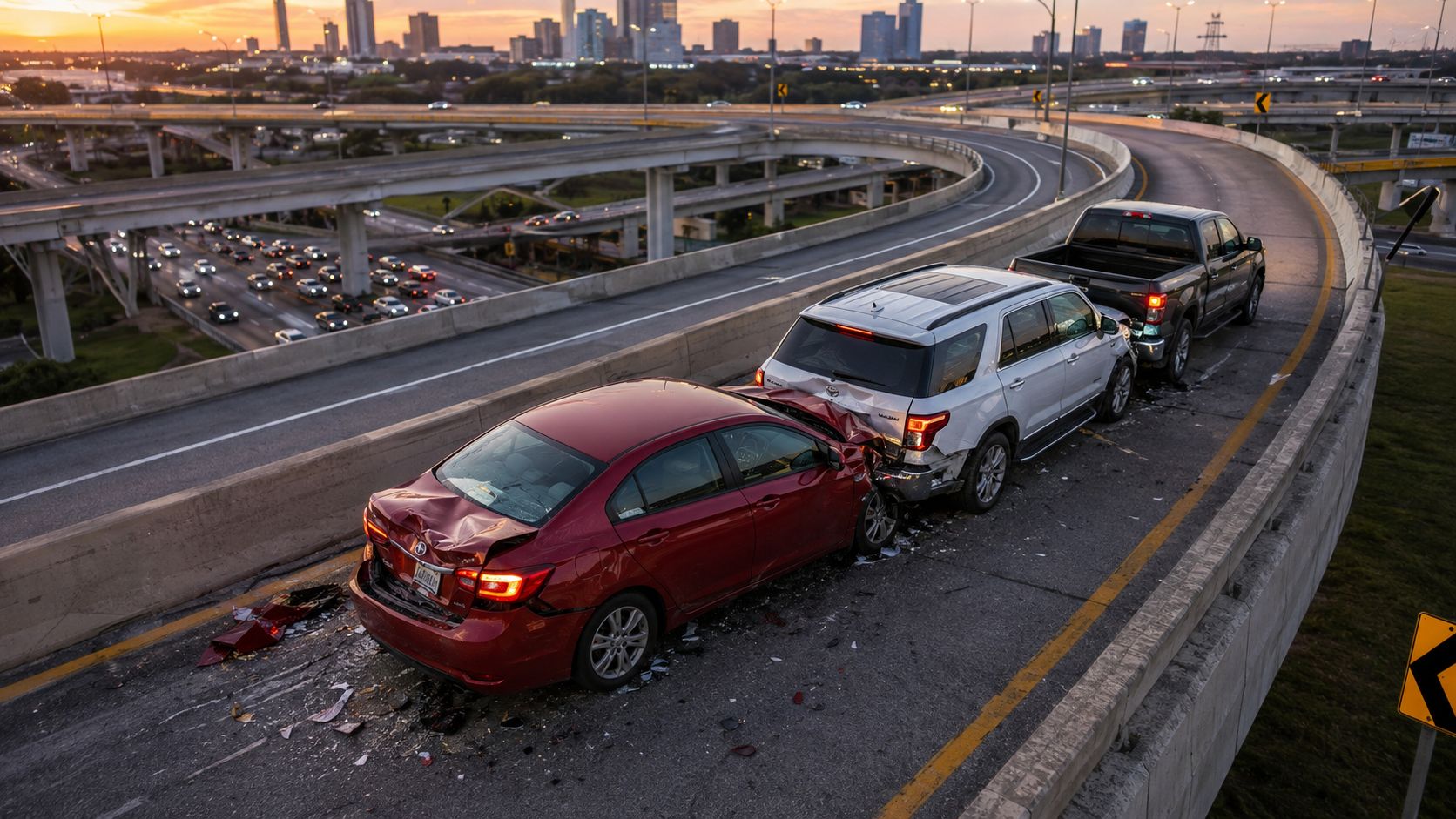
The 610 Loop creates the kind of crash scene that insurance companies love to oversimplify. On paper, a rear-end collision looks easy. On the roadway, a merged lane, a sudden brake check, or a chain reaction can make the actual cause much harder to pin down.
Why the loop produces fightable fault stories
Houston-area reporting highlights the I-69/US-59 and 610 interchange as a frequent rear-end collision zone because of merging and inconsistent speeds, and it identifies the Bissonnet Boulevard exit and Mykawa Road area as repeated fatality corridors along the loop. Those locations matter because they show how traffic density and interchange design create pressure points where drivers make rushed decisions.
A pickup sideswiped near Bissonnet may have been forced by a last-second merge. A multi-vehicle pileup near Mykawa may have started with one vehicle braking hard in heavy traffic. A rideshare or delivery driver may stop or change lanes unpredictably, then disappear into traffic before anyone sorts out the sequence. These are the kinds of cases where the first driver to speak to the police is not always the driver who caused the chain reaction.
Why the evidence problem matters most
Freeway crashes often turn on who started the impact, not who ended up with the most damage. Dashcam video, traffic cameras, nearby business footage, and witness statements can matter more than bent metal alone. A lawyer has to move fast to preserve proof before it is overwritten or lost.
If a commercial truck is involved, the insurance picture gets more layered. The same is true when a delivery driver is working or a rideshare driver is on duty. Those cases can involve more than one policy and more than one potentially responsible business. For a practical view of how these incidents are described on Houston highways, you can also review this local video discussion:
The bottom line is that the 610 Loop rarely rewards simple assumptions. If your crash happened in a merge lane, near an interchange, or in a multi-car chain reaction, the fight is often about proof, not just damage.
Filing Deadlines and Why Waiting Can Cost You
Texas gives most injured drivers two years from the date of the crash to file a personal injury lawsuit under Texas Civil Practice & Remedies Code § 16.003. If that deadline passes, the claim can disappear entirely, even if your evidence is strong and your injuries are real.
The clock is only part of the problem
Waiting also makes the proof harder to hold onto. Vehicles get repaired. Witnesses forget. Camera footage gets overwritten. Insurance companies also tend to harden their positions when a claim sits too long without a lawyer pushing for records and answers.
That's especially true on a freeway case where the location itself matters. A shoulder, merge point, or interchange may be the whole reason fault is disputed. If that evidence is not preserved early, you may be left arguing from memory instead of from video, photos, and paperwork.
A common real-world mistake is waiting until the pain becomes obvious and then trying to rebuild the case from scratch. By then, the repair shop may have released the car and the clearest scene photos may already be gone. That doesn't mean there's no case. It means the margin for error is smaller.
The practical move is simple. Get legal help early enough to preserve the proof while the road still tells its story.
Choosing the Right Houston Car Accident Lawyer
Hiring a lawyer after a loop crash should feel like getting a clear plan, not signing away control. The right Houston car accident lawyer should explain the case in plain language, tell you what evidence matters, and be honest about what the claim may need before it settles.
What to ask before you sign anything
A strong consultation should cover who will handle your file, how contingency fees work, and what the likely timeline looks like. It should also cover the fault issues in your case, because the question isn't just whether you were hurt. It's whether the facts can prove the other driver, or another business, was legally responsible.
| What to Ask | What to Look For | Red Flag |
|---|---|---|
| Who will work my case? | A clear answer about the attorney and staff handling it | Vague answers or a handoff with no explanation |
| How do fees work? | Plain explanation of contingency fees | Pressure to sign before you understand the fee |
| What evidence matters most? | A concrete plan for reports, photos, and video | Generic promises without a strategy |
| How do you handle fault disputes? | Discussion of Chapter 33 and comparative fault | Dismissing fault as “automatic” |
| What cases do you handle? | Car, truck, rideshare, and wrongful death claims | Overpromising or headline numbers with no detail |
Houston-area plaintiff firms often advertise very high success percentages and large recoveries, but those numbers don't tell you how your case will be handled. A better question is whether the lawyer explains contingency fees, litigation timing, and fault thresholds in a way that makes sense to you.
The Houston Personal Injury Lawyer resource is one example of the kind of representation available for injury victims across Houston and Harris County. The more important issue is whether the lawyer is prepared for the evidence problems that come with a freeway crash on the 610 Loop.
If you choose The Law Office of Bryan Fagan, PLLC, you can expect a free consultation and contingency-fee representation, which means you don't pay unless the firm wins your case. The firm also handles car, truck, rideshare, and wrongful death matters, so the conversation can cover both injury claims and more complex liability disputes. That matters when a crash involves multiple drivers, commercial coverage, or a family trying to understand wrongful death compensation after a fatal collision.
A good first call should leave you calmer, not more confused. You should know what records to gather, what to say to the insurer, and what not to sign yet. If your crash happened on the 610 Loop, now is the time to protect the evidence, get medical care, and speak with a lawyer before the insurance company shapes the story for you.
If you were hurt in a crash on the 610 Loop, The Law Office of Bryan Fagan, PLLC can help you sort out fault, insurance, and deadlines without adding pressure to an already hard day. Visit The Law Office of Bryan Fagan, PLLC to request a free consultation and get clear answers about your next step.