 Skip to content
A car crash can change your life in seconds, but you don't have to face recovery alone.
If you were hit on I-45, pushed across a lane on the 610 Loop, or rear-ended in stop-and-go Houston traffic by a driver who later said, “I don't have insurance,” the shock can hit just as hard as the collision. Your car may be damaged, your body may hurt, and your questions may pile up fast. A Houston uninsured motorist accident lawyer helps you make sense of what happens next, especially when the at-fault driver can't pay.
That matters because the fight after an uninsured crash often isn't just about who caused it. It's about whether your own policy will step up, what proof your insurer wants, and how quickly you act after the wreck. A trusted Texas injury attorney can help you turn a confusing auto insurance claim into a clear recovery plan, one document at a time.
A Car Crash Can Change Your Life in Seconds
A Houston driver gets rear-ended near downtown, pulls over on the shoulder, and the other driver says the words nobody wants to hear, “I have no insurance.” In that moment, the scene changes from a traffic crash to a coverage problem. You're left trying to protect your health, your car, and your finances at the same time.
The hard part is that the crash doesn't just create damage. It creates paperwork, deadlines, and pressure from an insurance company that may ask for statements before you've even seen a doctor. That's why uninsured motorist cases feel so personal. You're hurt, stressed, and suddenly forced to prove what happened while dealing with pain and uncertainty.
What you need to know right away
Practical rule: If the other driver lacks insurance, your own policy may become the main path to payment.
That's why people often look for a Houston uninsured motorist accident lawyer after the crash instead of waiting to see how the claim unfolds. The goal isn't to panic. The goal is to get organized early, because the quality of your proof can shape the claim from the start.
If your crash also involved serious injury, a death in the family, or a commercial vehicle, the stakes go up fast. You may be dealing with medical bills, missed work, and questions about wrongful death compensation if a loved one was killed. The path forward exists, but it starts with understanding what kind of coverage you have and how Texas insurance rules work.
What Uninsured and Underinsured Motorist Coverage Really Means
Uninsured motorist coverage, often called UM, helps when the at-fault driver has no insurance at all. Underinsured motorist coverage, or UIM, applies when the other driver has some insurance, but not enough to cover the full loss. Think of UM as a safety net when there's no net on the other side, and UIM as the bridge that covers the gap when the other policy runs out.
Liability insurance works in the opposite direction. It protects other people if you cause a crash. Liability means legal responsibility, so when a driver is at fault, that driver's liability coverage is supposed to pay the injured person. Damages means the losses you can recover, such as medical care, lost income, pain, and repair costs.
Texas drivers usually buy liability insurance to comply with the law, and UM/UIM is often offered as optional protection on top of that. Many people accept it without thinking much about it until they need it. That's why a policy review matters after a wreck, because your own declarations page may be the difference between a valid claim and a dead end.

Why the policy language matters
A UM or UIM claim only works if the policy applies to your crash and your damages. That's why insurers focus on details like who was driving, whether the other car can be identified, and whether your injuries are tied to the wreck. In Texas practice, Uninsured Motorist Coverage in Texas is often less about the idea of coverage and more about how the policy is written.
If you're already dealing with an insurer, Dealing With Insurers After a Houston Accident is really about protecting your claim from Houston-area insurance tactics. That's where confusion starts for many people, because the company collecting your premiums can still ask for strict proof before it pays.
Your policy may sound simple at purchase, but the claim process is rarely simple after a crash.
Why Houston Drivers Face Higher Uninsured Motorist Risk
A Houston driver can do everything right and still end up facing an uninsured motorist claim after a routine commute, a lane change on a feeder road, or a rear-end collision in stop-and-go traffic. The problem starts before the crash ever happens, because Texas requires only minimum insurance coverage for many drivers, and that minimum can leave an injured person looking at a claim that is larger than the at-fault driver's policy. A closer look at Texas minimum insurance requirements helps explain why so many crashes turn into coverage disputes instead of straightforward payments.
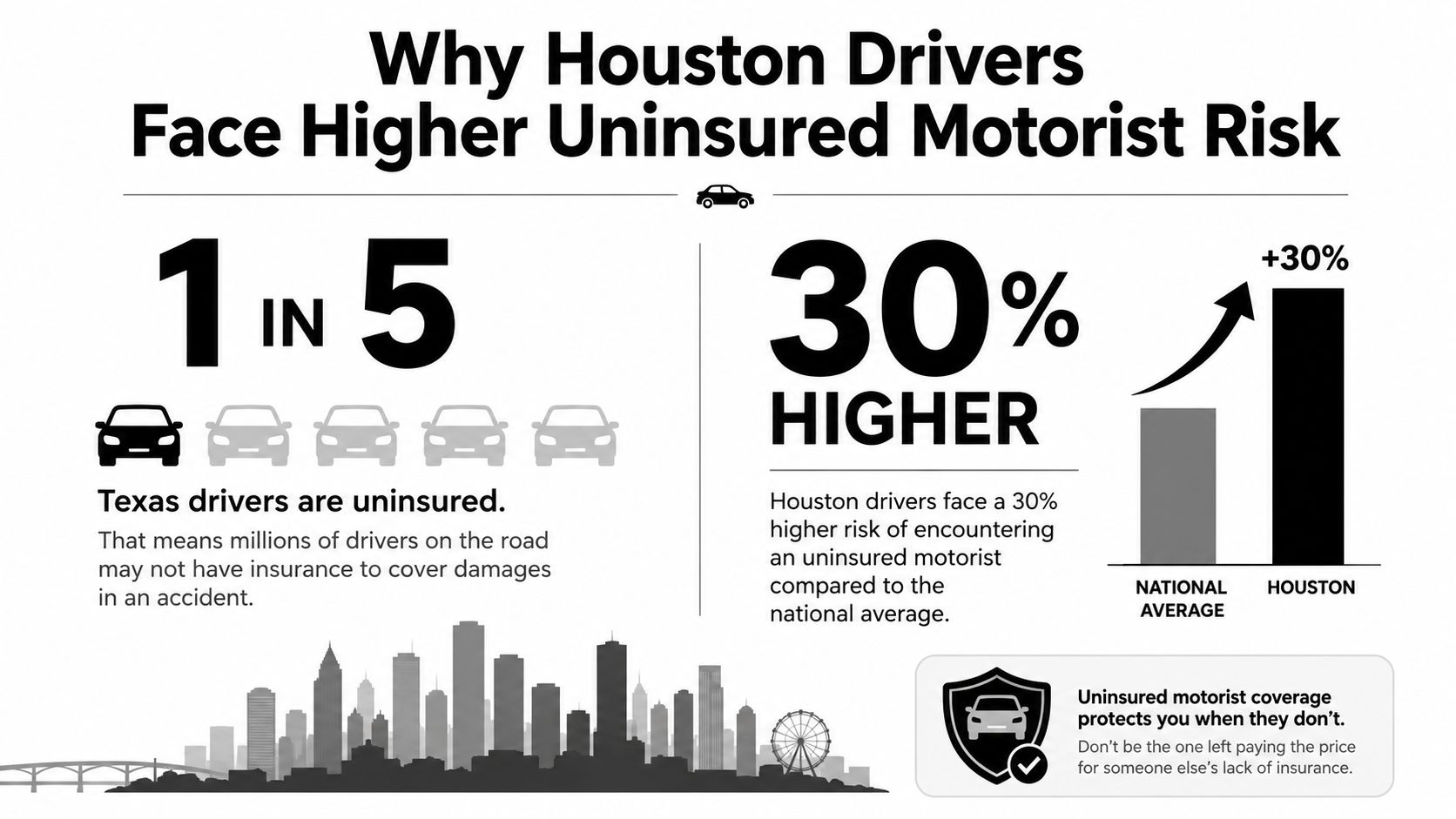
Houston drivers live with a bigger uninsured-driver problem than many people realize. Recent independent reporting estimates that about 20% of Texas drivers are uninsured, while the Insurance Research Council's 2025 study put the national uninsured rate at 15.4% in 2023. Earlier Texas estimates were lower but still serious, including 13.3% uninsured drivers in 2012 and 2.6 million uninsured drivers statewide source.
That history matters because it shows this is a long-running risk that sits in the background of everyday driving in Houston. On crowded roads, the gap between a safe trip and a claim can be a single mistake by someone who has no usable insurance. When you are moving through I-10, US-59, or the Sam Houston Tollway, you cannot screen the drivers around you for coverage. You learn the truth only after the wreck.
Texas accident-recovery economics make the problem even more serious. The Insurance Information Institute reported that the average Texas auto bodily injury liability claim paid out at $22,734 in 2022 source. That figure helps explain why a crash that looks minor at the scene can still lead to medical bills, lost wages, and a disputed UM or UIM claim once the insurer starts asking for proof.
What that means for your claim
In Houston, the central question after an uninsured-driver crash is usually not whether the wreck was frustrating. It is whether the at-fault driver has the money, or insurance, to cover the harm. UM and UIM coverage often becomes the financial backstop, but it is still a first-party insurance claim, which means your own carrier may start as the company reviewing, questioning, and resisting payment. That is why the quality of your evidence matters so much.
Insurers want clear proof because these claims can be expensive and heavily contested. They look for consistent medical records, reliable crash documentation, and timely notice that complies with the policy. If the evidence is thin, or if deadlines are missed, the claim can turn into a fight over coverage instead of a payment for losses.
The risk is not abstract, and it is not rare. It is part of daily driving in Texas, which is why uninsured motorist protection deserves real attention before and after a wreck.
Steps to Protect Your Claim After a Crash With an Uninsured Driver
After the crash, start with the police. Texas claim guidance puts a premium on prompt reporting, because a police report helps establish what happened and who was involved. If the other driver says they have no insurance, that detail needs to be documented early, not remembered later.
Then gather the scene evidence while you still can. Take photos of the cars, the roadway, skid marks, traffic signals, and visible injuries. Get the other driver's name, plate number, and contact information if possible. If there are witnesses, ask for their names and phone numbers before everyone leaves.
Your first-day checklist
-
Call 911 and get a police report.
A report creates an official record and helps preserve fault information. -
Document the scene and the damage.
Photos can show impact points, lane positions, and the condition of both vehicles. -
Gather witness information.
Neutral witnesses can matter when the insurance company questions what happened. -
Notify your insurance company promptly.
Your policy may require notice sooner than you expect, and delay can create problems. -
Seek medical attention and keep records.
Medical charts link your injuries to the wreck and support your damages claim.
If the crash was a hit-and-run or the driver fled, Hit by an Uninsured Motorist is especially relevant because these cases turn on proof and timing. A UM claim can survive without a known driver, but the evidence has to do the work.
Practical rule: Don't wait for pain to become severe before getting checked out. Early medical records usually help more than memory later.
One more caution. Be careful with recorded statements. Insurance adjusters often ask for them quickly, but a rushed statement can create inconsistencies that the insurer later uses against you. If you're unsure what to say, pause and get guidance first.
How Insurance Companies Handle UM and UIM Claims in Texas
A UM or UIM claim feels like a claim against the other driver, but that's not always how it works. In Texas, it's often a first-party coverage dispute, which means you're asking your own insurer to pay under your own policy. That changes the tone of the case immediately, because the insurance company is no longer just investigating someone else's negligence.
To get paid, you usually have to prove two things. First, the other driver was uninsured or underinsured. Second, the crash caused recoverable damages under your policy. That can mean medical bills, wage loss, pain, and other losses tied to the wreck. The insurer may challenge either point if it sees room to do so.
Why claims get fought so hard
Insurers often question whether the other driver lacked coverage, whether your injuries came from the crash, and whether your policy applies the way you think it does. In hit-and-run cases, the proof fight can be even tougher because there may be no easy way to identify the other vehicle. That's why prompt notice, police documentation, and medical records are so important.
If you have no UM/UIM coverage or too little of it, the problem shifts from liability to collectability. You can sue an uninsured driver directly, but collecting money from someone with limited assets can be difficult. That's where other coverages may help with short-term needs. PIP and health insurance can sometimes keep treatment moving while the larger claim plays out.
For readers trying to understand the legal labor behind these files, a resource like skills for personal injury paralegals shows how much document management, deadline tracking, and record gathering sit behind a serious injury claim. In practice, that same level of organization is what helps a UM file stay credible.
The insurer's first job is often to test your proof. Your first job is to preserve it.
Real Houston Scenarios Where UM Coverage Makes the Difference
A driver on the Southwest Freeway gets clipped in traffic, and the other car takes off before anyone can read the plate. In a hit-and-run, UM coverage may still apply, but the claim depends on proof quality and strict reporting. The driver needs the police report, the medical records, and enough scene evidence to support what happened.
A different case starts on I-10 with a commercial truck driver whose policy isn't enough to cover the injuries. That's where UIM matters. The victim may have a valid claim, but the at-fault policy may run out before the full loss is covered.
When a crash turns fatal, the issue becomes even harder. If an uninsured driver causes a death, UM coverage may help a family pursue wrongful death compensation, including funeral expenses, loss of companionship, and lost future income. Those losses are personal, and the claim process can feel overwhelming while the family is grieving.
Why these examples matter
These are not rare or abstract situations. They happen on Houston roads every day, and they show why policy language matters before the lawsuit part ever starts. If the crash leaves you with injuries, a wrecked car, or the loss of a loved one, the coverage question can decide whether recovery is possible at all.
The evidence burden is still the same in every scenario. The claim succeeds when the facts are clear, the deadlines are met, and the losses are documented well. That's what makes UM work in practice.
How a Houston Uninsured Motorist Accident Lawyer Fights for Your Recovery
A strong claim starts with evidence, but it usually needs more than a stack of papers. A lawyer can pull the crash report, organize medical records, document wage loss, and push back when the insurer tries to narrow the claim. In Houston UM and UIM cases, that kind of work often decides whether a file moves forward or stalls out.
At The Law Office of Bryan Fagan, PLLC, the process can include claim investigation, insurer negotiation, and litigation when needed. The firm also handles car, truck, rideshare, and wrongful death cases, which matters when your crash overlaps with other coverage issues or liability disputes. Texas personal injury claims also run on deadlines, so waiting can put the case at risk even when the facts are strong.
Why timing matters
Texas law gives personal injury claims a limitations window, and missed deadlines can end valid claims. Evidence also fades. Witnesses forget details, photos get lost, and medical records become harder to connect to the crash if too much time passes.
A lawyer can help you avoid those problems by getting the file organized early. That includes checking policy terms, identifying every possible coverage source, and deciding whether a lawsuit against the uninsured driver makes practical sense. For readers who want to understand the legal support side of this work, the structure behind a claim often looks a lot like the careful documentation used in paralegal-driven case management.
You shouldn't have to guess your next step while you're trying to heal. A consultation can give you a clearer picture of what your UM claim may look like and what evidence still needs to be secured.
If you were hurt by an uninsured driver in Houston, The Law Office of Bryan Fagan, PLLC can help you understand your UM or UIM options and take the pressure off the claims process. Visit The Law Office of Bryan Fagan, PLLC to get started with a free consultation and talk through your next steps with a team that handles these coverage disputes every day.


