 Skip to content
A car crash can change your life in seconds, but you don't have to face recovery alone.
A side-impact wreck often lands people in the same spot at once, stunned, hurt, and trying to figure out who pays for the damage. If you're dealing with a Houston T-bone accident lawyer issue right now, the most important thing to know is this, these cases can be proven, and the proof usually lives at the intersection where the crash happened. Signal timing, camera footage, damage patterns, and witness accounts can all help show what really happened.
In plain English, a T-bone collision is a side-impact or broadside crash. One vehicle hits the side of another, often at a 90-degree angle, which is very different from a rear-end crash or a frontal crash. The angle matters because the side of a car has far less protection than the front or rear, so the impact can push straight into the space where people are sitting.
That's why these crashes often cause more than bent metal. The force can lead to broken bones, head trauma, internal injuries, and long recovery periods. When someone's life is suddenly filled with ER visits, missed work, and insurance calls, clear legal guidance can make the next steps feel less overwhelming.
A Crash Can Change Everything in a Single Second
The sound usually comes first, a hard slam, glass, metal, and then silence that feels too long. A Houston driver or passenger who gets hit in the side often has only seconds to realize what happened before the important questions hit, is everyone okay, can I move, and how am I going to pay for this.
That moment is why these cases are so personal. Your car may be the first thing you see, but your mind goes straight to your family, your job, and the bills that are already waiting. A calm plan matters because the insurance company will start building its version of the crash almost right away.
Why side-impact crashes are different
A T-bone crash puts the weakest part of a vehicle right in the path of force. The side door has much less crush space than the front or back, so the body absorbs more of the impact. That's one reason these collisions can turn a normal drive into a major injury case so quickly.
A simple way to think about it is this. A front-end impact gives the car more room to absorb energy, but a side hit is like getting punched through the door into the seat itself. That's why the injuries can feel disproportionate to the visible damage.
Practical rule: if your body took a direct side hit, don't judge the seriousness by the dent alone. Get checked, keep records, and assume the evidence will matter later.
Houston intersections make this worse because traffic is dense and turning conflicts are common. The legal question often becomes who had the right of way, who ignored the light, and what the intersection records show. A Houston Car Accident Lawyer who handles Houston and Harris County crashes can use that intersection evidence to help sort out fault.
The goal isn't to panic. It's to understand that your case may rise or fall on the details that disappear fast, like signal timing, vehicle positions, and who said what right after the crash.
The Most Common Causes of Houston T-Bone Crashes
Most side-impact wrecks don't happen by chance. They happen when a driver makes a bad decision at a place where traffic control matters, especially at intersections. In Houston and Harris County, that usually means running a light, rolling through a stop sign, turning left without yielding, or driving while distracted.
The driver mistakes that keep showing up
A left-turning driver on a busy Houston street may look down for a second, then pull across traffic that was already moving straight through the light. That's the classic failure-to-yield pattern, and it's one of the most common ways T-bone claims get built. The same thing happens when someone assumes the intersection is clear and cuts across an oncoming lane too early.
Distraction is a big factor too. One Houston-area source reports 4,827 side-impact crashes in Harris County in the most recent Texas Department of Transportation statistics it cites, and says 68% were linked to driver inattention or distraction (source). That makes a practical difference because a distracted driver often can't explain why they missed a light, a car, or a turning vehicle.
Speed matters because it shrinks reaction time. A driver who tries to beat a light change may enter the intersection while the other car is already committed to the crossing path. In that moment, the question stops being whether the impact was “an accident” and becomes whether someone failed to yield, ran the signal, or drove without paying attention.
How the law sees that pattern
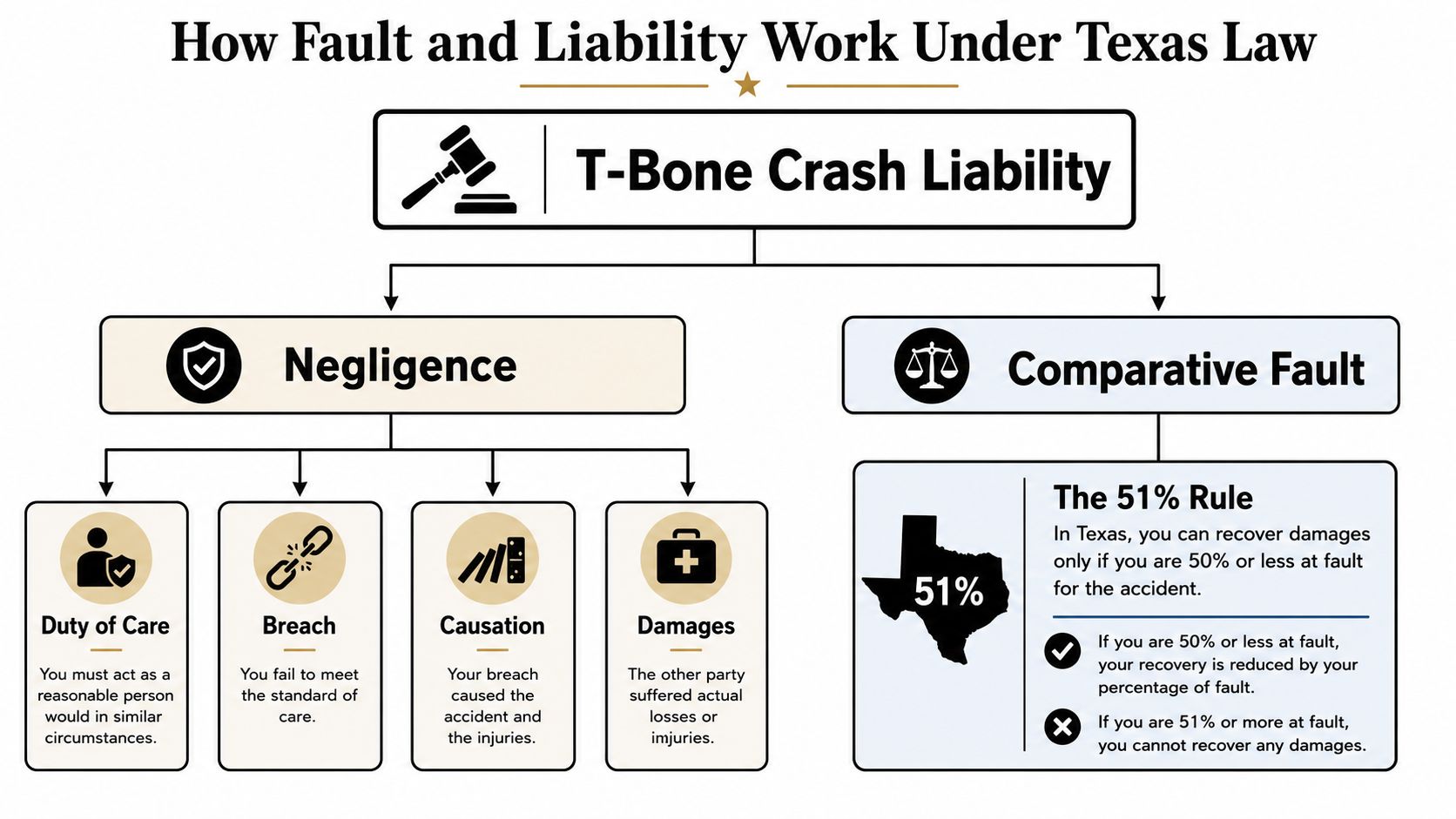
Texas negligence law asks whether a driver had a duty to drive safely, breached that duty, caused the crash, and caused damages. On Houston roads, intersection cases often turn on the factual proof around that chain. That's why police reports, camera footage, and damage patterns matter so much.
A T-bone case is rarely solved by a single witness line. It's usually solved by a stack of proof that points to one driver entering when they shouldn't have.
The liability analysis becomes easier when the vehicle damage shows a near-right-angle strike and the timing evidence matches a red-light or failure-to-yield event. That's the kind of intersection record an experienced lawyer looks for early.
How Fault and Liability Work Under Texas Law
Texas is not a no-fault state. That means the injured person has to show that another driver's negligence caused the crash and the resulting harm. In plain English, liability means legal responsibility, the person or company that may have to pay for the losses.
Negligence and comparative fault in plain English
Negligence is just a legal word for carelessness that causes harm. If a driver runs a red light, ignores a stop sign, or fails to yield while turning, that can be negligence if it causes a side-impact crash. The key is proving the four parts together, duty, breach, causation, and damages.
Texas also uses comparative fault under Chapter 33 of the Texas Civil Practice and Remedies Code. That rule matters because the jury or insurer can assign percentages of fault to each driver. If you're found 51% or more responsible, you can't recover damages in court. If you're 50% or less responsible, your recovery is reduced by your percentage of fault.
The classic left-turn crash shows how that works. A driver turning left across traffic may say the other car was speeding, while the other driver says the turn happened against the light. The lawyer's job is to prove the intersection facts that show who had the legal right to go first.
Why exemplary damages are different
Texas law also limits exemplary damages under Chapter 41. These are punitive-style damages, and they generally require clear and convincing proof of fraud, malice, or gross negligence. The statute also places limits on how much can be recovered, subject to statutory exceptions.
That matters because not every serious crash turns into a punitive-damages case. Most T-bone claims are about making the injured person whole, through medical bills, wage loss, and related harm. If intoxication or extreme misconduct is involved, the legal strategy changes, but the core goal stays the same, prove liability clearly and protect the value of the claim.
For readers who want a plain-language breakdown of fault rules, the linked explanation of comparative fault definition is a useful reference point.
What to Do in the First Days After a T-Bone Crash
The first few days matter because evidence disappears fast and insurance adjusters move quickly. A crash report, a photo set, and early medical records can help show what happened before memories fade or stories change.
A simple checklist you can follow
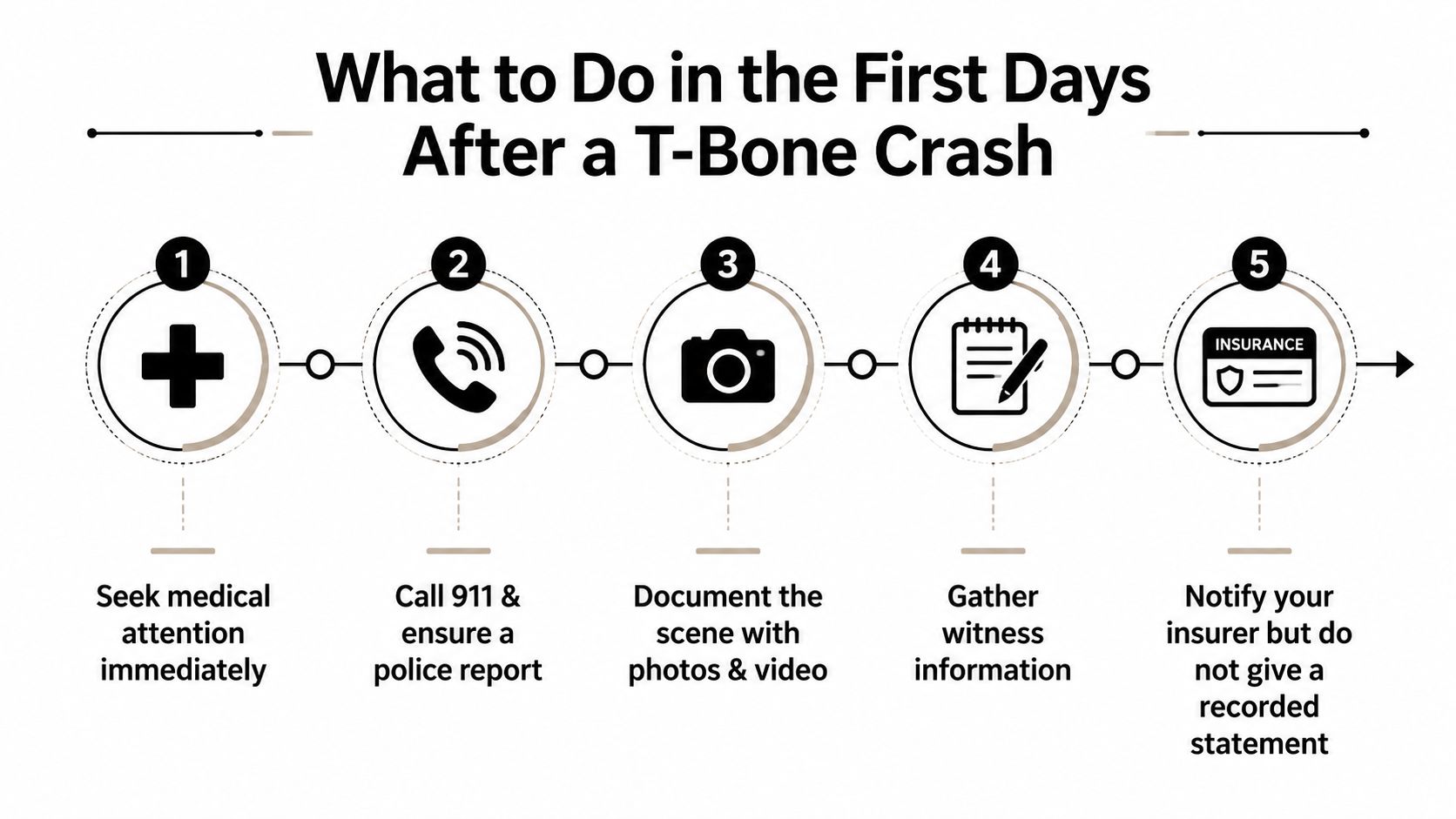
Get medical care right away. Even if you think the pain is minor, get checked. Side-impact injuries can show up later, and early records help connect the crash to the symptoms.
Make sure a police report is filed. If officers document the impact angle, traffic signal issue, or a citation, that report can become one of the most useful pieces of proof in your claim. That's especially true when the other driver later gives a different story.
Photograph everything you can. Take pictures of the cars, the intersection, the traffic lights, the lanes, and any visible injuries. Video can also help capture vehicle positions before anything gets moved.
Gather witness names and contact information. Neutral witnesses often matter because they can confirm who entered the intersection first or whether someone ran a light. A short statement now can be more useful than a vague memory months later.
Be careful with insurance calls. You can notify your insurer, but don't give a recorded statement to the other driver's insurer before you understand the claim. An adjuster may sound friendly, but the goal is usually to limit what gets paid.
When health coverage issues come up, a practical resource like find clear health insurance help can make the medical side easier to sort out. That doesn't replace legal advice, but it can help you understand how treatment gets paid while the claim is pending.
For a broader checklist of immediate post-crash actions, the firm's guide on what to do after a car accident in Houston can also help you stay organized.
Damages and Settlement Value in Side-Impact Cases
Damages means the money category for what the crash cost you. That can include current and future medical bills, lost wages, reduced earning ability, pain and suffering, and loss of enjoyment of life. In a T-bone case, those losses often grow faster because side-impact injuries can be more serious than a simple bumper hit.
| T-Bone Settlement Bands by Injury Severity | Typical Settlement Range | Key Documentation |
|---|---|---|
| Less severe injuries | roughly $15,000-$50,000 | ER notes, imaging, follow-up care |
| Moderate injuries | $50,000-$150,000 | Specialist records, work restrictions, rehab |
| Catastrophic cases | $150,000-$500,000 or more than $1,000,000 | Long-term care plans, disability proof, future wage loss |
Those settlement bands come from Texas legal sources discussing T-bone injury claims (source). The point isn't that every case lands in one of those boxes. The point is that documented injury severity changes the value, and the proof has to match the harm.
What insurance companies care about
Adjusters usually pay for documented loss, not just a stack of ER bills. Imaging, specialist follow-up, work notes, physical therapy, and rehab records help show how the crash changed your daily life. If you want the claim to reflect more than a quick checkup, the paper trail has to show real functional impairment.
A useful comparison is the guide to total loss negotiation. Property damage and bodily injury are separate issues, but both depend on proof, photos, records, and a clear explanation of why the number should be higher than the first offer.
Practical rule: keep every receipt, referral, and work restriction note. A claim is stronger when the records show how the injury affected your ability to move, work, and live normally.
For a more detailed explanation of how losses are measured, the firm's internal resource on how to calculate damages can help you understand what belongs in a personal injury claim.
How a Houston T-Bone Accident Lawyer Builds Your Case
A Houston T-bone accident lawyer does more than send a demand letter. The core work starts with preserving the proof that can disappear in days, not months. Intersection cases often live or die on early evidence, especially when both drivers blame each other.
The evidence package that moves a claim forward
A lawyer may seek traffic-camera footage, signal timing records, police reports, and vehicle damage mapping. If needed, the firm can also work with accident reconstruction professionals to analyze the angle of impact, the lane positions, and the likely sequence of movement. That matters because a side-impact crash often looks simple until the drivers tell different stories.
The lawyer also handles the insurance calls. That means you don't have to keep repeating the same facts to the at-fault driver's insurer, which reduces the risk of a recorded statement being used to twist your words later. It also keeps the claim focused on proof instead of pressure.
A Houston driver hit at a Bellaire Boulevard intersection may think the case is just about a dented car at first. If the intersection footage, witness statements, and damage patterns all line up, that same claim can become a much stronger bodily-injury case because the fault picture gets clearer. That's the difference between guessing and building.
The damages model matters too. A lawyer looks at medical treatment, wage loss, future care, and long-term effects instead of treating the crash like a single bill. That broader view helps when the injuries need ongoing care or the recovery affects work.
The Houston car accident lawyer page is one example of a Texas injury attorney resource focused on car accident victims in Houston and Harris County. For injured people, that kind of local focus matters because intersection crashes are very fact-specific.
Tricky Coverage Situations That Change the Strategy
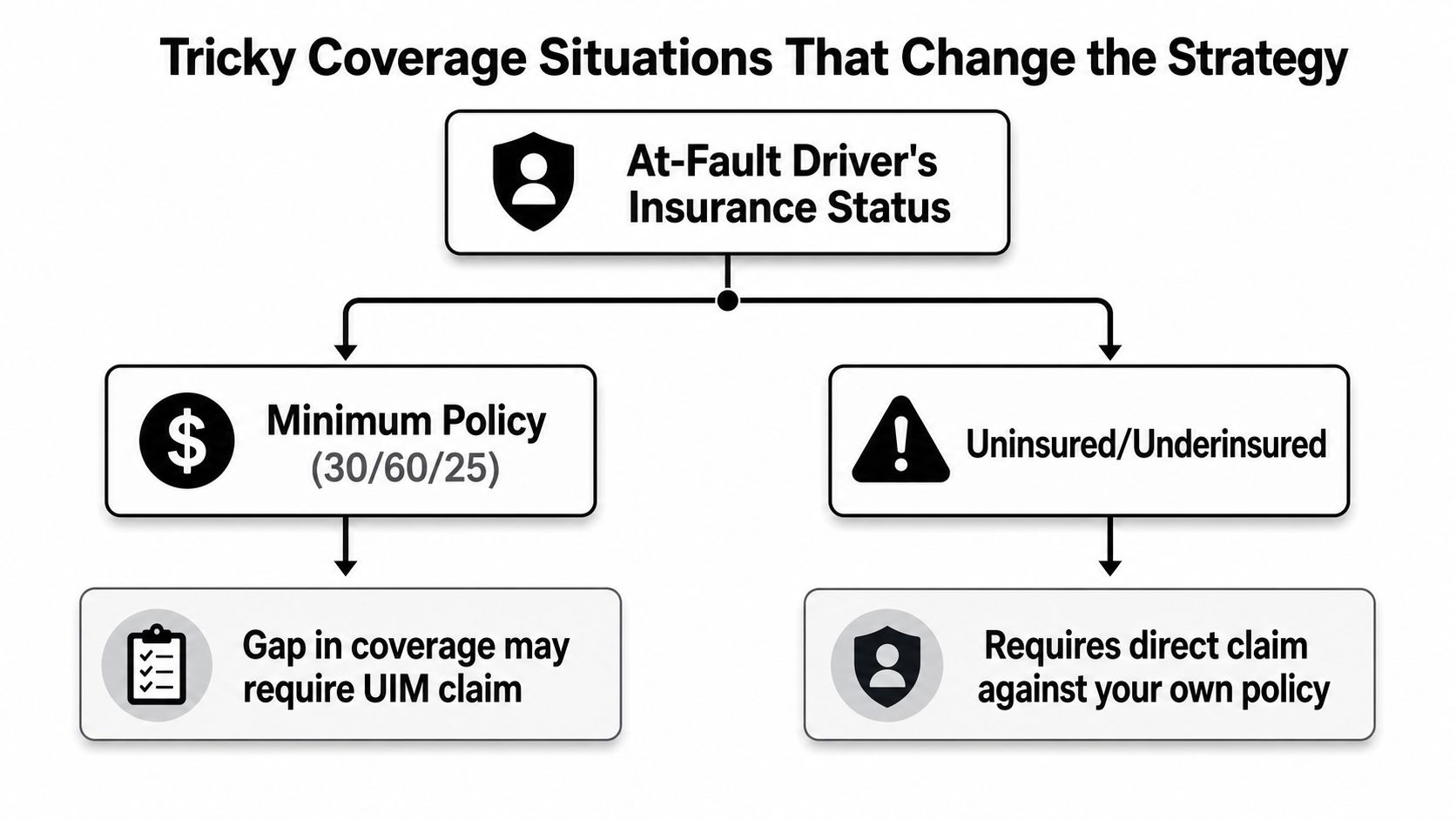
Sometimes the biggest issue isn't who caused the crash. It's which policy pays first. That becomes especially important when the at-fault driver has only the Texas minimum coverage, no coverage at all, or was working when the collision happened.
Uninsured, underinsured, and work-vehicle claims
If the at-fault driver's policy is too small, your own UM/UIM coverage may become part of the strategy. A Texas personal injury source explains that many drivers carry only the minimum and that uninsured or underinsured recovery can matter when the other policy doesn't cover the full loss (source). That's why the first insurance answer is rarely the final one.
Work vehicles add another layer. If the driver was delivering food, driving for rideshare, or operating a company vehicle, there may be commercial or employer coverage available too. Those cases often require fast notice to the company because delay can create avoidable coverage fights.
For a more detailed discussion of those policy problems, uninsured and underinsured is worth reading if your own policy may have to step in.
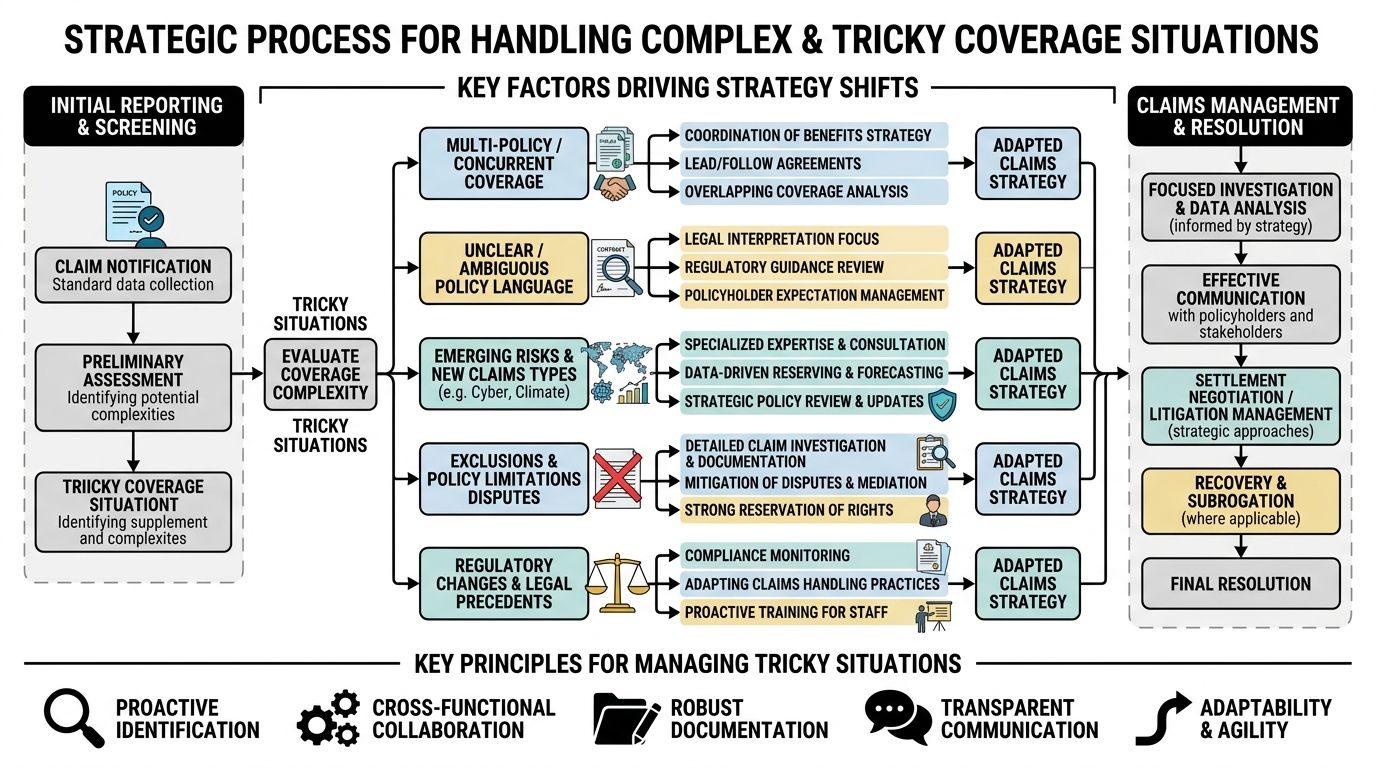
The question is not only who caused the crash. It's also which policy is on the hook, in what order, and what notice was given before the insurance companies start arguing.
That's why a Houston T-bone accident lawyer has to think in layers. Liability evidence, policy layers, and notice deadlines all affect the outcome. If the wrong insurer gets the first chance to control the narrative, the claim can become much harder to resolve fairly.
Timeline and Answers to Common Questions
Texas has a two-year statute of limitations for most personal injury lawsuits, including car crash claims, under Texas Civil Practice and Remedies Code Section 16.003 (source). In plain English, that means the clock starts running soon after the crash, and waiting too long can take away your right to ask a court for compensation even when the other driver was clearly at fault.
How long will this take
A T-bone claim with documented injuries often settles within 6 to 12 months once the records, imaging, wage loss proof, and treatment history are organized. If the insurer fights fault, disputes the seriousness of the injuries, or argues about future care, the case can last longer. When litigation is needed, the timeline often stretches past 18 months because discovery, depositions, and court scheduling add layers that negotiation does not.
Coverage can also change the pace. A crash involving a rideshare driver, a work vehicle, or an uninsured motorist claim usually moves more slowly because more than one policy may need to be reviewed before anyone knows which insurer should pay first.
You do not always have to go to court. Many cases resolve through negotiation once the liability proof and medical documentation are assembled in a way the insurer cannot easily ignore. Court becomes more likely when the insurer refuses to make a fair offer or when the intersection story is sharply contested, such as a fight over signal timing, camera footage, or the damage pattern on the cars.
What it costs to hire a lawyer
A contingency fee usually means you do not pay an upfront attorney's fee, and the firm gets paid only if it recovers money for you. That matters when you are already facing medical bills and missed work. It lets you get legal help without having to choose between getting treatment and hiring representation.
If you are deciding whether to move forward, the best first step is usually a free consultation. A Texas injury attorney can review the police report, the intersection facts, the insurance picture, and the medical records, then explain whether the claim looks straightforward or more layered.
The Law Office of Bryan Fagan, PLLC serves Houston, Dallas-Fort Worth, Austin, San Antonio, and surrounding Texas communities, and it handles car, truck, rideshare, uninsured motorist, and wrongful death compensation matters with contingency-fee representation. If you are trying to protect your rights after a side-impact crash, you do not have to sort it out alone.


