 Skip to content
A car accident claim in Texas is controlled by a 2-year statute of limitations, and most injured drivers or passengers have to file suit within two years of the crash date or risk losing the right to recover damages. In Spring, that deadline matters fast because evidence disappears, vehicles get repaired, and witnesses get harder to find.
A crash on I-45 near the Hardy Toll Road split can leave you shaken, sore, and flooded with insurance calls. If that's where you are right now, focus on the next right steps, not the whole case at once. A Spring TX car accident lawyer can help you sort out liability, insurance, and deadlines while you handle your recovery.
What to Do Right Now After a Spring Car Crash
A Spring commuter getting rear-ended on I-45 near the Hardy Toll Road split usually has the same first thought, “I just need to get home.” Don't make that mistake. The 2-year Texas deadline is already running, and the earlier you act, the easier it is to preserve the evidence that can make or break your claim.
If the crash happened on your way to work, on the Grand Parkway, or while merging near a busy feeder road, your job is to protect yourself first. You don't need to know every legal rule yet. You need a clean record of what happened, who was involved, and what injuries showed up afterward.
The strongest early move is to treat this like a paper trail problem. Get the crash documented, get checked by a doctor, and keep your statements short and factual. If you're trying to figure out whether this is just a property-damage issue or a full injury case, use a Harris County accident report guide to understand how the official report fits into your claim.
A lot of people feel pressure to “see how they feel tomorrow.” That's risky. Pain often shows up later, and insurance adjusters know it.
Practical rule: If you were hit hard enough to notice the crash, treat it like a legal case from day one.
If you need a simple way to think about it, start with three priorities, safety, proof, and treatment. That's the order that protects both your health and your claim. And if the other driver's insurer starts calling early, keep the conversation brief until you know what your injuries and repairs really look like.
If you want help understanding your options, a Houston Car Accident Lawyer handles car accident victims in Houston and Harris County. That's the kind of local help people usually need when the crash happened in the middle of a daily commute and the paperwork starts piling up fast.
Your First 48 Hours After the Crash
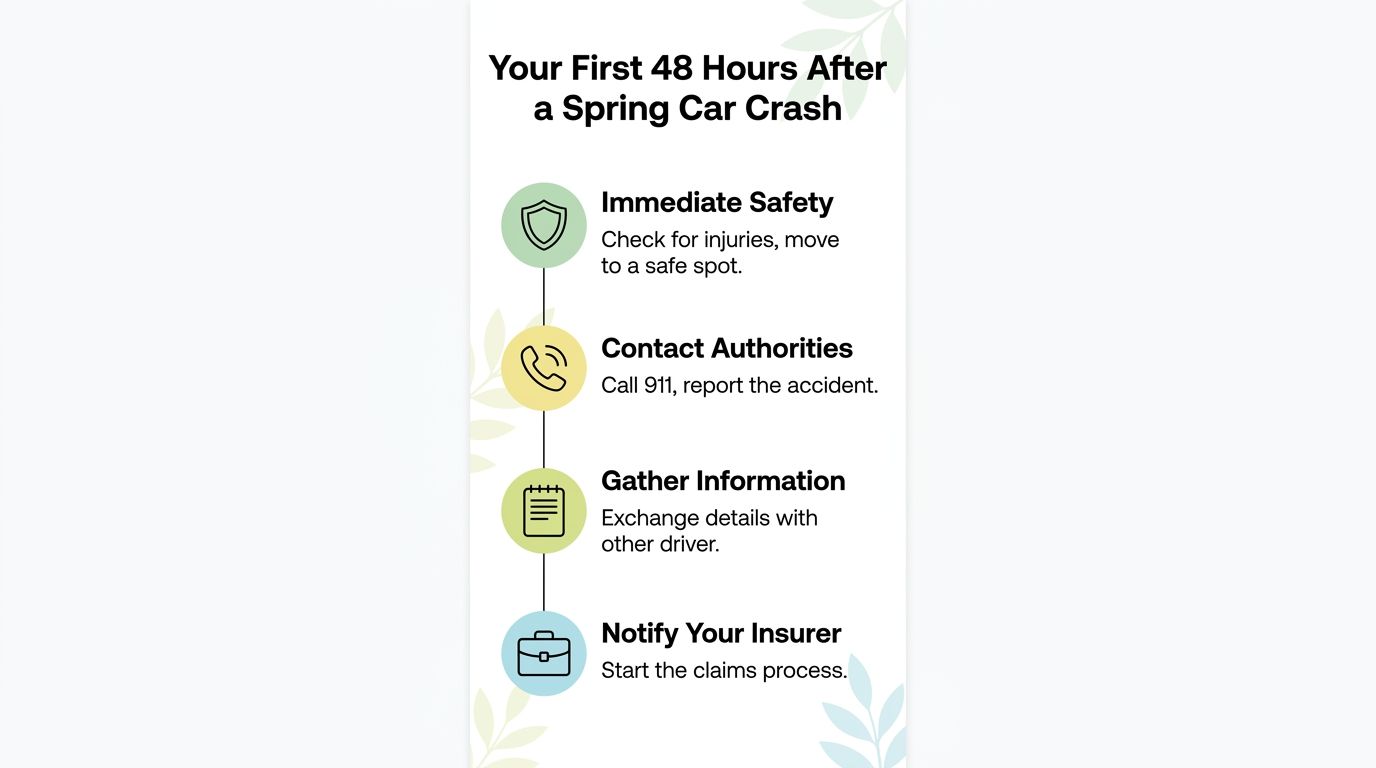
The first two days after a collision are about control. You can't undo the crash, but you can keep the situation from getting worse. Safety comes first, then proof, then medical care, then the insurance call.
Start with safety and a police report
Check yourself and everyone else for injuries. If anyone is hurt, call 911 right away and ask for help at the scene. That creates the official crash response and gets a Spring-area law enforcement agency involved.
If the vehicle can move and it's safe to do so, pull it to a safer spot. Turn on your hazard lights. If moving the car would put you in danger, stay put and wait for responders.
Gather evidence before the scene changes
Use your phone to photograph the vehicle positions, the damage, the roadway, skid marks, lane markings, license plates, traffic signals, and any visible injuries. Get the other driver's name, phone number, insurance information, and license plate in writing. Don't rely on memory.
Witnesses matter too. If someone saw the crash, ask for a name and phone number before they leave. People disappear fast once traffic starts moving again, and that's especially true on busy roads like I-45 and the Grand Parkway.
Save the scene as if nobody else is coming back to look at it later.
Protect your medical and insurance record
See a doctor even if the pain feels minor. Some injuries don't show up right away, and a medical visit creates a clean link between the crash and your symptoms. Report the collision to your own insurer, but keep your description factual. Don't guess about fault, speed, or injuries you haven't been evaluated for yet.
The point of this first 48-hour window is simple, preserve the truth before it gets diluted by time, repairs, or memory gaps. If you do that, your claim starts on solid ground instead of guesswork.
Who Is Liable Under Texas Negligence Law
A Spring crash on I-45, the Grand Parkway, or the Hardy Toll Road usually comes down to one question first, who caused it. Texas is an at-fault state, so you have to prove another driver was legally responsible before you can recover compensation. In plain English, liability means legal responsibility. Damages are the losses you are trying to recover, like medical bills, missed work, and pain. The statute of limitations is the filing deadline, and in Texas car accident cases, that usually means two years from the crash date.
Texas Civil Practice and Remedies Code Chapter 33 controls comparative fault. If you were partly at fault, your recovery can be reduced by your share of blame. Chapter 41 is different. It caps certain noneconomic damages in medical malpractice cases, and while it does not directly govern most car crashes, insurers still keep it in mind during serious-injury negotiations.
Fault is usually shared, not clean-cut
A Spring intersection crash at Rayford Road and the Grand Parkway is a familiar example. One driver starts a left turn, another drives straight through the intersection, and each side points to the other as the driver who could have avoided the collision. That split is common. Adjusters start sorting out percentages right away because they know fault is often divided.
If a case had $100,000 in damages and a jury found one driver 40% at fault and the other 60% at fault, the recovery would be reduced under comparative fault rules. A small shift in blame can change the value of the claim, so the fault fight matters from the start.
What proof matters most
Texas negligence cases turn on evidence, not assumptions. You need facts that show what happened and what it cost you. That usually includes crash reports, witness statements, vehicle damage photos, and medical records tied to the collision.
Bottom line: The insurer is already building a fault argument. You should be building your proof just as early.
For a closer look at how fault changes claim value, the article on how liability affects your claim value is a useful companion read.
Types of Crashes a Spring Lawyer Handles
Not every Spring crash is a simple bumper tap. The evidence changes based on the type of wreck, and that changes how the claim gets built. A rear-end collision on the feeder road is handled differently from a truck wreck, a rideshare crash, or a hit-and-run on the Hardy Toll Road.
Everyday crashes and faster proof
Rear-end, T-bone, and head-on crashes usually turn on police reports, photos, and the physical damage to the vehicles. Those cases often look straightforward at first, but don't assume the insurer will agree. They may still argue about speed, lane position, or whether your injuries came from something else.
Intersection crashes and rollover cases usually need a closer look at traffic flow, impact points, and witness accounts. That's where a good photo set and a clean medical timeline start to matter.
Higher-risk cases need layered evidence
Distracted-driving crashes often depend on phone records, camera footage, and statements that show what the driver was doing before impact. DWI cases may involve toxicology results and criminal proceedings running alongside the civil claim. Truck crashes add another layer because the carrier, the driver, and the company's records all matter.
Rideshare cases can be messy because insurance coverage depends on what the driver was doing in the app when the wreck happened. Pedestrian and motorcycle cases also need careful handling because insurers often undervalue those injuries unless the evidence is strong and organized.
Special coverage problems catch people off guard
Hit-and-run and uninsured motorist claims usually shift the fight to your own policy. That's where people get surprised, because they expected the other driver's insurer to handle everything. When there isn't enough coverage, every policy layer has to be checked in the right order.
That's one reason a spring tx car accident lawyer looks at the crash type before talking settlement. The evidence strategy has to match the wreck.
How a Lawyer Investigates and Builds Your Claim
Once a lawyer gets involved, the work gets more detailed, and that is the point. A claim for a Spring wreck on I-45, the Grand Parkway, or the Hardy Toll Road should not rest on a single phone call with the insurer. It should rest on documents, deadlines, and steady pressure to force the carrier to deal with facts instead of guesses.

The first move is usually the crash report. A lawyer requests the Texas Peace Officer's Crash Report, gathers 911 audio and dispatch logs, and asks for scene evidence before it disappears. In truck and rideshare cases, spoliation letters go out fast so dashcam footage, app data, and electronic records are not lost.
Evidence collection comes before negotiation
Distracted-driving claims often need phone records and related documents. That helps tie the driver's conduct to the wreck instead of leaving the issue as a guess. If the case involves a commercial vehicle, the records trail can get wider and more technical, because driver logs, company files, and maintenance records may all matter.
The next step is the damages file. That means collecting every medical record and bill, from the ER to follow-up care and physical therapy. Pay stubs and tax returns help prove lost income, and treating physicians can explain future care needs in serious injury cases. Strong proof on these points affects how liability affects your claim value, because insurers pay differently when fault is clear and the injury record is complete.
A claim is a financial story backed by proof
The lawyer then turns the evidence into a demand package. That package should show liability, injuries, and the full extent of damages in a way the insurer cannot brush aside. If the carrier lowballs the claim, the lawyer pushes back. If the insurer still will not deal fairly, suit gets filed.
The Law Office of Bryan Fagan, PLLC is one option for that kind of representation, especially if you want help dealing with insurance pressure and building the record from the start. If you are comparing the process behind a claim, a good overview of auto accident attorney fees can also help you understand how contingency work is usually structured.
If you want a practical look at the numbers behind a demand, the guide on how to calculate damages is worth reading. The key point is simple. Do not settle based on the first number the insurer throws out.
Property damage is often handled early, but injury claims take longer because the full medical picture has to develop. Medical treatment, wage loss, and recovery time all shape the value of the case. A lawyer builds that record piece by piece, then uses it to press for a fair result.
Compensation You May Recover in Texas
A Spring crash on I-45, the Grand Parkway, or the Hardy Toll Road can leave you with more than a wrecked car. Texas car accident compensation usually falls into two buckets, economic and noneconomic losses. Economic damages are the paper-trail losses, like medical bills, lost wages, rehabilitation, and out-of-pocket costs. Noneconomic damages cover the harm you can't itemize neatly, like pain, emotional strain, and the way a serious crash changes family life.
If the wreck caused a wrongful death, the family may pursue wrongful death compensation for funeral expenses, loss of financial support, and loss of companionship. Those cases are hard, and they deserve careful handling because the losses go far beyond the vehicle damage.
The claim value depends on proof and fault
The same injury can be valued very differently depending on the evidence and the fault dispute. If liability is unclear, the insurer will try to cut the number down. That is why records matter from the start, especially in commuter crashes where lane changes, rear-end impacts, and merge disputes often leave both sides pointing fingers.
A claim is only as strong as the documents behind it.
If you want a practical breakdown of what supports a damages demand, the guide on how to calculate damages explains the moving parts. For a broader look at how liability affects your claim value, see how liability affects your claim value. The key point is simple, do not settle based on the first number the insurer throws out.
Property damage is often handled early, but injury claims take longer because the full medical picture has to develop. Medical treatment, wage loss, and recovery time all shape the value of the case. And if the other driver is uninsured or underinsured, coverage disputes can change which policy pays first. That is common in Spring when one crash can involve a personal policy, an employer policy, and a dispute over whether the driver was on the clock.
Those uninsured and multi-policy claims need more than a basic form. The policy language matters. So does the order of coverage, because the first policy in line is not always the one that ends up paying.
How Long a Spring Car Accident Case Takes
A quick settlement feels tempting when bills are coming in. Don't rush it. If you settle before your injuries stabilize, you may miss future treatment, and that can leave you paying for care out of pocket later.
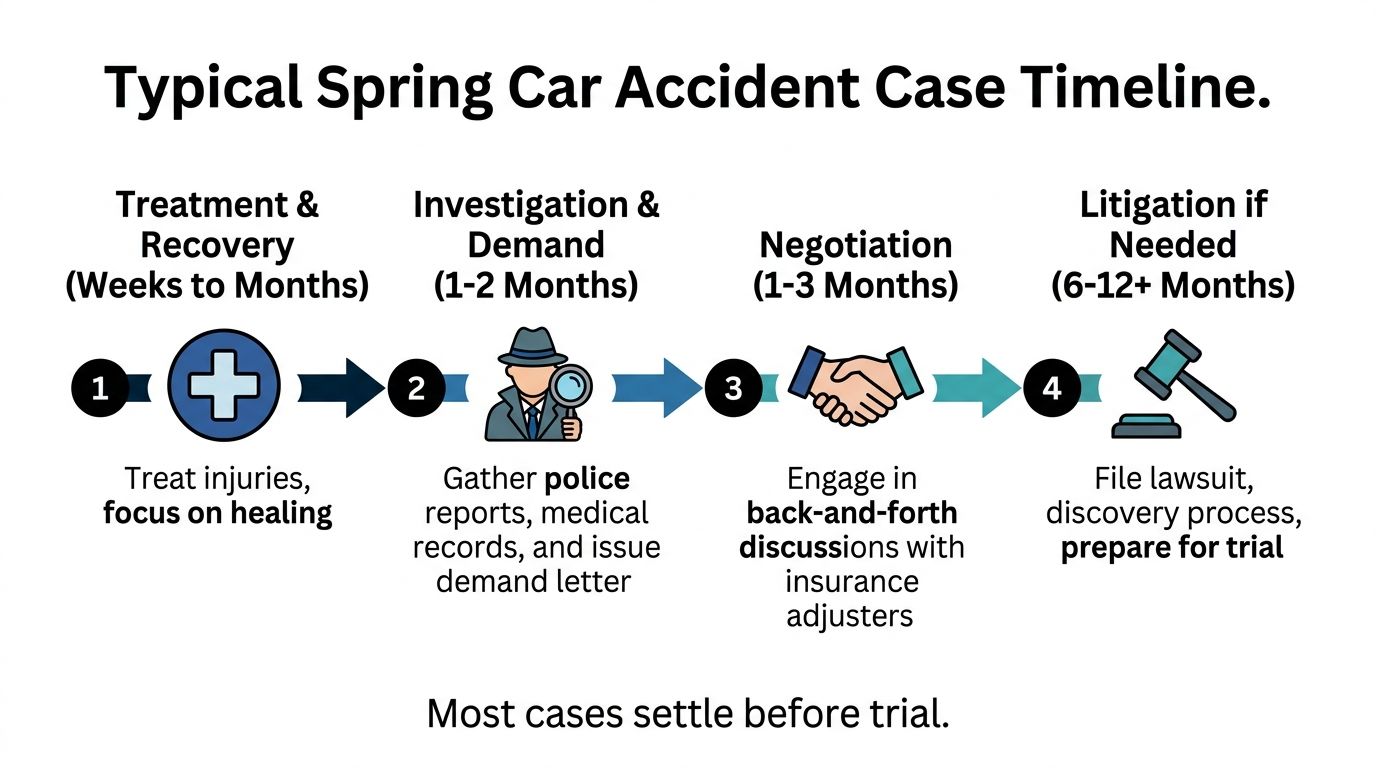
A straightforward soft-tissue case may resolve in a few months once treatment wraps up and the insurer makes a real offer. Cases with disputed fault, ongoing treatment, or litigation take longer, sometimes much longer if they go through Harris County court.
Timing usually follows the medical timeline
Medical care often comes first, because the case value depends on knowing how serious the injury really is. After treatment settles down, the lawyer sends the demand package. Insurers often respond within 30 to 60 days with an opening offer, but that first number is rarely the final number.
Cases involving more serious injuries or disputed blame can stretch much longer. The hard limit stays the same, the 2-year statute of limitations. That deadline controls everything, even when the claim itself is still developing.
Patience protects value when the injury picture is still unfolding.
The worst move is to settle too fast because the insurer is pressuring you for closure. You only get one chance to settle a claim correctly. If your doctor still hasn't finished evaluating the injury, the number is probably too low.
Contingency Fees, Free Consults, and What Hiring Us Looks Like
A Spring wreck can leave you staring at repair bills, medical bills, and missed paychecks at the same time. You should not have to pay a lawyer out of pocket just to find out whether you have a case. A car accident lawyer should be easy to reach, clear about the process, and plain about fees. That is why the usual setup is a free consultation and a contingency fee, which means no upfront payment and no attorney fee unless the case recovers money, as explained in our guide to auto accident attorney fees.
When you call, have the crash report, photos, insurance letters, medical paperwork, and anything showing missed work ready if you can get them. The first conversation should cover what happened, what injuries you have, and whether the claim deserves a full review. It should also tell you who will handle your file, how you will get updates, and how the firm deals with insurer pressure after a crash on I-45, the Grand Parkway, or the Hardy Toll Road.
A small claim can still matter. If the wreck changed your body, your job, or your family routine, it deserves a real look.
The right question is not whether your case feels big enough for a lawyer. The right question is whether fault can be proven and whether the insurer is likely to pay fair value without a fight. Spring commuters deal with lane changes, rear-end impacts, and merge crashes every day, and those claims turn on the evidence, not on how dramatic the crash sounds.
If you want a firm that handles injury claims across Texas, offices in Houston, Dallas-Fort Worth, Austin, and San Antonio make in-person help accessible for Spring families. If you were hurt in a Spring crash, call The Law Office of Bryan Fagan, PLLC for a free consultation today. Bring your crash report, insurance information, photos, and medical records, and get a straight answer about your options before the deadline gets any closer.


